The Periodic Table
Presentation
•
Science
•
8th Grade
•
Medium
+16
Standards-aligned
Garfield Baker
Used 82+ times
FREE Resource
24 Slides • 32 Questions
1
There are 118 elements known to man .
How are these elements elements arranged ?
Why is it important that the elements are arranged?
2
The Periodic Table

3
The 118 elements known to man are also arranged in a way to make it easier for us to find and study by placing them in the PERIODIC TABLE
4
THE PERIODIC TABLE
5
Objectives:
Discuss the main criteria used in organizing elements in the periodic table
Understand the information that is given on each element in the periodic table
Correctly identify the location of metals , nonmetals and metalloids
Give examples of metals , metalloids and nonmetals
Differentiate between Groups and Periods
Understand that the reactivity of elements decrease as one move from left to right
Understand that elements in same group has similar properties
6
The periodic Table was developed by the Russian Dmitri Mendeleev
As he arranged them he noticed that the elements when grouped together based on increasing atomic mass had similar properties.
He noticed that properties grouped together based on Atomic mass had similar properties
For example, he knew that after Fluorine the next heaviest one was sodium
He could then predict elements that were not yet discovered
7
8
Multiple Choice
Mendeleev left gaps in his periodic table because
the table was too small.
protons belonged there.
the table was too full.
no known elements fit there.
9
Multiple Choice
How was Mendeleev's periodic table arranged?
by increasing atomic mass
by decreasing atomic mass
by increasing atomic number
by decreasing atomic number
10
Multiple Choice
In Mendeleev's periodic table, elements in each column had similar
atomic masses.
properties.
atomic numbers.
symbols.
11
The periodic table has one square for each element
Information on the square includes ; atomic number, chemical symbol, name, and atomic mass
The atomic mass is usually an average of the isotopes of all the atoms of that elements
12
Multiple Choice
The atomic mass is
26
78
14
55.845
13
Multiple Choice
The chemical symbol in this element box is
26
Fe
Iron
55.845
14
Multiple Choice
The atomic number is
26
Fe
Iron
55.845
15
Today's periodic table is patterned based on Mendeleev table
However, the ATOMIC NUMBER is used to arrange the elements in the periodic Table
16
What do you notice about the Atomic number as you go from left to right ?
17
The periodic table is arranged in rows called periods and columns called groups
There are 7 periods in the modern periodic table
There are 18 columns or groups. The groups are also called families and are given the name of the element that is at the top
18
19
Multiple Choice
The order of elements in the modern periodic table is based on an element's
atomic number.
name.
chemical symbol.
atomic mass.
20
Multiple Choice
Elements in an elemental family have similar
atomic symbols.
atomic sizes.
atomic weights.
chemical properties.
21
Multiple Choice
Each column of the periodic table is
an element.
a group.
an isotope.
a period.
22
Multiple Choice
A row on the Periodic Table of Elements
family
period
row
isotope
23
Multiple Choice
A grouping of elements based on similar chemical properties, arranged by columns in the periodic table; also known as a group
family
period
row
isotope
24
Multiple Choice
Find the element on Period 3 and Group 17. What is
this element’s chemical symbol?
F
Br
Cl
I
25
Multiple Choice
Find the element on Period 3 and Group 1. What is
this element’s chemical symbol?
F
Br
Na
I
26
Multiple Choice
Find the element on Period 5 and Group 10. What is
this element’s chemical symbol?
F
Ni
Pd
IAu
27
Multiple Choice
Find the element on Period 4 and Group 3. What is
this element’s chemical symbol?
Sc
Ti
K
IAu
28
The properties (characteristics ) of an element can be predicted from its location in the periodic table
29
Reactivity
Elements to the left are more reactive than those to the right
Group 1 elements are the most reactive while group 18 elements are the least reactive
30
Mass
As one go down the the group the atomic mass increases .
Ex. Hydrogen and Lithium are in Group 1 but in different periods . As one go down the period the mass increases , H =1.008 while Lithium =6.94, K= 39.098
31
Metals vs. Nonmetals
The elements are organized in a way that separates metals from non metals.
Metals are found to the left and non metals to the right
32
Metals
More than 75% of elements are metals
Metals are more reactive than nonmetals
Group 1-12 are the metals
Group 1 are called called Alkali Earth Metal which is the most reactive
Group 2 are called Alkaline Earth Metals
Group 3-12 are the least reactive metals and are called Transition metals
Transition Metals are the least reactive metals
33
Characteristic of metals
Shiny
Can conduct electricity
Ductile : Can be drawn out in wire
Malleable : Can be rolled out in different shape
Metals are very reactive
Solid at Room Temperature
34
Lanthanide and Actinide
These Elements are found below the Periodic Table
Lanthanides are mixed with other more common elements to form Alloy
An Alloy is a mixture of metals
35
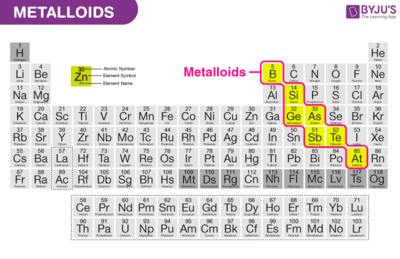
Metalloids
In between metals and nonmetals are Metalloids
Partially metal and nonmetals
Look like metals but behave like nonmetals
Zigzag line on periodic table identify metalloids
36
Characteristic of metalloids
Solid
Shiny
Solid at room Temperature
Very Brittle
Semi conductor of heat and electricity
37
Multiple Choice
The three main groups of elements are metals, nonmetals, and
inert gases.
alkali metals.
radioactive isotopes.
metalloids.
38
Multiple Choice
Most of the elements on the periodic table are
metals.
nonmetals.
metalloids.
semiconductors.
39
Open Ended
Group 1 and 2 elements are never found uncombined in nature. Explain why
40
Multiple Choice
The periodic table is mostly comprised of what type of element?
Metals
Nonmetals
Metalloids
41
Multiple Choice
The elements that touch the zigzag line on the Periodic Table are called
metals
nonmetals
metalloids
gasses
42
Multiple Choice
Which color on the image of the periodic table corresponds with the transition metals.
red
black
blue
orange
43
Multiple Choice
What is the name of group number 2?
transition metals
halogens
metaloids
alkaline earth metals
44
Multiple Choice
What is the name of group number 1?
halogens
noble gases
alkali metals
alkaline earth metals
45
Multiple Choice
Metals are located on the
________ side of the
Periodic Table.
ZIG-ZAG
LEFT
RIGHT
BOTTOM
46
Multiple Choice
47
Multiple Choice
48
Multiple Choice
Which color on the image of the periodic table corresponds with the metalloids.
bright yellow
gold
teal
light blue
49
Multiple Choice
where are the metaloids found
far left, vertical
stair step/diagonal
far right horizontal
at the bottom
50
Open Ended
Name a Metalloid
51
Non metals
Nonmetals lack the characteristics of metals
Nonmetals starts at group 14 and is mixed in with metals up to group 17
52
Nonmetals families
Carbon : Group 14
Nitrogen: Group 15
Oxygen : Group 16
Halogen: Group 17
Noble Gases : Group 18 least reactive of all
53
Characteristics of Nonmetals
Poor Conductor of Electrcity and heat
Reactive
Solid nonmetals are dull and brittle
54
Multiple Choice
Which family of elements is very stable and does not combine with other elements unless under special conditions in a laboratory?
Noble gases
Halogens
Metalloids
Alkaline earth metals
Actinides
55
Multiple Choice
Which color on the image of the periodic table corresponds with the halogens.
red
black
blue
orange
56
Multiple Choice
Which halogen is found in period 4?
Krypton (Kr)
Xenon (Xe)
Bromine (Br)
Iodine (I)
There are 118 elements known to man .
How are these elements elements arranged ?
Why is it important that the elements are arranged?
Show answer
Auto Play
Slide 1 / 56
SLIDE

Similar Resources on Wayground
51 questions
DESIGNING THE EXPERIMENT
Presentation
•
7th Grade
50 questions
Body System
Presentation
•
8th Grade
48 questions
Magnets
Presentation
•
8th Grade
52 questions
Tracking Tropical Cyclone
Presentation
•
8th Grade
51 questions
Biomolecules (AP)
Presentation
•
8th Grade
55 questions
Scientific Method & Graphing
Presentation
•
8th Grade
53 questions
First Semester Review
Presentation
•
8th Grade
49 questions
Ecology Review
Presentation
•
8th Grade
Popular Resources on Wayground
20 questions
STAAR Review Quiz #3
Quiz
•
8th Grade
20 questions
Equivalent Fractions
Quiz
•
3rd Grade
6 questions
Marshmallow Farm Quiz
Quiz
•
2nd - 5th Grade
20 questions
Main Idea and Details
Quiz
•
5th Grade
20 questions
Context Clues
Quiz
•
6th Grade
20 questions
Inferences
Quiz
•
4th Grade
19 questions
Classifying Quadrilaterals
Quiz
•
3rd Grade
12 questions
What makes Nebraska's government unique?
Quiz
•
4th - 5th Grade
Discover more resources for Science
8 questions
Amoeba Sister Asexual vs Sexual Reproduction
Interactive video
•
8th Grade
19 questions
Introduction to Properties of Waves
Presentation
•
6th - 8th Grade
16 questions
Interactions within Ecosystems
Presentation
•
6th - 8th Grade
45 questions
Food Webs
Quiz
•
6th - 8th Grade
50 questions
Stars, Galaxies, HR Diagram
Quiz
•
8th Grade
40 questions
Unit F1 Review
Quiz
•
8th Grade
20 questions
Energy Transformations
Quiz
•
6th - 8th Grade
46 questions
8th Science STAAR Review
Quiz
•
8th Grade