Search Header Logo
Covalent bonds/compounds

Covalent bonds/compounds

Assessment

Presentation

•

Chemistry

•

10th - 12th Grade

•

Practice Problem

•

Medium

•
NGSS
HS-PS1-1, MS-PS1-1, HS-PS1-2

Standards-aligned

Created by

Sara Geitner

Used 30+ times

FREE Resource

9 Slides • 11 Questions

1

Covalent Bonds/ Compounds

Slide image

2

Multiple Choice

Which of the following compounds is considered a covalent compound?

1

NH3

2

NaCl

3

MgO

4

K2S

3

Multiple Choice

Ice, H2O(s), is classified as

1

an ionic compound

2

a molecular compound

3

a homogeneous mixture

4

a heterogeneous mixture

4

Covalnet Bonding

Sharing of electrons

Single bonds = 2 electrons = 1 pair

Double bonds = 4 electrons = 2 pairs

Triple bond = 6 electrons = 3 pairs

Slide image

5

Poll

Question image

In Carbon Dioxide, the bond between the carbon and oxygen is,

single bond

double bond

triple bond

6

Slide image

7

Multiple Choice

Based on Table S, which group on the Periodic Table has the element with the highest electronegativity?

1

Group 1

2

Group 2

3

Group 17

4

Group 18

8

Multiple Choice

Based on Table S, an atom of which element has the strongest attraction for electrons in a chemical bond?

1

chlorine

2

nitrogen

3

oxygen

4

selenium

9

Slide image

10

Fill in the Blanks

What is the difference in electronegativity in a bond between Hydrogen and Chlorine?

Type answer...

11

Fill in the Blanks

What is the difference in EN in a bond between Carbon and Hydrogen

Type answer...

12

Slide image

13

Fill in the Blanks

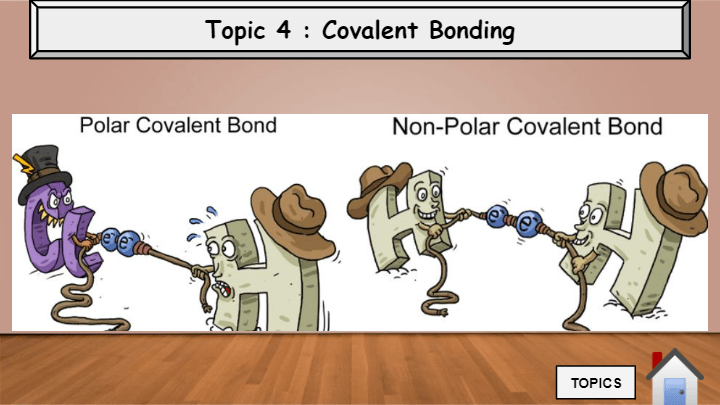
Which is more polar? A C-H bond or H-Cl bond?

Type answer...

14

Slide image

15

Multiple Choice

The least polar bond is found in a molecule of

1

HI

2

HF

3

HCl

4

HBr

16

Multiple Choice

Which property is used to determine the degree of polarity between two bonded atoms?

1

density

2

electronegativity

3

pressure

4

temperature

17

Slide image

18

Multiple Choice

Which two terms represent major categories of compounds?

1

ionic and nuclear

2

ionic and molecular

3

empirical and nuclear

4

empirical and molecular

19

Slide image

20

Slide image
pattern-tertiary

Covalent Bonds/ Compounds

Slide image

Show answer

Auto Play

Slide 1 / 20

SLIDE