Search Header Logo
  1. Resource Library
  2. Science
  3. Biology
  4. ...
  5. Lungs Review
Lungs  Review

Lungs Review

Assessment

Presentation

Science

11th - 12th Grade

Medium

NGSS
HS-LS1-3, HS-LS2-5, HS-LS3-1

+1

Standards-aligned

Created by

Stacy King

Used 13+ times

FREE Resource

19 Slides • 30 Questions

1

Respiratory Review

Slide image

2

Upper Respiratory

  • nose

  • mouth

  • pharynx

Slide image

3

Lower Respiratory

  • larynx

  • trachea

  • bronchi

  • alveoli

Slide image

4

Multiple Choice

Question image

The organs in letter a and b are ....

1

pharynx, trachea

2

pharynx, larynx

3

trachea, bronchi

4

larynx, trachea

5

Multiple Choice

Question image

The respiratory organ in the picture is called ....

1

lung

2

trachea

3

bronchioles

4

bronchi

6

Multiple Choice

Question image
What is tube that is also known as your wind pipe?
1
esophogus
2
bronchi
3
trachea
4
alveoli

7

Multiple Choice

Smaller branches of the bronchi inside the lungs.

1

alveoli

2

bronchioles

3

larynx

4

mouth

8

Respiratory Cilia

  • filtering

Slide image

9

Pleural membranes responsible for pressure gradient

  • visceral- surrounds the lungs

  • parietal- lines the chest wall

Slide image

10

Respiratory Muscles

  • Diaphragm -inhalation

  • intercostals-inhalation

  • Abdominal- forced expiration

Slide image

11

Multiple Choice

The thoracic cavity has to decease in size in order for ______ to occur.

1

inspiration

2

expiration

3

both

12

Multiple Choice

A contraction of the diaphragm during inhalation causes it to flatten. What else does the contraction result in?

1

An increase in the volume of the thoracic cavity

2

Increase in alveolar pressure

3

A decrease in lung volume

4

A decrease in the volume of the thoracic cavity

13

Multiple Choice

When air pressure inside the lungs is less than air pressure in the atmosphere...
1
Air moves into the lungs
2
Air moves out of the lungs

14

Multiple Choice

Which of the following would protect lungs?

1

cilia and mucus membrane

2

pleural membrane and ribcage

3

diaphragm and linings

4

it is safe from where it is located

15

Gas Exchange at the alveoli

  • diffuses across membrane with the concentration gradient

  • CO2 metabolic waste from respiration diffuses out of the blood capillary into the alveoli

  • O2 diffuses into the blood capillary

Slide image

16

Hemoglobin carries CO2 and O2

  • Deoxyhemoglobin- deoxygenated

  • Oxygenated- carrying O2

Slide image

17

Homeostatic Controls

  • Chemoreceptors in the brain

  • peripheral receptors in the lungs

Slide image

18

Multiple Choice

Question image
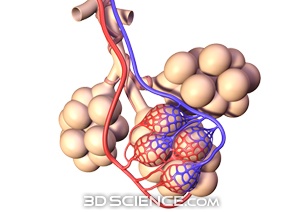
The air sacs that are covered with capillaries where gas exchange takes place
1
bronchi
2
lungs
3
oxygen
4
alveoli

19

Multiple Select

the autonomic controls that maintain oxygen transport homeostasis is

1

the brain

2

the spinal cord

3

the heart

4

the liver

20

Multiple Choice

the component of blood responsible for oxygen transport

1

hemoglobin

2

white blood cells

3

platelets

4

arteries

21

Multiple Choice

A place to exchange oxygen and carbon dioxide is ....

1

bronchus

2

alveoli

3

lung

4

bronchi

22

Asthma

  • Antigen mediated response-something irritates the tissue


  • bronchoconstriction- narrowing of the bronchioles


  • Airway edema- mucus production increases

Slide image

23

COPD Chronic obstructive pulmonary disease

  • Inhalation of toxic gases


  • Emphysema

Slide image

24

Multiple Choice

Question image

Which of the following describes the given picture?

1

Inflammation of the lining of your bronchial tubes, which carry air to and from your lungs.

2

A condition in which your airways narrow and swell and may produce extra mucus.

3

Inflammation or swelling of the tissue lining the sinuses

4

A condition that causes shortness of breath, caused by damage in the air sacs in the lungs (alveoli).

25

Multiple Choice

It refers to a condition that causes shortness of breath, caused by damage in the air sacs in the lungs (alveoli)?

1

Asthma

2

Emphysema

3

Bronchitis

4

Sinusitis

26

Multiple Choice

There is a cure for asthma

1

True

2

False

27

Multiple Choice

Common treatments for this lung disorder is to stop smoking or working around toxic gases, also prescribed inhaled corticosteroids, and in extreme cases oxygen therapy

1

Asthma

2

COPD

3

pneumonia

4

TB

28

Multiple Choice

antigen mediated inflammatory response that can cause bronchoconstriction and is common in both children and adults

1

pneumonia

2

asthma

3

COPD

4

TB

29

Acute Bronchitis

  • Infection of the bronchial tubes


  • Viral is common


  • Prevalent after upper respiratory infections

Slide image

30

Cystic fibrosis 

  • Genetic disease


  • Gene alteration for a protein 


  • Causing excess mucus  that traps bacteria


Slide image

31

TB

  • Tuberculosis

  • Highly Contagious


  • Infection causing inflammation 


Slide image

32

Multiple Choice

Caused by a highly contagious bacteria that causes numbness in fingers/toes, nausea, coughing, and jaundice

1

TB

2

ARDS

3

Pneumonia

4

Pulmonary edema

33

Multiple Choice

Infection of the bronchial tubes common with infections such as the flu and pneumonia

1

acute bronchitis

2

asthma

3

TB

4

cystic fibrosis

34

Multiple Choice

Question image

Inherited disorder of exocrine glands resulting in thick mucus secretions in the respiratory tract that do not drain normally?

1

asthma

2

diphtheria

3

cystic fibrosis (CF)

4

emphysema

35

Multiple Choice

Question image

Which of the following describes the given picture?

1

Inflammation of the lining of your bronchial tubes, which carry air to and from your lungs.

2

A condition in which your airways narrow and swell and may produce extra mucus.

3

Inflammation or swelling of the tissue lining the sinuses

4

A condition that causes shortness of breath, caused by damage in the air sacs in the lungs (alveoli).

36

Pulmonary edema

  • Enlarged Alveoli


  • Caused by congestive heart failure


  • Blood is pooled in the veins 


Slide image

37

ARDs

  • Acute respiratory distress syndrome


  • Rapid onset of pulmonary edema- fluid in the lungs


  • Inflammation

Slide image

38

Multiple Choice

An accumulation of tissue fluid in the alveoli of the lungs:

1

pulmonary edema

2

pneumonia

3

pleural effusion

4

pulmonary thromboembolism

39

Multiple Choice

rapid onset of pulmonary edema causing fluid in the lungs and is associated with COVID-19

1

acute bronchitis

2

COPD

3

pneumothorax

4

ARDS

40

Multiple Choice

enlarged alveoli caused by congestive heart failure

1

pulmonary edema

2

pulmonary hypertension

3

pulmonary embolism

4

ARDS

41

Pulmonary Embolism


  • Blockage of the of a pulmonary artery


  • Blood clots 

    They can form in the legs and move to the lungs


Slide image

42

Pulmonary hypertension

  • Caused by high blood pressure


  • Narrowing of the arteries 


Slide image

43

Pneumothorax

  • Collapsed Lung


  • Air fills the pleural cavity between the lungs and chest wall


  • Often from injury, but also scuba diving/altitude changes, tb


Slide image

44

Multiple Choice

The blockage of an artery in the lungs usually caused by a blood clot

1

pulmonary edema

2

pulmonary hypertension

3

pulmonary embolism

4

pneumothorax

45

Multiple Choice

increased blood pressure that damages the alveoli

1

pulmonary hypertension

2

pulmonary edema

3

pulmonary embolism

4

COPD

46

Multiple Choice

Doctor traditionally treat this lung disorder with vasodilators to help reduce the pressure in the arteries

1

pulmonary hypertension

2

pulmonary embolism

3

pulmonary edema

4

COPD

47

Multiple Choice

Often doctor treat this lung disorder with blood thinners and clot dissolvers

1

pulmonary hypertension

2

pulmonary embolism

3

pulmonary edema

4

pneumothorax

48

Multiple Choice

a collapsed lung

1

pneumothorax

2

cystic fibrosis

3

Pulmonary edema

4

emphysema

49

Multiple Choice

Doctors treat this lunge disorder, by using needle aspiration or inserting a chest tube

1

pneumonia

2

pneumothorax

3

cystic fibrosis

4

TB

Respiratory Review

Slide image

Show answer

Auto Play

Slide 1 / 49

SLIDE