

Vocabulary for the Development of Political Parties

Presentation
•
Social Studies, History
•
7th - 9th Grade
•
Medium

Adele Champlin
Used 28+ times
FREE Resource
15 Slides • 10 Questions
1
Unit 5 Vocabulary: The Development of Political Parties
Political parties are groups of people who share similar political beliefs or goals. Political parties change, and new ones develop, in response to the conflicts a country faces. Sometimes parties work together to help the people, and at other times they argue and accomplish very little.

2
Poll
3
So how did political parties start? With Alexander Hamilton and Thomas Jefferson!
Hamilton and Jefferson each had different ideas about what America should be. Those different values led to the development of the first two American political parties - Federalists and Democratic-Republicans.
Dozens more political parties have evolved and disappeared in the USA since then, and there are now hundreds of them (including the five on the previous slide). However, the Democrats and Republicans are the largest and most powerful right now.
On the next three slides, we'll define the terms political party, Federalists, and Democratic-Republicans.
4
political party
- an organized group of people who collaborate to gain power and control policy by winning elections.
Political parties nominate members of the party to run for various positions in the government. They run against members of other parties. The more elected positions a party wins, the more power the group has. Like sports teams, parties are represented by symbols.

5
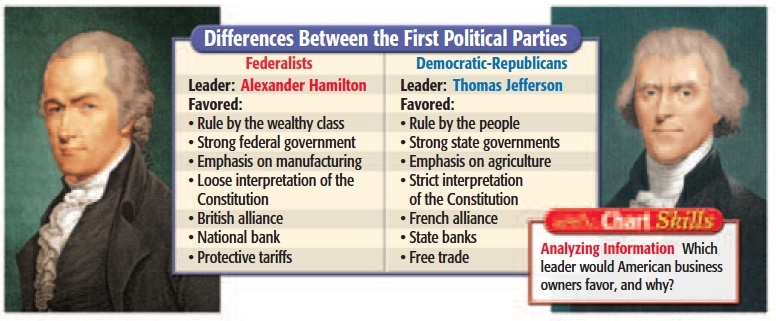
Federalists
Led by Alexander Hamilton
Favored rule by the educated/elite/wealthy
Wanted to focus on trade and manufacturing
Believed in a loose or broad interpretation of the Constitution
Favored an alliance with Great Britain
Favored a national bank
Favored tariffs to protect trade

6
Democratic-Republicans
Led by Thomas Jefferson
Favored rule by all the people regardless of education or wealth
Wanted to focus on farming and agriculture
Favored a strict interpretation of the Constitution
Favored an alliance with France
Favored state banks instead of a national one
Favored free trade

7
Multiple Choice
8
policy
- a set system of rules and actions for dealing with a specific issue.
For example, our school has policies for dealing with fights, sickness, and tardies. This helps us be consistent.
Our country has much larger, far more complicated policies for each aspect of government. New policies are created to deal with new issues, and different political parties argue over what the policy should be.

9
values
- one's ideas about what is best, fair, right, or just for a society.
Shared values unite the members of a party, and those values become the party's priorities. Each party prioritizes education, healthcare, the economy, the environment, the military, equal rights, and other things in a different order.
Parties argue over policy because the parties have different VALUES.

10
candidate
- a person who is nominated for / is running for a position.
In local, state, and federal elections, each political party can nominate a candidate. That candidate runs as a representative of the party's values.
Candidates can also run as an Independent, which is a way of showing they are not beholden to a party or its values and priorities.

11
Talk Time:
Look at the capital letters beside each candidate's name.
Which political party does each candidate represent? (Think back to the five party names you saw at the start of this lesson.)
Now that you know which party each candidate represents, you as a voter could figure out what each candidate values and what policies they believe in.

12
Multiple Choice

Do you know which animal symbol represents each of today's two biggest American political parties?
13
Multiple Choice
14
Multiple Choice
15
Multiple Choice
16
Multiple Choice
17
opposition
This word can be used multiple ways in politics and government:
- To oppose means to disagree. Two parties who disagree on policy are in opposition to one another.
- The opposition party is the minority (smaller) party and has less control over the government.
- The opposition often acts as a watchdog on the majority party.

18
majority
- More than half. A majority is more than 50% of the given total.
Ex. 1: The US president is chosen by electoral votes. There are 538 electoral votes, and 538÷2 = 269. So, a candidate must receive 270 votes (the majority) to win the election.
Ex. 2: There are 100 Senators in the US Senate. They vote on policy issues. The political party that has the majority can win most votes.

19
minority
- the opposite of a majority. The smaller of two groups that together make up a whole.
In the US Senate, the minority party has less power.
Which party is the minority in this image? The majority?
(The two yellow seats are Independents and the two grey seats are still being voted on.)

20
coalition
- a temporary alliance of different parties, persons, or states who join together to accomplish something.
When members of different parties cooperate and work together, this is a coalition.
In some countries there are many political parties in the government, and coalitions happen more often.

21
function
- the job or actions for which a person or thing is specifically used.
Ex.1: Each of the three branches has specific functions. Can you recall a specific function of the legislative, judicial, or executive branch?
Ex. 2: What is the function of the Bill of Rights? Of the First Amendment?
Ex. 3: What are the functions of political parties?

22
Multiple Choice
23
Multiple Choice
24
Multiple Select
25
Great job today!
You can use this Quizizz to review your vocabulary and to reattempt these questions.

Unit 5 Vocabulary: The Development of Political Parties
Political parties are groups of people who share similar political beliefs or goals. Political parties change, and new ones develop, in response to the conflicts a country faces. Sometimes parties work together to help the people, and at other times they argue and accomplish very little.
Show answer
Auto Play
Slide 1 / 25
SLIDE


