Theoretical and Experimental Probability
Presentation
•
Mathematics
•
7th Grade
•
Medium
+7
Standards-aligned
Alycia WATKINS
Used 1K+ times
FREE Resource
8 Slides • 12 Questions
1
Theoretical and Experimental Probability
2
Multiple Choice
Just to review: Probability can be written as ...
a fraction
a decimal
a percent
all of the above
3
What is probability?
Probability is how likely something will occur
Think of probability of the chance something can or cannot happen
4
Remember: Probability is the chance something will happen on a scale from 0 to 1.
5
How to read the probability scale:
Impossible (0%): something cannot occur
Unlikely: there is a small percentage of occuring
Even Chance (50%): there is a 50% chance it can occur and 50% it cannot
Likely: there more of a chance something occurring than not
Certain (100%): it will happen
6
Multiple Choice
A likely chance event is closer to what number?
0
1
.5
100
7
Theoretical vs Experimental Probability
Theoretical: is calculating the probability of it happening, what should happen.
ex. If you flip a coin six times, it should land on heads 21 , 1 out of 2, or 50% of the time.
Experimental: is the results of an experiment, what did happen.
ex. you flip and coin and see how many times it lands on heads.
8
Multiple Choice
Experimental Probability is:
What Will happen
What actually happens
What should happen
What I think Happens
9
Multiple Choice
Theoretical Probability is?
What Should happen
What does happen
What Will Happen
What I want to Happen
10
Multiple Choice
What is the theoretical probability of the spinner landing on yellow?
1/4
1/2
1/3
2/3
11
Theoretical Probability
If you and 7 friends were playing Among Us (8 total players) the theoretical probability of being imposter would be 81 or 12.5%. So, if you played 8 games you would expect to be imposter 1 time.
12
Experimental Probability
If you played 8 games and were the imposter 3 times then your experimental probability would be 83 or 37.5%.
13
Theoretical and Experimental Probability
- they can be equal or they can be different
In the example before, you were imposter 3 times which is higher than expected of only 1 time. However, you could play 8 games and never be an imposter, thus, having an experimental probability less than the theoretical.
14
Multiple Choice
15
Multiple Choice
5 equal-size sections colored red, blue, orange, white, and green. What is the probability that Dustin spins pink on the next spin?
16
Multiple Choice
What is the theoretical probability of randomly picking a Purple marble from Molly's Sack of Marbles?
4/5
3/15
2/15
8/21
17
Multiple Choice
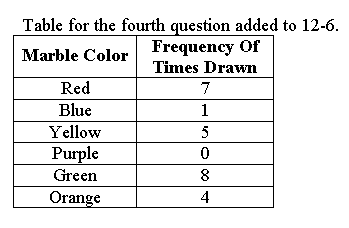
Based on the chart, what is the experimental probability of pulling a green marble?
12.5%
32%
8%
80%
18
Multiple Choice
A bag contains 5 quarters, 2 dimes, and 4 pennies. What is the probability of picking a quarter?
5/11
5/6
1/3
5
19
Multiple Choice
A bag contains 5 quarters, 2 dimes, and 4 pennies. What is the probability of picking a quarter?
5/11
5/6
1/3
5
20
Open Ended
Please give me feedback on the lesson. Did you like how it broke it down more? What changes would you like?
Theoretical and Experimental Probability
Show answer
Auto Play
Slide 1 / 20
SLIDE

Similar Resources on Wayground
13 questions
Triangle Theorems
Presentation
•
7th Grade
15 questions
Dividing Fractions
Presentation
•
7th Grade
15 questions
Mean, Median, Mode, and Range
Presentation
•
7th Grade
14 questions
Adding and Subtracting Decimals
Presentation
•
7th Grade
14 questions
7.RP.3
Presentation
•
7th Grade
14 questions
Subtract Linear Expressions
Presentation
•
7th Grade
16 questions
Inequalities
Presentation
•
7th Grade
14 questions
One and Two-Step Inequalities
Presentation
•
7th Grade
Popular Resources on Wayground
20 questions
STAAR Review Quiz #3
Quiz
•
8th Grade
20 questions
Equivalent Fractions
Quiz
•
3rd Grade
6 questions
Marshmallow Farm Quiz
Quiz
•
2nd - 5th Grade
20 questions
Main Idea and Details
Quiz
•
5th Grade
20 questions
Context Clues
Quiz
•
6th Grade
20 questions
Inferences
Quiz
•
4th Grade
19 questions
Classifying Quadrilaterals
Quiz
•
3rd Grade
12 questions
What makes Nebraska's government unique?
Quiz
•
4th - 5th Grade
Discover more resources for Mathematics
10 questions
Box Plots
Quiz
•
6th - 7th Grade
14 questions
Volume of rectangular prisms
Quiz
•
7th Grade
22 questions
Simple Probability
Quiz
•
7th Grade
20 questions
Graphing Inequalities on a Number Line
Quiz
•
6th - 9th Grade
15 questions
Simple Probability
Quiz
•
7th Grade
10 questions
Pythagorean Theorem and its Converse
Quiz
•
7th - 9th Grade
20 questions
Theoretical and Experimental Probability
Quiz
•
7th Grade
12 questions
Simple Probability
Quiz
•
7th Grade