
Mutations
Presentation
•
Biology
•
9th - 10th Grade
•
Practice Problem
•
Medium
Standards-aligned
Phoebe Quinn
Used 78+ times
FREE Resource
10 Slides • 15 Questions
1
Mutations
2
Mutations
We all make mistakes, don’t we? Sometimes, cells make mistakes when they copy their DNA.
Mutations are mistakes in DNA sequencing, and they can affect the genetic information passed to offspring.
Sometimes the mistakes are so small that they are
never noticed.
These are called silent mutations.
3
Mutations
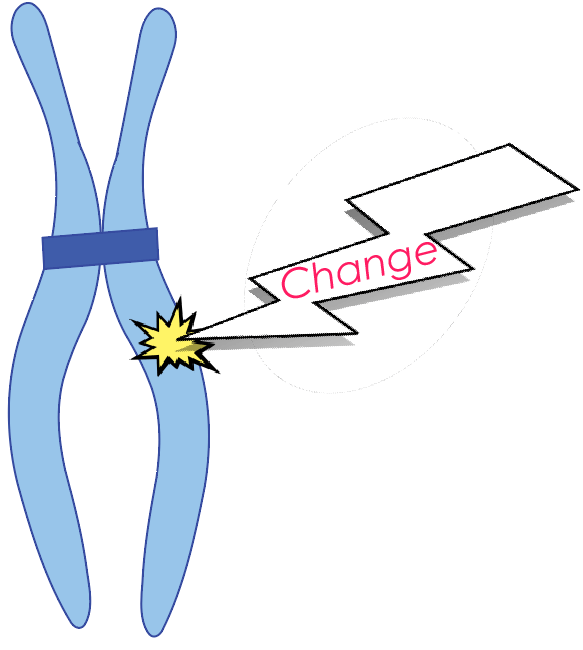
Mutations can fall into two different categories – gene mutations and chromosome mutations.
Gene mutations occur when 1 or more nucleotide bases are changed.
Chromosome mutations occur when pieces/parts of chromosomes are changed. They have much larger effects.
4
Gene Mutations: Point Mutations
Point Mutations are mutations that involve only one single nucleotide.
Ex: Substitution: a gene mutation that
occurs when one mutation is substituted for another nucleotide.
5
Gene Mutations: Frameshift Mutations
Frameshift Mutations are mutations that occur when a nucleotide is added or deleted and it causes a shift in how the codons are read; this results in one or more wrong amino acids being added.
Ex: Deletion: a gene mutation in which a nucleotide is lost or deleted.
Ex: Insertion: a gene mutation in which a nucleotide is added.
6
Chromosomal Mutations
Another type of mutation is a chromosomal mutation, where the structure or numbers of chromosomes change.
The structure of a chromosome can change if a part of a chromosome is broken off or lost during the process of mitosis or meiosis.
7
Types of Chromosomal Mutations
A broken part can sometimes reattach to a sister chromatid and cause deletion of genetic information in one chromatid and duplication of genetic information on the other.
If the broken part reattaches backwards, it is called an inversion.
The broken part may also attach to another chromosome, which is called translocation.
8
If a chromosome does not separate correctly, this is called nondisjunction, and a gamete will have an extra or a missing chromosome.
9
Meiosis vs. Mitosis
When mutations occur during the process of meiosis, that mutation can be passed on to offspring.
The mutation becomes part of the offspring’s DNA and will be found in almost every cell.
This mutation can then be passed on to the next generation.
Existing genetic disorders are passed on to offspring when the defective gene becomes part of the gamete formed during meiosis.
Example: Sickle Cell Anemia - caused by a single substitution in a gene that forms the protein hemoglobin. Because of the substitution, the wrong amino acid is added and the resulting hemoglobin protein is shaped differently and does not function as well.
10
Mitosis vs. Meiosis
When mutations occur during mitosis, they usually happen during an organism’s lifetime.
Most mutations occur during the process of mitosis when the DNA is being copied and a mistake occurs – when the mistake isn’t repaired, it can lead to cellular malfunctions.
They affect the individual but aren’t passed to offspring.
A mutagen is an external agent that can change DNA, such as radiation or some chemicals.
A common result of mutations is cancer, and mutagens that are linked to cancer are called carcinogen.
Examples: excessive UV light exposure, radiation, tobacco, and chemical pesticides.
11
Multiple Choice
12
Multiple Choice
13
Multiple Choice
T-G-A-C-C-A
T-G-A-G-C-A
14
Multiple Choice
In order for offspring to get a genetic mutation, the mutation must occur in what type of cell?
Cells with no nucleus.
Any body cell after birth.
Cells with no cell wall or cell membrane.
Cells like eggs or sperm cells that are undergoing reproduction.
15
Multiple Choice
A frameshift mutation where a nucleotide base
is removed from the DNA sequence.
Deletion Mutation
Substitution Mutation
Translocation
Silent Mutation
16
Multiple Choice
A frameshift mutation where a nucleotide base is added
to the DNA sequence
Insertion Mutation
Deletion Mutation
Substitution Mutation
Chromosomal Mutation
17
Multiple Choice
Part of a chromosome is repeated
Gene Mutation
Point Mutation
Deletion Mutation
Duplication Mutation
18
Multiple Choice
Part of one chromosome is transported and attached
to a non-homologous chromosome
Inversion Mutation
Translocation Mutation
Duplication Mutation
Point Mutation
19
Multiple Choice
Failure of homologous chromosomes
to separate during meiosis.
Results in gametes with either one extra or one missing chromosome.
Translocation
Nondisjunction
Replication
Transcription
20
Multiple Choice
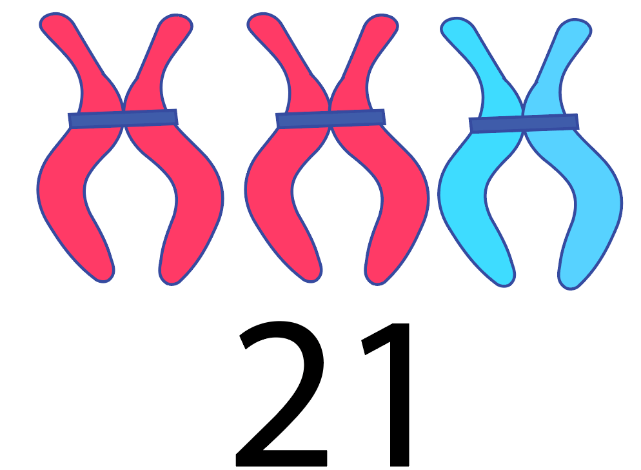
Condition caused by nondisjunction at pair 21 during meiosis.
Individuals have an extra chromosome
at pair 21, or a total of 47 chromosomes.
Also called Trisomy 21.
Cystic Fibrosis
Translocation
Hemophilia
Down Syndrome
21
Multiple Choice
A point mutation where DNA adenine (A)
is replaced by thymine (T) resulting in a single amino acid change during translation(affects blood cell
shape and function)
Encephelitis
Hemophilia
Sickle Cell Anemia
Influenza
22
Multiple Choice
A nucleotide base is inserted or deleted shifting the entire DNA sequence. Entire protein will be changed.
Substitution Mutation
Silent Mutation
Frameshift Mutation
Translocation
23
Multiple Choice
A point mutation where one nucleotide base replaces an original nucleotide base
Inversion Mutation
Chromosomal Mutation
Translocation
Substitution Mutation
24
Multiple Choice
One nucleotide base is changed so only one amino acid
is affected
Substitution Mutation
Point Mutation
Translocation
Inverse Mutation
25
Multiple Choice
A change in a gene, group of genes or chromosome that results in a change in the proteins
Replication
Mutations
Translation
Transcription
Mutations

Show answer
Auto Play
Slide 1 / 25
SLIDE

Similar Resources on Wayground
20 questions
Reteach Biomolecules
Lesson
•
9th - 10th Grade
20 questions
Natural selection vtrevino
Lesson
•
9th Grade
20 questions
Macromolecule review
Lesson
•
9th Grade
18 questions
Sex-linked Inheritance
Lesson
•
9th Grade
21 questions
G9 Chap 9.2 Mitosis and Cytokinesis
Lesson
•
9th Grade
20 questions
C5L3 Solving Systems of Equations
Lesson
•
8th - 10th Grade
20 questions
Cell Cycle Lesson
Lesson
•
9th Grade
21 questions
DNA the Genetic Material
Lesson
•
9th - 10th Grade
Popular Resources on Wayground
10 questions
5.P.1.3 Distance/Time Graphs
Quiz
•
5th Grade
10 questions
Fire Drill
Quiz
•
2nd - 5th Grade
20 questions
Equivalent Fractions
Quiz
•
3rd Grade
15 questions
Hargrett House Quiz: Community & Service
Quiz
•
5th Grade
20 questions
Main Idea and Details
Quiz
•
5th Grade
20 questions
Context Clues
Quiz
•
6th Grade
20 questions
Inferences
Quiz
•
4th Grade
15 questions
Equivalent Fractions
Quiz
•
4th Grade
Discover more resources for Biology
14 questions
Ecological Succession: Primary and Secondary
Quiz
•
9th Grade
20 questions
Cladogram Practice
Quiz
•
10th Grade
20 questions
Evolution and Natural Selection
Quiz
•
9th Grade
21 questions
Cell Cycle and mitosis
Quiz
•
9th - 10th Grade
45 questions
Unit 9 Review: Biosphere
Quiz
•
9th Grade
20 questions
Food Chains and Food Webs
Quiz
•
7th - 12th Grade
20 questions
Sex-Linked Traits
Quiz
•
9th - 12th Grade
22 questions
AP Biology: Unit 7 Review (CED)
Quiz
•
9th - 12th Grade