

Search Header Logo
  1. Resource Library
  2. Ela
  3. Grammar
  4. ...
  5. Verbs
Verbs

Verbs

Assessment

Presentation

English

5th - 12th Grade

Medium

CCSS
L.5.1.B-D, L.1.1E, L.3.1A

+9

Standards-aligned

Created by

Lauren Ellis

Used 46+ times

FREE Resource

8 Slides • 12 Questions

1

Verbs

Slide image

2

Action vs. Being

The task of the verb is to give information about the subject of the sentence. Verbs do this by either expressing the action in a sentence, or the state of being of the subject. An action verb usually tells what the subject does. A state of being verb usually tells what the subject is.

Example:

1. Five frogs flopped into the water. (action)

2. The frogs are large, green, and shiny. (state of being)

3

Multiple Choice

Identify the kind of verb by choosing action or being.

Cats and dogs are domestic animals.

1

action

2

being

4

Multiple Choice

Identify the kind of verb by choosing action or being.

Chris and Stephen followed their dad.

1

action

2

being

5

Multiple Choice

Identify the kind of verb by choosing action or being.

Who will be the first one home?

1

action

2

being

6

Verb Tenses


Slide image

7

Multiple Choice

The present tense forms of the verb be are _____.

1

will be

2

have been

3

was, were

4

am, are, is

8

Multiple Choice

The present, past, and future of speak is _____.

1

speaking, spoke, will speak

2

speak, spoke, will speak

3

speak, spoken, speaking

4

speak, spoke, will speak

9

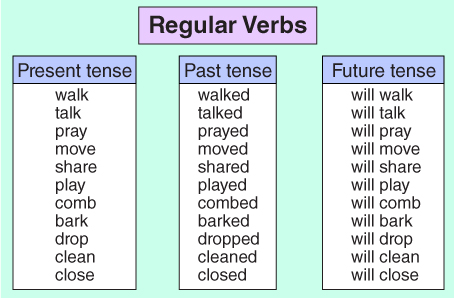
Regular Verbs

When a root word changes by adding the suffix -ed (or -d) to form the past tense, it is known as a regular verb. Notice that the suffix -ed (or -d) changes the time of the action to the past.
Slide image

10

Irregular Verbs

The second way a word changes to express the past tense is by making changes in the original form. For example, the past tense of the verb find is not finded but rather found. A verb such as find which changes its form without adding the suffix -ed to form the past tense is known as an irregular verb. An irregular verb is changed to past tense by changing its root word. Notice how each word is spelled and pronounced in the past tense.

Slide image

11

Multiple Choice

Select regular or irregular for the verb given below.

sank

1

regular

2

irregular

12

Multiple Choice

Select regular or irregular for the verb given below.

was playing

1

regular

2

irregular

13

Multiple Choice

Select regular or irregular for the verb given below.

was

1

regular

2

irregular

14

Multiple Choice

Select regular or irregular for the verb given below.

woke

1

regular

2

irregular

15

Multiple Choice

Select regular or irregular for the verb given below.

studied

1

regular

2

irregular

16

Subject Verb Agreement

The verb must be in agreement with the subject noun. If a subject noun is singular, the verb must be in its singular form (usually -s or -es). If the subject noun is plural, the verb must be in its plural form.

These examples illustrate the use of a singular verb with a singular subject.

The child is happy with his work.

The child was happy with his work.

The child will be happy with his work.

These examples illustrate how plural subjects and verbs agree.

These children are happy with their work.

These children were happy with their work

These children will be happy with their work.

17

Slide image

18

Slide image

19

Multiple Choice

Complete the sentence by choosing the correct verb.

Douglas and Olivia _____ waiting for their parents to come home.

1

are

2

was

3

am

20

Multiple Choice

At the end of this unit, we will take a test on everything we ________

this past month.

1

learn

2

learns

3

learned

Verbs


Slide image

Show answer

Auto Play

Slide 1 / 20

SLIDE
