

Storyboard

Presentation
•
Arts, English, Fun
•
8th Grade
•
Practice Problem
•
Medium

MARCELA FERNANDEZ
Used 48+ times
FREE Resource
12 Slides • 9 Questions
1
Broadcasting 3
2
3
Open Ended
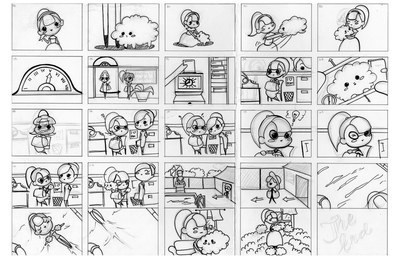
What is a storyboard?
4
Multiple Choice
Storyboards are a technical document
True
False
5
Multiple Choice
You need to know how to draw to make a storyboard
True
False
6
Multiple Select
Who can be in charge of the storyboard? (Select all correct answers)
Director
Storyboarder
Production designers
Cinematographers
7
Multiple Choice
What does the panel represent?
Duration of a scene
What the camera will see
The special effects needed
The soundtrack in that scene
8
Open Ended
Why is there different size of panels?
9
A storyboard is a sequence of drawings or illustrations used to map out key events in stories, videos, commercials and other similar projects. It is essentially a scene-by-scene plan of your project.

(Copy in your notebook)
10
There are many benefits for using a storyboard to plan your project, such as:
Helps you visualise each scene in your project.
Put scenes into a logical order that makes sense.
Clearly communicate your ideas to other team members.
Make sure you don’t miss out on anything crucial.

(Copy in your notebook)
11
Open Ended
Mention 2 benefits of a storyboard
12
As mentioned earlier storyboards are great for planning your story. However, they are not-so-great at idea generation or idea development. For this reason, it is important to have your idea clearly mapped out before using your storyboard template.
For example, you have an idea of ninja cats who steal food from their neighbour’s house at night. The first step to defining this idea is brainstorming (see image below):
13

14
Multiple Choice
Storyboards are great for generating ideas for a project
True
False
15
Brainstorming is the part where you quickly jot as many ideas as you can down on a piece of paper. It is important not to worry about whether your ideas make sense or not, as later on you can remove any bits that don’t make sense.
At this point you may be able to visualise how the story may flow, what the main characters may look like, even how the story is going to start or end. This is a sign that your story is slowly coming to life.
The next step is to use your brainstorm to list the key events of your story. You can put these events in the order you want them to happen. Below, you can see the key events in the ninja cat example.
16

17
For each event you listed previously you can draw a simple and quick drawing of it in the boxes provided in the template, with a short description of what that scene is about.

18

19
Make a storyboard
Use the images to make a storyboard. Paste them in your notebook and don't forget to add text explaining what is going on.
20
Match
A boy playing with his dog
Then he can't find his dog
He makes posters for his missing dog
The boy is sad because he can't find him
He finds his dog and is happy again
A boy playing with his dog
Then he can't find his dog
He makes posters for his missing dog
The boy is sad because he can't find him
He finds his dog and is happy again
21
Making a storyboard
The Red Riding Hood
Read the short story.
Then make a list of 8 key events.
Then make a story board in your notebook.
Broadcasting 3
Show answer
Auto Play
Slide 1 / 21
SLIDE
Similar Resources on Wayground

16 questions
Determining the Theme
Presentation
•
8th Grade
15 questions
Academic vocab 8
Presentation
•
8th Grade
15 questions
Worldy Wise Book 8 Lesson 4
Presentation
•
8th Grade
17 questions
Plot Elements
Presentation
•
8th Grade
17 questions
Infinitives
Presentation
•
8th Grade
15 questions
Spiderman literary terms
Presentation
•
8th Grade
15 questions
Citing Sources
Presentation
•
8th Grade
16 questions
ARTICLE
Presentation
•
8th Grade
Popular Resources on Wayground
10 questions
Safety Day 2026 – Student Review

Quiz
•
9th Grade
21 questions
Continents and Oceans
Quiz
•
6th Grade
20 questions
Parts of Speech
Quiz
•
5th Grade
16 questions
Subject & Predicate
Quiz
•
5th Grade
25 questions
Multiplication Facts
Quiz
•
5th Grade
12 questions
Map Skills
Quiz
•
3rd Grade
22 questions
Continents and Oceans
Quiz
•
5th Grade
15 questions
Rounding Decimals
Quiz
•
5th Grade