Search Header Logo
Willowridge Evolution

Willowridge Evolution

Assessment

Presentation

Biology

8th - 10th Grade

Medium

NGSS
MS-LS4-2, MS-LS4-4, MS-LS4-1

+16

Standards-aligned

Created by

Jorge Rodriguez

Used 27+ times

FREE Resource

38 Slides • 36 Questions

1

Willowridge Evolution
Slide image

2

Slide image

3

What is Evolution?

4

Did you know Whales were land animals?

5

Open Ended

Question image

What caused whales to change from land animals to water animals? Please provide detail. You have 5 mins.

6

Slide image

7

Slide image

8

Slide image

9

Slide image

10

Slide image

11

Slide image

12

Slide image

13

Slide image

14

Slide image

15

Slide image

16

Slide image

17

Slide image

18

Slide image

19

Slide image

20

Slide image

21

Giraffe long necks

Discuss why the giraffes necks evolved.

Interesting fact: When you bend down for a long time and stand you feel dizzy. Giraffes dont have this problem because their brains are like sponges and retain blood. Even the giraffe brain had to evolve for them to be tall!!!!!

Slide image

22

Slide image

23

Slide image

24

Slide image

25

Multiple Choice

Question image

Which of the following is true about the picture above?

1

Camels are highly adapted to cold climates.

2

There are no benefits to using a camel vs. a horse in the desert.

3

Camels have directly evolved from whales.

4

A camels long large intestine, long eyelashes and wide feet allow it to be very adapted to the desert.

26

Multiple Choice

Question image
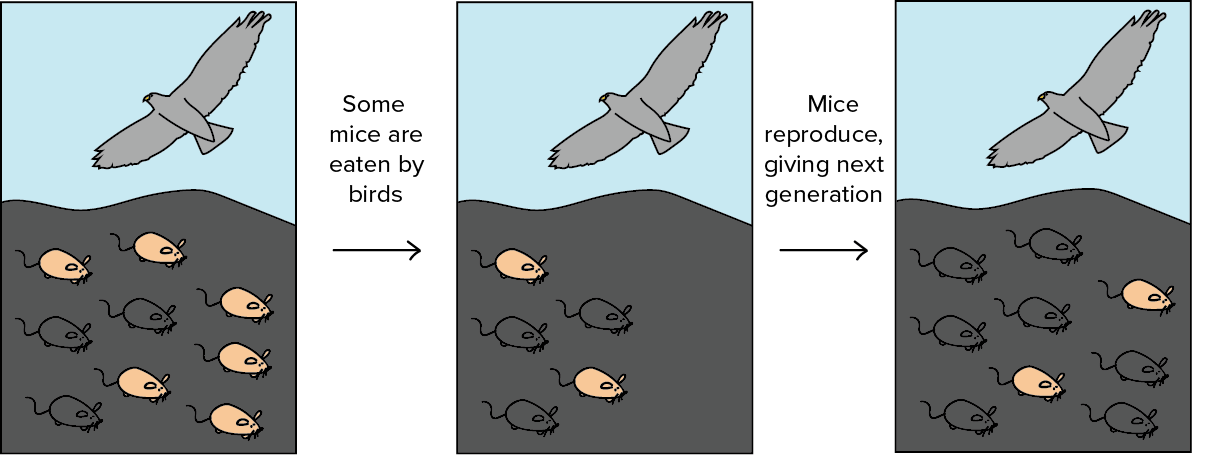
Why is the mouse population changing over time?
1
The light mice can reproduce more successfully than the dark mice
2
The hawks eat more dark mice than light mice because the dark mice taste better
3
The hawks eat more light mice than dark mice because they can see the light mice more easily
4
The hawks eat more dark mice than light mice because they can see the dark mice more easily

27

Multiple Choice

Question image
The similarities of the bones in the diagram provide evidence that---
1
The organisms shown lived in the same natural envionrment
2
The organisms shown may have developed from a common ancestor
3
The organisms shown have the same genetic diseases
4
All vertebrate species have identical forelimbs

28

Multiple Choice

Question image

Adaptations are:

1

physical or behavioral tendencies.

2

physical or behavioral characteristics that help an organisms survive and reproduce.

3

physical or behavioral characteristics that do not help the organism in any way.

4

genetic mutations that have gone wrong.

29

Multiple Choice

Question image

What type of evidence are shown in the picture above?

1

Fossils

2

Embryology

3

Homologous Structures

4

Vestigial Structures

30

Multiple Choice

Question image

What type of evidence is shown in this picture?

1

Fossils

2

Homologous Structures

3

Vestigial Structures

4

DNA

31

Multiple Choice

Question image

What type of evidence is shown in the image above?

1

Fossils

2

Vestigial structures

3

Homologous Structures

4

DNA

32

Multiple Choice

A group of similar organisms that can mate with each other and produce fertile offspring is called a species.  
1
True  
2
False

33

Multiple Choice

A well-tested concept that explains a wide range of observations is called a(an):
1
hypothesis
2
experiment
3
cause and effect
4
scientific theory

34

Multiple Choice

Remains of ancient organisms are called
1
Extinctions
2
Fossils
3
Mutations
4
Variations

35

Multiple Choice

What is the advantage of having different shaped beaks?
1
To look different from other species.
2
To be able to eat the food readily available in the environment.
3
To protect itself against predators.
4
To protect itself against prey.

36

Multiple Choice

Genetic differences between organisms of the same species
1
Variation
2
Adaptation
3
Behavior
4
Environment

37

Multiple Choice

When an organism completely dies out, it is called.....
1
Adaption
2
Extinction
3
Fossilization
4
Mutation

38

Multiple Choice

Which term refers to the process by which individuals that are better suited to the environment survive and reproduce therefore passing down their genes to their offspring? 
1
Evolution 
2
Variation 
3
Adaptation
4
Natural Selection 

39

Multiple Choice

Question image
Another word for adapt is ____________.
1
change
2
create

40

Multiple Choice

Question image
Darwin wrote that organisms with traits that are best suited to the environment will ________________
1
increase in number
2
become extinct

41

Multiple Choice

Question image
The gradual change in species over time is...
1
Evolution
2
Nucleotide 
3
Adaptation
4
Natural Selection

42

Multiple Choice

Question image
Who was the naturalist that traveled the world to study plants and animals?
1
Albert Einstein
2
Charles Darwin
3
Charles Barkley
4
Isaac Newton

43

Multiple Choice

What do we call a change in a species over time?

1

Adaptation

2

Evolution

3

Extinction

4

Environmental influences

44

Multiple Choice

When looking at two birds of the same species, you notice that one has darker feathers than the other one. You also notice that one has a beak that is just a little longer. These slight differences within members of the same species are called.....

1

Fossils

2

Extinction

3

Meiosis

4

Variations

45

Multiple Choice

What most likely caused the finches on the Galapagos Islands to have beaks that were different from the finches on the mainland?

1

There were different types of predators on the island.

2

There were different types of food available on the island.

3

The finches had no water to drink.

4

The finches on the mainland could not fly high enough.

46

Slide image

47

Slide image

48

Slide image

49

Slide image

50

Slide image

51

Slide image

52

HUmans are still evolving. What will we look like in the future?

53

Slide image

54

Slide image

55

Slide image

56

Slide image

57

Slide image

58

Slide image

59

The Evolution of cars

60

Open Ended

What causes cars to change? And how do those changes benefit us? You have 5 mins

61

Multiple Choice

The scientific name for humans is _______ ____
1
Homo sapiens
2
Homo neandertal
3
homo Sapiens
4
homo sapiens

62

Multiple Choice

Question image

Charles Darwin came up with this theory

1

Natural Selection

2

Mutation

63

Multiple Choice

Question image

Sometimes bones in the front limbs of animals are very similar in structure. What do we call similar bone structures that indicate a link to a common ancestor?

1

Adaptations

2

Gradualism

3

Homologous Structures

4

Extinction

64

Multiple Choice

Question image
Scientists are studying the evolutionary history of a group of plants in the United States, and they developed an evolutionary tree, as shown below.Which statement can be inferred from the evolutionary tree?
1
Species 1 is most closely related to Species 8.
2
Species 2 is most closely related to Species 3.
3
Species 3 is most closely related to Species 7.
4
Species 5 is most closely related to Species 6.

65

Multiple Choice

A physical or behavioral trait that helps an organism survive and reproduce in its environment is called a what?

1

An adaptation

2

A response to a stimulus

3

A mutation

4

Evolution

66

Slide image

67

Multiple Choice

Which scientist visited the Galapagos Islands and came up with the theory of natural selection?

1

Theodor Schwann

2

Gregor Mendel

3

Charles Darwin

4

Rudolf Virchow

68

Multiple Choice

Question image

Scientists have found evidence that about 2.4 million years ago a gene regulating jaw muscles mutated and may have led to the more graceful human jaw we see today. The diagram below shows the skulls of 3 hominid species.Which statement below most closely explains the link between jaw size and hominid evolution?

1

The jaws of hominids evolved to be smaller and less protruding over time.

2

The jaws of hominids evolved to be smaller and less protruding over time.

3

There appears to be no change in the jaws of hominids over time.

4

The jaws of hominids changed over time due to a change in brain size.

69

Multiple Choice

Question image

Gigantopithecus were very large primates that lived 500,000 years ago. Since none of these mammals are still today, they are said to be....

1

Extinct

2

Threatened

3

Endangered

4

Declining

70

Multiple Choice

Question image
Scientists are studying the evolutionary history of a group of plants in the United States, and they developed an evolutionary tree, as shown below.What information about the organisms best helps the scientists to determine the evolutionary relationships among them?
1
DNA sequences
2
 Anatomical features
3
Habitat types
4
Reproductive Strategies

71

Multiple Choice

When organisms are better adapted to their environment they will survive and reproduce more successfully than organisms less adapted. This process is called what?

1

Selective breeding

2

Natural Selection

3

Cloning

4

Evolution of all species

72

Multiple Choice

Which occurrence represents an example of evolution?
1
 Exposure to radiation reduces the rate of mutation in leaf cells.
2
A mutation in a liver cell causes a person to produce an enzyme that is less efficient.
3
 Cells in a zygote eventually change into bone cells or skin cells
4
Some antibiotics are almost useless, because pathogens have developed a resistance to these antibiotics.

73

Multiple Choice

Question image
The diagram illustrates an embryonic stage of two organisms.Which of the following can be determined by observing the embryos shown in the diagram? 
1
The organisms share a common ancestry.
2
The organisms belong to the same genus.
3
The organisms are native to the same geographic areas.
4
The organisms will grow into anatomically similar adults.

74

Multiple Choice

According to fossil records, the horses that lived 50 million years ago were much smaller, weaker and slower than modern horses. Which process is most likely responsible for the changes that have led to the increased size, strength, and speed in horses?
1
commensalism
2
inbreeding
3
migration
4
evolution by natural selection

Willowridge Evolution

Slide image

Show answer

Auto Play

Slide 1 / 74

SLIDE