

5.3 The Great Depression

Presentation
•
Social Studies
•
9th Grade
•
Practice Problem
•
Easy

Mr. Kennelly
Used 3+ times
FREE Resource
15 Slides • 23 Questions
1
5.3 The Great Depression
The roaring 20s ended with a flash with a severe economic decline

2
The Great Depression
The economic boom of the Roaring Twenties was followed by an economic bust in the 1930s.
This period of severe economic decline was called the Great Depression. The Great Depression was caused, in part, by:
-The federal government’s monetary policies
-Stock market speculation
-Increasing consumer debt
3
Multiple Choice
What was the cause of these?
4
Consumer Debt (Cause 1)
During the 1920s a new wave of inventions and products led to a new way of life and a higher standard of living.
Overproduction
-More goods were being produced than most people could afford to buy
-Factories had a surplus of goods they couldn’t sell
-As a result, factories closed, workers lost income, and consumer debt increased
Credit
-People turned to banks to get loans so they could afford to buy new products
-Families quickly went into debt and couldn’t repay the banks for the loans they took out
5
Multiple Choice
6
Multiple Choice
7
Monetary Policy (Cause 2)
The excessive amount of lending by banks helped lead to the Great Depression. The Federal Reserve attempted to control these practices but made poor choices.
What is the Federal Reserve?
-The Federal Reserve has the responsibility of monitoring the health of the economy. They make adjustments to interest rates to help balance the economy
Monetary Policy
-The main role of the Federal Reserve Bank is to keep our economy healthy.
8
Multiple Choice
What poor decision did the Federal Government make that helped lead to the Great Depression?
Increased money in circulation
decreased money in circulation
9
Stock Market
Investments
-When someone starts a business, they divide the business into parts called shares. -When people buy shares of a company, they are making an investment in that business.
-Many people bought stock expecting companies to make money. That way they could sell their share for a profit later down the road
-But when the stock prices fell, many investors or, people who bought stocks, lost everything!
10
Multiple Choice
What happened if stock prices fell?
This meant the economy was doing great!
More factories would then began to open to meet the demands of the economy
People who invested a lot of money lost a lot of money
More people began taking out loans so they could invest as prices fell
11
Buying on Margin
Buying on Margin
-Buying stocks was easy in the 1920s. You didn’t even need to have the full amount of money to buy stocks
Example: Buying on margin allowed you to pay 10% of the stock's price upfront. You could be loaned the other 90% Someone with $1,000 could borrow $9,000 and get $10,000 worth of stocks
-This led to stock speculation and inflated prices of stocks(stock is worth less than it should be)
12
Multiple Choice
What did Buying on Margin allow for?
It allowed people to use loans to invest in the Stock Market
It allowed stocks to be split between multiple people
They were coupons used to get cheaper stocks
It made it so only the rich could invest in the stock market
13
Multiple Choice
14
Stock Market Crash (Cause 3)
People were BUYING stocks in businesses that were not worth the amounts they were paying for them and the banks were loaning out more money than what peoples’ investments were worth
Stocks market crashes
-October 1929 the Stock Market completely crashes
-Stocks fall at a rapid rate, and investors/traders are trying to sell that way they don't lose too much money
Banks
-Banks began requiring people to pay back loans. When they couldn’t that's when the trouble really began
15
Multiple Choice
What do I mean by speculation, when I say Stock Market Speculation?
Stocks are doing great and they had proof!
Stocks are doing okay
Stocks are doing terrible, but investors think they are doing great because of prices
Stocks are doing terrible because of high prices
16
Multiple Choice
When did the Stock Market Crash?
1930
1929
1920
2020
17
Multiple Choice

October 1929
The topic of this newspaper article is the...
18
Banks
Banks Close
-Banks close due to people not being able to pay back their loans
-People who put their money in the bank lost their life savings.
-When large numbers of people tried to take money out of the banks, many banks went out of business because they did not have the people’s money!
The banks closing really mark the start of The Great Depression. The stock market crash speculation & crash, consumer debt, and bad monetary policies from the Government lead us to banks closing.
19
Multiple Choice
20
Herbert Hoover (1929-1933)
When the Great Depression began, Hoover believed the U.S. economy would recover on its own and refused to provide any direct relief
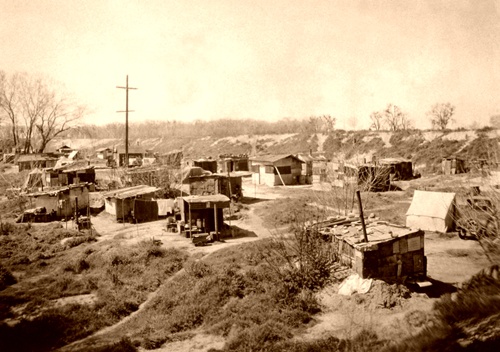
"Hoovervilles”
Communities where homeless people lived. They built shacks out of scrap wood and metal
Hoover finally acted after increased pressure from the public. He cut taxes, increase jobs through public projects, helped out farmers, and tried to help banks secure loans.
-He was easily defeated in the next elections by Franklin Delano Roosevelt(FDR)
21
Multiple Choice
Who was the president during the beginning of the Great Depression?
Woodrow Wilson
Franklin Roosevelt
Herbert Hoover
Jimmy Carter
22
Multiple Choice
23
Multiple Choice
24
FDR
-Elected in 1932 - served until 1945… (he was elected 4 times!)
-He promised a “New Deal” for the American People
-Hoover believed the Government shouldn’t interfere with the economy, but FDR felt the opposite
-FDR took an active role to try and help the economy
25
New Deal
Roosevelt’s New Deal
His plan to help the nation recovered involved pumping money into the economy. Through the New Deal, we see new programs and acts that increase jobs, increase money circulation, and put regulations on the economy.
Banks
President Roosevelt closed the banks calling it a “bank holiday”
-Allowed for banks to reopen under the supervision of the Federal Treasury
-Helped stabilize the banks and to bring back confidence in the banking system
26
Multiple Choice
27
Multiple Choice
28
Multiple Choice
29
New Deal Programs (read next slide!!!)
30
New Deal Programs
-Works Progress Administration(WPA) - The WPA hired artists to paint murals and create sculptures to decorate buildings across the country.
-Public Work Administration(PWA) - This program built roads, bridges, schools, hospitals, and dams across the country
-The Civilian Conservative Corps (CCC) - created jobs for many men like environmental projects (national/state parks)
-23rd Amendment - Repealed 21st Amendment
-Agricultural Adjustment Administration (AAA) - first one paid farmers to plant less, but was deemed unconstitutional - second one bought farmers surplus and stored them until prices went up
-Federal Deposit Insurance Corporation(FDIC) -Insurance on bank deposits - this way if the bank fails people won’t lose their money
-Tennessee Valley Authority(TVA) - Goal was to get power and electricity to rural areas. The government built 21 dams to control floods produce electricity
-Security & Exchange Commission - Created to watch over Stock Market to prevent fraud and another collapse (no more buying on margin)
-Social Security Act - Most important - Provided a pension to retired people, cared for orphans and the disabled and set up a system of unemployment insurance
31
Multiple Choice

Social Security• Federal Work Programs• Farm Assistance• Increased rights for labor• Environmental Improvement Programs
What is the best title for the list?
League of Nations
New Deal
Reconstruction
Segregation
32
Multiple Choice

The purpose of the New Deal program was to...
improve working conditions in factories
stop the sale of alcohol in states
end discrimination against African Americans
help the nation recover from the Depression
33
Dust Bowl
Midwestern farms and homes were destroyed when a drought in the 1930s dried up crops and topsoil. Heavy winds blew the topsoil away, burying homes and destroying crops. Over 1 million farmers were driven from their farms. Many moved to California.
34
Multiple Choice
35
The New Deal did not end the Great Depression
The Great Depression doesn't end until WWII. The New Deal increased the Government's role in the economy and of the lives of American Citizens.
FDR
After FDR was elected to his fourth term he suddenly died. With his death and the end of his presidency came an amendment to the constitution that limited the presidents to only serve 2 terms.
36
Multiple Choice

What chapter would most likely be found in this book?
37
Multiple Choice
38
Multiple Choice
Which of the following was "NOT" a cause of the Great Depression?
Over speculation on stocks using borrowed money
bad monetary policies
Unpaid debts from fighting World War I
Too much debt from buying goods on installment plans
5.3 The Great Depression
The roaring 20s ended with a flash with a severe economic decline
Show answer
Auto Play
Slide 1 / 38
SLIDE
Similar Resources on Wayground

36 questions
Research Questions
Presentation
•
9th - 10th Grade
33 questions
Cell Cycle
Presentation
•
9th Grade
33 questions
Mean, Median and Mode
Presentation
•
9th Grade
32 questions
Mao Zedong
Presentation
•
9th Grade
33 questions
Plant Systems
Presentation
•
9th Grade
31 questions
Drainage
Presentation
•
9th Grade
35 questions
Introducción al Presente Indicativo
Presentation
•
9th Grade
37 questions
Neolithic Revolution
Presentation
•
9th Grade
Popular Resources on Wayground
21 questions
Continents and Oceans

Quiz
•
6th Grade
20 questions
Parts of Speech
Quiz
•
5th Grade
16 questions
Subject & Predicate
Quiz
•
5th Grade
25 questions
Multiplication Facts
Quiz
•
5th Grade
12 questions
Map Skills
Quiz
•
3rd Grade
22 questions
Continents and Oceans
Quiz
•
5th Grade
15 questions
Rounding Decimals
Quiz
•
5th Grade
20 questions
Brand Labels
Quiz
•
5th - 12th Grade
Discover more resources for Social Studies
10 questions
Exploring the Age of Exploration: Key Events and Figures

Interactive video
•
6th - 10th Grade
10 questions
Exploring Ancient Mesopotamia Through Song
Interactive video
•
6th - 10th Grade
18 questions
Understanding Population Pyramids Quiz
Quiz
•
9th Grade
25 questions
World Geo Unit 3 Review
Quiz
•
9th Grade
33 questions
Unit 3 Western Classical Civilizations Review
Quiz
•
9th Grade
23 questions
Unit 2 Review
Quiz
•
9th Grade
19 questions
Spanish American War
Presentation
•
8th - 12th Grade
44 questions
Q1 Civics Review
Quiz
•
7th - 9th Grade