Limiting Factors and Carrying Capacity EOC Review
Presentation
•
Biology, Science
•
9th - 12th Grade
•
Practice Problem
•
Medium
+2
Standards-aligned
Elizabeth Wait
Used 185+ times
FREE Resource
8 Slides • 18 Questions
1
Limiting Factors and Carrying Capacity EOC Review
​
2
Pre-Assessment
3
Multiple Choice
In a large Maine forest with many animals and lots of space, there are only a small number of bears. Which of these most likely limits the population of bears in the forest?
Supply of food
Space
Cloud cover in the atmosphere
Types of trees in the area
4
Multiple Choice
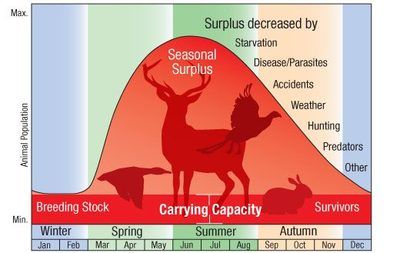
Look at the carrying capacity graphic.
Why does the month of June have the largest seasonal carrying capacity?
Longer summer days causes vegetation to wilt, leading to animal starvation
An increase in humidity allows predators extra moisture for hunting
Warm weather supplies ample food and shelter for life
The breeding stock is not interested in mating during hot, humid days.
5
Multiple Choice
An environmental factor such as storms and extreme heat or cold that decrease a population are considered to be -
density-dependent factor
population density
dispersion
density-independent factor
6
Multiple Choice
Which of the following would INCREASE the carrying capacity of an ecosystem?
Increase in predators
Disease
Increase in available food
Drought
7
Multiple Choice
European Mouflon sheep were introduced in Tasmania in year 1813. The graph shows the population of Mouflon sheep from the year 1814 to the year 1914. According to this graph, around which year did the population of European Mouflon sheep reach their carrying capacity?
1844
1854
1874
1894
8
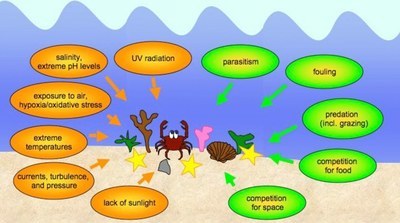
Limiting factors are any factor that reduces or the size of a population or keeps it from increasing
May be a resource, another species, the environment, etc.
Example: food is a limiting factor because you can't have more individuals than food to feed them
9
Multiple Choice
Components of an environment that can reduce a population size are called -
biotic factors
limiting factors
abiotic factors
half-life
10
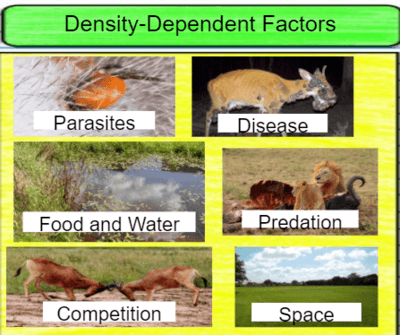
Limiting factors whose effect depends on the size of the population are called density-dependent
Includes natural resources (food, water, space), diseases, and predators
Tend to have a greater effect on large, dense populations because of increased competition and more opportunity to attract predators and disease
11
Multiple Choice
Competition for food is a limiting factor that can cause a decrease in the growth of a population. The growth of which type of population will most strongly be affected by this limiting factor?
Large and dense
Small and sparse
Large and sparse
Small and growing
12
Multiple Choice
In population ecology, one of the factors that is studied is a density-dependent factor. Density-dependent factors have the greatest effect on dense populations and little to no effect on very sparse populations. What would NOT be an example of a density-dependent factor?
Parasitism
Predation
Communicable disease
The average rainfall of a region
13
Limiting factors that DO NOT depend on population size are called density-independent
Include climate, weather, natural disasters, and pollution
Affect all populations the same, whether they are large or small
14
Multiple Choice
15
The maximum number of organisms an ecosystem can support is its carrying capacity
This number depends on what limiting factors are present
May increase or decrease if those limiting factors change
16
Multiple Choice
The maximum number of members of a species that an environment can support is called its -
niche
limiting factors
carrying capacity
abiotic factors
17
On a population graph, the carrying capacity is represented by a flat line
May also be a small "wave"
Follows a period of exponential growth; a J-shaped curve where the population keeps increasing
The line represents population size, so it decreases in response to a limiting factor
18
Multiple Choice
The graph shows the growth rate of a population in an ecosystem. At which two points on the graph does the population reach its carrying capacity?
Points D and E
Points B and D
Points B and E
Points A and C
19
Multiple Choice
In the graph to the right, what is the population of deer at the carrying capacity of the environment?
3
7
70
40
20
Multiple Choice
Which graph depicts exponential growth in a population?
21
Post-Assessment
22
Multiple Choice
The picture to the right represents a sunny, dry desert.
Which factor most likely limits the desert’s carrying
capacity for plant life?
The number of animals that eat plants
The amount of sunlight
The availability of space to grow
The availability of water
23
Multiple Choice
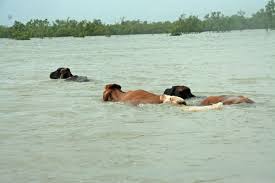
Excessive amounts of rain caused a flood in the southwest United States that resulted in substantial amounts of deaths in the rabbit population? This situation is an example of a _____________ limiting factor.
density-independent
density-dependent
too high
too low
24
Multiple Choice
Which example describes or illustrates how a density-dependent limiting factor can affect a forest ecosystem?
A forest fire forces many animals to move to new habitats
A heat wave causes the death of many animals in the forest
An earthquake causes the death of many animals in the forest
A disease causes death of many animals in the forest
25
Multiple Choice
The carrying capacity of the water flea Daphnia in a laboratory culture medium is 134/mL. A researcher adds a fixed amount of nutrients to the medium every day to maintain their concentration. The researcher decides to increase the amount of nutrients that are added daily to the culture. How will this increase impact the carrying capacity of Daphnia in the medium?
The carrying capacity will remain unchanged
The carrying capacity will decrease
The carrying capacity will decrease and then increase
The carrying capacity will increase
26
Multiple Choice
On which day did the population represented in the graph reach the carrying capacity of the ecosystem?
Day 11
Day 8
Day 3
Day 5
Limiting Factors and Carrying Capacity EOC Review
​
Show answer
Auto Play
Slide 1 / 26
SLIDE

Similar Resources on Wayground
21 questions
Cells
Presentation
•
9th - 12th Grade
22 questions
Fossils
Presentation
•
9th - 11th Grade
20 questions
Ionic Vs Covalent Lesson
Presentation
•
9th - 12th Grade
20 questions
Anatomical Directional Terms
Presentation
•
9th - 12th Grade
22 questions
Trophic Levels, Food Chains, and Food Webs Review
Presentation
•
9th - 12th Grade
23 questions
3.3 Fluids
Presentation
•
9th - 12th Grade
23 questions
Forensics: Observation pt 2
Presentation
•
9th - 12th Grade
17 questions
DNA and RNA
Presentation
•
9th - 12th Grade
Popular Resources on Wayground
20 questions
STAAR Review Quiz #3
Quiz
•
8th Grade
20 questions
Equivalent Fractions
Quiz
•
3rd Grade
6 questions
Marshmallow Farm Quiz
Quiz
•
2nd - 5th Grade
20 questions
Main Idea and Details
Quiz
•
5th Grade
20 questions
Context Clues
Quiz
•
6th Grade
20 questions
Inferences
Quiz
•
4th Grade
19 questions
Classifying Quadrilaterals
Quiz
•
3rd Grade
12 questions
What makes Nebraska's government unique?
Quiz
•
4th - 5th Grade
Discover more resources for Biology
14 questions
Ecological Succession: Primary and Secondary
Quiz
•
9th Grade
20 questions
Structure & DNA Replication Quiz
Quiz
•
9th Grade
50 questions
Biology EOC Review
Quiz
•
9th Grade
33 questions
Module C - Virus vs Cells, Biomolecules & Enzymes
Quiz
•
9th Grade
25 questions
photosynthesis and cellular respiration
Quiz
•
9th Grade
25 questions
STAAR Evolution Vocabulary
Quiz
•
9th Grade
20 questions
Food Chains and Food Webs
Quiz
•
7th - 12th Grade
20 questions
Genetics 2026
Quiz
•
10th Grade