

Endothermic vs exothermic

Presentation
•
Chemistry
•
10th - 11th Grade
•
Practice Problem
•
Easy
Standards-aligned

Kristen Vanderveen
Used 33+ times
FREE Resource
10 Slides • 9 Questions
1
Bromfield Honors Chemistry

2
Multiple Choice
Energy that transfers from one substance to another until the temperatures are equal is called...
free energy
temperature
entropy
heat
3
Multiple Choice
Which of the following describes the heat transfer when you hold an ice cube in your hand?
from the cold ice cube to your warm hand
the cold ice cube makes your hand cold
from your warm hand to the cold ice cube
no heat transfer occurs
4

5

6
Multiple Choice
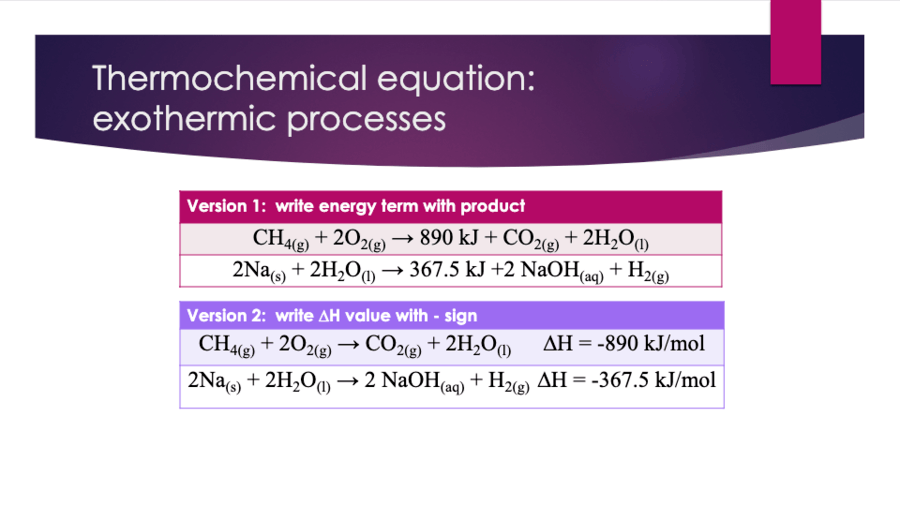
A(n) _____ is a balanced chemical equation that includes the physical states of all reactants and products and the energy change that accompanies the reaction
thermochemical equation
enthalpy of combustion
formation reaction
molar enthalpy of vaporization
7

8

9

10

11
12
Multiple Choice
A hot marble is dropped into a container of cool water. Which of the following statements most accurately describes the molecular motion of molecules?
Both the marble molecules and the water molecules will slow down until they eventually come to rest.
The marble molecules will slow down while the water molecules speed up until they reach reach the same average kinetic energy.
The marble molecules will speed up while the water molecules will slow down until they reach nearly identical speeds.
Both the marble molecules and the water molecules will speed up until they reach nearly identical speeds.
13

14
Multiple Choice
If the enthalpy (ΔH) is negative the reaction is ____.
endothermic
exothermic
15
Multiple Choice
If ΔH is positive, heat would be shown on the _____ side of the thermochemical equation.
reactant
product
16
Multiple Choice
A positive ΔH means that:
In order for the reaction to happen, heat must be added to the system.
The process is exothermic
In order for the reaction to happen, heat must be added to the system.
The process is endothermic.
When the reaction happens, heat is released to the surroundings. The process is exothermic
When the reaction happens, heat is released to the surroundings. The process is endothermic
17
Multiple Choice
A negative ΔH means the reaction is:
complete
at equilibrium
exothermic
endothermic
18
ex.
+ΔH: A + B + heat ⟶ C
-ΔH: C ⟶ A + B + heat
19
Multiple Choice

Is the following process exothermic or endothermic?
2 Al + 3CuCl2 ⟶ 2AlCl3 + 3 Cu + heat
endothermic
exothermic
Bromfield Honors Chemistry
Show answer
Auto Play
Slide 1 / 19
SLIDE
Similar Resources on Wayground

14 questions
Giant Molecular Structure
Presentation
•
10th - 12th Grade
17 questions
Tour of the Periodic Table
Presentation
•
10th - 12th Grade
17 questions
Determining Significant Figures
Presentation
•
10th Grade
13 questions
Ionic Versus Covalent
Presentation
•
9th - 12th Grade
16 questions
Exothermic vs Endothermic
Presentation
•
10th - 12th Grade
12 questions
The Mole & Gram to mole conversions
Presentation
•
9th - 12th Grade
16 questions
Empirical and Molecular Formulas
Presentation
•
9th - 12th Grade
14 questions
Rules for Redox
Presentation
•
10th - 11th Grade
Popular Resources on Wayground
10 questions
How much do you know about our Portrait of an Eagle?

Quiz
•
10th Grade
10 questions
Fast Food Slogans
Quiz
•
6th - 8th Grade
21 questions
Continents and Oceans
Quiz
•
6th Grade
20 questions
Parts of Speech
Quiz
•
5th Grade
16 questions
Subject & Predicate
Quiz
•
5th Grade
25 questions
Multiplication Facts
Quiz
•
5th Grade
12 questions
Map Skills
Quiz
•
3rd Grade
22 questions
Continents and Oceans
Quiz
•
5th Grade
Discover more resources for Chemistry
20 questions
Metric Conversions
Quiz
•
11th Grade
20 questions
electron configurations and orbital notation
Quiz
•
9th - 12th Grade
26 questions
Atomic Structure, Isotopes and Ions
Quiz
•
10th Grade
20 questions
Periodic Trends
Quiz
•
10th Grade
5 questions
Atomic Theory Intro Video

Interactive video
•
10th Grade
20 questions
COUNTING ATOMS
Quiz
•
10th Grade
20 questions
Practice: E-Con, Orbital Notation, Noble Gas Notation
Quiz
•
10th Grade
20 questions
Ions
Quiz
•
10th Grade