

The Columbian Exchange Lesson

Presentation
•
Social Studies
•
6th Grade
•
Practice Problem
•
Easy

Crystal Mouton
Used 281+ times
FREE Resource
4 Slides • 10 Questions
1
The Columbian Exchange Lesson
2
DO NOW
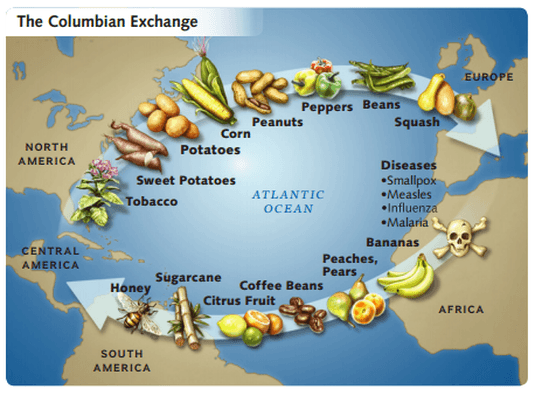
Use the map and passage below to answer the following questions.

3
Multiple Select

Use the map above and identify the continents included in the “Old World.”
4
Multiple Select

Use the map above and identify the continents included in the “New World.”
5
Columbian Exchange
By the end of this lesson you will be able to analyze the Colombian Exchange as an example of cultural diffusion, colonization, and immigration.

6

https://web.microsoftstream.com/video/835d906e-776d-454d-87f2-57192bf96362
7
Open Ended

After watching the video identify at least three items that were exchanged during the Columbian Exchange.
Three items that were exchanged during the Columbian Exchange was...
8
Open Ended
9
Multiple Choice
10
Open Ended

This introduction of new plants and animals to Europe and America is called the Columbian Exchange. It's called Columbian because it started with Columbus, and exchange because people traded, or exchanged, things with each other. The Columbian Exchange changed life on both sides of the Atlantic Ocean.
The Columbian Exchange included many plants and animals. Corn, cocoa, peanuts, potatoes and tomatoes went from the Americas to Europe, and later to Africa and Asia. Chickens, wheat, and cows went from Europe to the Americas.
Throughout the world, the variety of food that people could grow and eat increased greatly. Europeans brought horses and this changed life in the Americas. Not only did it allow people to travel distances more quickly, but it also changed the ways they hunted and
fought. For example, horses made hunting easier for the Indians of the North
American plains.
Identify some items that diffused (spread) from the Americas to Europe:
Some items that were diffused from Americas to Europe are…
11
Open Ended

This introduction of new plants and animals to Europe and America is called the Columbian Exchange. It's called Columbian because it started with Columbus, and exchange because people traded, or exchanged, things with each other. The Columbian Exchange changed life on both sides of the Atlantic Ocean.
The Columbian Exchange included many plants and animals. Corn, cocoa, peanuts, potatoes and tomatoes went from the Americas to Europe, and later to Africa and Asia. Chickens, wheat, and cows went from Europe to the Americas.
Throughout the world, the variety of food that people could grow and eat increased greatly. Europeans brought horses and this changed life in the Americas. Not only did it allow people to travel distances more quickly, but it also changed the ways they hunted and
fought. For example, horses made hunting easier for the Indians of the North
American plains.
Identify some items that diffused (spread) from Europe to the Americas:
Some items that were diffused from Europe to Americas are…
12
Open Ended

Not every part of the Columbian Exchange was positive. European people also brought diseases, like smallpox, to the Americas. Because they were separated from the rest of the world, Native Americans had no prior contact with smallpox and other deadly diseases. This made the diseases more dangerous than they were for the Europeans. Native Americans who caught these diseases died from them because they had no immunity—their bodies did not know how to fight off the germs. As many as 80 percent of the Native American population died from European diseases between 1492 and 1650. These diseases included measles, smallpox, and influenza.
Describe what happened to the population of Native American after the Columbian Exchange.
Sentence Stem: During the Columbian Exchange the population of Native Americas...
13
Open Ended

Many explorers to the Americas also wanted to find gold and silver. They used any means available to bring them riches back in Europe. The Europeans needed workers, or human resources, in the Americas. Native Americans were enslaved in order to complete that work through the Spanish system of “encomienda”. Enslaved Native Americans were forced to learn the Spanish language and the Catholic religion. Due to disease and war with the Europeans, the Native American population was too small to do all the work that the Europeans wanted. To solve the problem, Europeans kidnapped and enslaved between 8 and 10.5 million Africans to work for them in the Americas. After the Americas were colonized by Spain and Portugal, many Europeans started to immigrate to the new colonies. This increased the population of Europeans living in the Americas.
Identify who performed the labor (work) in the Americas.
Sentence Stem: ... performed labor (work) in the Americas.
14
Open Ended

Many explorers to the Americas also wanted to find gold and silver. They used any means available to bring them riches back in Europe. The Europeans needed workers, or human resources, in the Americas. Native Americans were enslaved in order to complete that work through the Spanish system of “encomienda”. Enslaved Native Americans were forced to learn the Spanish language and the Catholic religion. Due to disease and war with the Europeans, the Native American population was too small to do all the work that the Europeans wanted. To solve the problem, Europeans kidnapped and enslaved between 8 and 10.5 million Africans to work for them in the Americas. After the Americas were colonized by Spain and Portugal, many Europeans started to immigrate to the new colonies. This increased the population of Europeans living in the Americas.
According to the paragraph, identify the specific cultural traits that were diffused to the Native Americans.
Sentence Stem: The specific cultural traits that were diffused to the Native Americans were...
The Columbian Exchange Lesson
Show answer
Auto Play
Slide 1 / 14
SLIDE


