

The Periodic Table

Presentation
•
Chemistry
•
11th - 12th Grade
•
Medium

Hector Mendoza-Arias
Used 4+ times
FREE Resource
25 Slides • 18 Questions
1
The Periodic Table
Mr. Mendoza

2

3
Dmitri Mendeleev (1869)
Mendeleev(Russinan Chemist) and Lothar Meyer (Germany) published nearly identical classification schemes for elements known to date. (The Periodic Table)

4

Dont forget about me!!
5
The Periodic Table
Based on the similarity of properties and reactivities exhibited by certain elements.

6
Multiple Choice
7
Henri Moseley (England,1887-1915)
established that each elements has a unique atomic number, which is how the current periodic table is organized.

8
Multiple Choice
9
NOW!
A map of the building block of matter.

10
Down the Periodic Table
Group/Family: Are arranged vertically down the periodic table (columns or group, 1- 18 or 1-8 A,B)
These elements have the same number of electrons in the outer most shells, the valence shell.

11
Across the Periodic Table
Periods: Are arranged horizontally across the periodic table (rows 1-7)
These elements have the same number of shells or energy levels.

12
Multiple Choice
13
Multiple Choice
14
Multiple Choice
15
Open Ended
16
Periodic Table: The three broad Classes
Main, Transition, Rare Earth
Main (Representative), Transition metals, lanthanides and actinides (rare earth)

17
Notable families of the Periodic Table and some important members:
Alkali Metals (Group 1)
Alkaline Earth Metals(Group 2)
Halogens (Group 7)
Noble Gasses(Group 8)

18
Multiple Choice
19
Multiple Choice

Which elements have 1 valence electron?
20
Multiple Choice
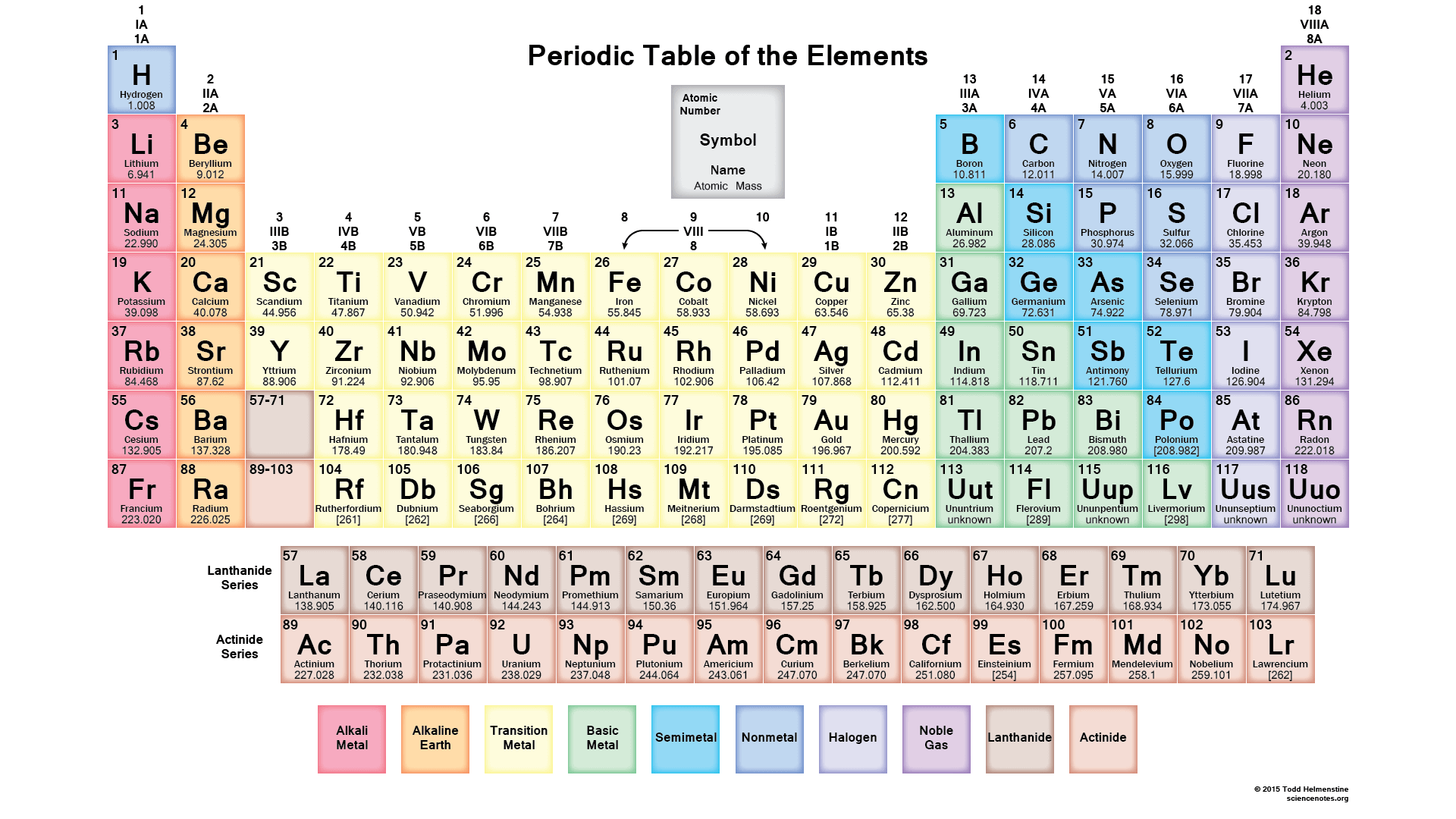
21
Metals
Metals are good conductors of heat and electricity, malleable and ductile (they can be drawn into wire).
Most of the metals are solids at room temperature, with a characteristic silvery shine (except for mercury, which is a liquid).
80%

22
Non Metals
Poor conductors of heat and electricity, and are not malleable or ductile; many of the elemental nonmetals are gases at room temperature
Exist in all three states of matter.
The solids are not lustrous.

23
Metalloids
intermediate in their properties
In their physical properties, they are more like the nonmetals, but under certain circumstances, several of them can be made to conduct electricity.

24
Metalloids
A jagged black line along the right side of the table separates the metals from the nonmetals
metals are to the left of the line (except for hydrogen, which is a nonmetal), the nonmetals are to the right of the line, and the elements immediately adjacent to the line are the metalloids.

25

26
Multiple Choice
27
Multiple Choice
28
Multiple Choice
29

30

31
Alkali Metals
All of these elements have a similar configuration of outer-shell electron
Very reactive metals( water), always combined with something else in nature (like in salt).

32
Multiple Choice
33
Multiple Choice
34
Alkaline Earth Metals
“Alkaline”: compounds of these elements form basic (pH greater than 7) or alkaline solutions when dissolved in water.
less reactive than the alkali metals
have two electrons in that outer shell.

35
Transition Metals
Elements in groups 3-11
Less reactive harder metals
Includes metals used in jewelry and construction.
Metals used“as metal.”

36
Halogens
7 Outer-shell electrons, very reactive, non-metals, poor conductors, never uncombined in nature, tend to form salts.

37
Multiple Choice
38
Multiple Choice
39
Multiple Choice
40
The Noble Gases
Elements whose atoms have full outer shells so they are very unreactive, colorless, odorless gases

41
Multiple Choice

42

43

https://www.pbs.org/video/nova-hunting-the-elements-promo/
The Periodic Table
Mr. Mendoza
Show answer
Auto Play
Slide 1 / 43
SLIDE

