Search Header Logo
Grade 10: Mirrors and Lenses

Grade 10: Mirrors and Lenses

Assessment

Presentation

Science

10th Grade

Practice Problem

Hard

NGSS
MS-PS4-2

Standards-aligned

Created by

Jeanette Delos Santos

Used 65+ times

FREE Resource

62 Slides • 5 Questions

1

Grade 10: Mirrors and Lenses

Slide image

2


How do you see yourself in a mirror? How do you compare the way you look and the way your image look? Can you explain how your image is formed on the mirror? This new lesson will lead you to the answer to these questions. 

Slide image

3

OPTICS

is a branch of Physics which deals with the study of light, mirrors, and lenses 

Slide image

4

Learning Competencies

  • Predict the qualitative characteristics (orientation, type, and magnification) of images formed by plane and curved mirrors and lenses

  •  Identify ways in which the properties of mirrors and lenses determine their use in optical instruments (e.g., cameras and binoculars)

5

Slide image

6

Multiple Choice

1. A clock hang on the wall is facing a plane mirror hanged on the opposite wall. As you see the reflection of the clock on the mirror, the clock shows the time of 9:00. What is the real time?

1

A. 2:00

2

A. 3:00

3

A. 4:00

4

A. 5:00

7

Multiple Choice

2. If a man stands 4 feet in front of a plane mirror, how far away is the man’s image from the mirror?

1

A. Nearer than the man from the mirror

2

B. Twice as far as the man from the mirror

3

C. Three times as far as the man from the mirror

4

D. The same distance as the man from the mirror

8

Multiple Choice

Question image

3. How do you describe the kind of the image shown on the given illustration?

1

A. Real image

2

B. Virtual image

3

C. Both a and b

9

Multiple Choice

Question image

4. On the given illustration, which is the incident ray?

1

A. A

2

B.B

3

C.C

4

D.D

10

Multiple Choice

5. In a plane mirror, how does the reflected image appear?

1

A. Slightly out of focus

2

B. Closer than the actual object

3

C. Upright and the same size as the object

4

D. Upside down and much smaller than the object

11

What do you think will happen if light hits a mirror?

  • When light hits a mirror, it reflects or bounces off the mirror’s surface.

Slide image

12

Simple Activity

Mirror...mirror on the wall!

Slide image

13

REFLECTION

  • Reflection is the turning back/bouncing of light rays when it hits a shiny surface like a mirror

Slide image

14

3 Imaginary Rays

  • Reflected Ray- is the ray from the reflecting surface

  • Normal Line (N)- is the line which is perpendicular to the mirror

  •  Incident Ray- is the ray of light approaching the mirror

Slide image

15

 Laws of Reflection

  • When a ray of light reflects off a surface, the angle of incidence is equal to the angle of reflection

  • The angle between the normal line and the reflected ray is the angle of reflection

Slide image

16


  • angle of incidence (θi)- is the angle between the incident ray and the normal line

  • angle of reflection (θr)- is the angle between the reflected ray and the normal line 

Slide image

17

2 types of Reflection

  • Specular/ Regular Reflection

  • Diffused/ Irregular Reflection

Slide image

18

Specular/ Regular Reflection

  • is a reflection of light on smooth surfaces such as mirrors or a calm body of water

Slide image

19

How does specular/regular reflection occur?

  • It occurs when the reflected rays are pointing in one direction

Slide image

20

Diffuse/Irregular Reflection

  • is the reflection of light on rough surfaces such as on a wavy body of water, clothing, paper, and the asphalt roadway.

Slide image

21

How does diffuse/irregular reflection occur?

  • occurs when the reflected rays are pointing in different directions

Slide image

22

Check Your Understanding about Specular and Diffuse Reflection

  • If a bundle of parallel incident rays undergoing diffuse reflection follow the law of reflection, then why do they scatter in many different directions after reflecting off a surface?

  • Answer: Each individual ray strikes a surface which has a different orientation. Since the normal is different for each ray of light, the direction of the reflected ray will also be different.

23

Check Your Understanding about Specular and Diffuse Reflection

  • Perhaps you have observed magazines which have glossy pages. The usual microscopically rough surface of paper has been filled in with a glossy substance to give the pages of the magazine a smooth surface. Do you suppose that it would be easier to read from rough pages or glossy pages? Explain your answer.

24


  • Answer: It is much easier to read from rough pages which provide for diffuse reflection. Glossy pages result in specular reflection and cause a glare. The reader typically sees an image of the light bulb which illuminates the page. If you think about, most magazines which use glossy pages are usually the type which people spend more time viewing pictures than they do reading articles.

25

MIRRORS

26

What do you see when you look at a mirror and a spoon?

  • You can see your image. Why?

  • These objects are image reflecting objects. A mirror is a smooth reflecting surface, usually made of polished metal or glass that has been coated with metallic substances.

  • There are two types of mirrors: a plane mirror and a curved mirror.

27

2 Kinds of Mirror

  • Plane Mirror

  • Curved/ Spherical Mirrors (Concave and Convex)

28

Plane Mirror

  • is flat, smooth surface that reflects light in a regular way

Slide image

29

Plane Mirror

  • also applies the Left-right Reversal

Slide image

30

Multiple Images

  • are formed by the reflection that happens when arranging at least 2 mirrors

Slide image

31

Identify the ff:

  • kind of image

  • position

  • size

  • location

32


  • Kind of Image: either virtual or real

  • Position: either upright or inverted

  • Size: smaller, bigger, the same size as the object

  • Location: Regardless of where the observer is located, when the observer sights at the image location, the observer is sighting along a line towards the same location that all other observers are sighting.

33

Plane mirror

  • What image is formed?

  • Virtual image. Why? 

  • Because when we look into a plane mirror, it seems that our image is formed and is present somewhere behind the mirror

Slide image

34

Slide image

Basically, no light reaches the behind the mirror, thus it is always said that rays appear to meet somewhere, as it is simply the perception of the viewer.

35

Slide image

As we can see here that light rays actually get focused at a certain position. And at that particular position, a visible image of that object is formed. It is to be noted here that after converging at a point, the rays get diverged from that particular point.

36

Slide image


37

Slide image

is/are a reflecting surface in which its surface is a section of sphere 

38

A. Concave Mirror

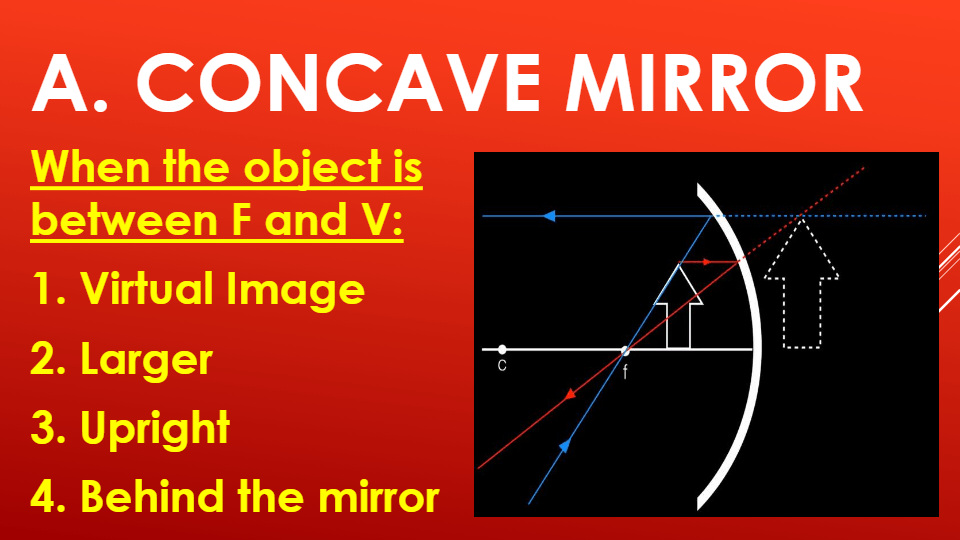
  • A concave mirror produces both real and virtual images, which can be upright or inverted. The size of the image can be bigger or smaller than the object. The nature, size, and position of the image depend on the position of the object.

Slide image

39

Slide image

40

Slide image

41

Slide image

42

Slide image

43

Slide image

44

Slide image

45

Slide image

46

Slide image

47

Slide image

48

Slide image

49

Slide image

50

Slide image

51

Slide image

52

Slide image

53

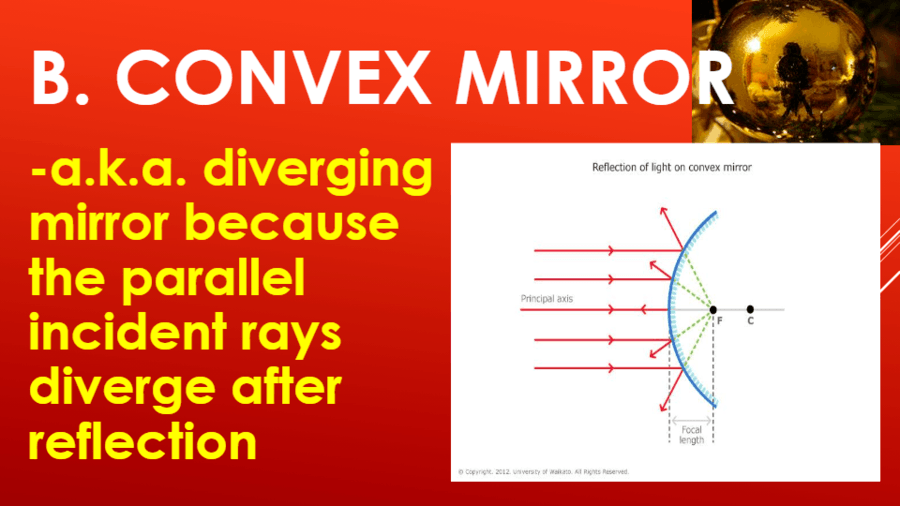
B. Convex Mirror

is a curved mirror in which the reflective surface bulges outward or toward the light source

Slide image

54

Slide image

55

Slide image

56

Slide image

57

Slide image

58

Slide image

59

Slide image

60

Slide image

61

Slide image

62

Slide image

63

Slide image

Why AMBULANCE is written as ECNALUBMA on emergency vehicles?

64

  • Most drivers will view the ambulance in their rear-view mirrors. As such, they will be viewing an image of the lettering. Such images appear with left-right reversal and so will be viewed with the proper orientation - AMBULANCE.

Slide image

65

 Do the following Learning Tasks

  •   a. Learning Task no. 1 Image in a Plane Mirror p. 23

  •   b. Learning Task no. 3 Image in spherical mirrors p. 24

  •  c. Learning Task no. 2 Image at Different Positions of the Object from the Lens pp. 28-29

Slide image

66

Dothe following:

  • Learning Task no. 4 (Performance Task no. 3) found in your weekly home learning plan dated Feb. 18 (soft copy is attached in your Google Classroom)

  • Answer the 10-item quiz through Google forms in your Google Classroom

67

References

  • https://www.youtube.com/watch?v=_HAfRsX6v0Q&t=432s

  • https://www.physicsclassroom.com/Physics-Interactives/Reflection-and-Mirrors

  • https://byjus.com/physics/difference-between-real-image-and-virtual-image/

  • https://autojosh.com/why-is-the-word-ambulance-spelt-backwards-on-emergency-vehicles/

  • https://www.youtube.com/watch?app=desktop&v=Poq3u7BFhqk

Grade 10: Mirrors and Lenses

Slide image

Show answer

Auto Play

Slide 1 / 67

SLIDE