Search Header Logo
Nervous System Review

Nervous System Review

Assessment

Presentation

Biology

9th Grade

Medium

NGSS
HS-LS1-3, HS-PS2-5

Standards-aligned

Created by

Stacy King

Used 21+ times

FREE Resource

12 Slides • 28 Questions

1

Nervous System Review

Slide image

2

Multiple Choice

Question image
What is the function of the nervous system.
1
provide nutrients for the body.
2
send and recieve messages
3
circulate oxygen to sells
4
remove carbon dioxide from blood

3

Multiple Choice

Question image
Two major branches of the nervous system
1
central and peripheral
2
peripheral and motor
3
motor and sensory
4
central and motor

4

Multiple Select

Which of the following are part of the central nervous system?

1

brain

2

spinal cord

3

nerves

4

skin

5

Nervous System Organization

  • CNS-central nervous system

  • brain and spinal cord

  • PNS-peripheral nervous system

  • nerves

Slide image

6

Multiple Choice

Your body temperature rises as you walk around outside in Bangladesh on a hot afternoon. The sensors in your skin detect the rise in your surface temperature so you start to sweat.

1

Positive Feedback

2

Negative Feedback

7

Multiple Choice

A feedback loop best fits which characteristic of life?

1

Cells

2

Organization

3

Homeostasis

4

Adaptation

8

Multiple Choice

What is the point of a feedback loop?

1

To provide the body with more energy

2

To provide the body with more food

3

To make sure the conditions in the body are always changing

4

To make sure the conditions in the body remain stable

9

Multiple Choice

A student is studying for an exam they are tired so they drink an energy drink to stay awake. They cannot sleep because of the caffeine, so they are tired the day of the exam so they drink another energy drink and cannot sleep again. This is an example of

1

positive feedback

2

negative feesback

3

neutral feedback

4

College

10

Feedback loops

  • positive- continues until stimulus is removed

  • negative- negates the stimulus to restore balance

Slide image

11

Multiple Choice

Question image
The lobe responsible for vision
1
Frontal Lobe
2
Temporal Lobe
3
Parietal Lobe
4
Occipital Lobe

12

Multiple Choice

Question image
The lobe responsible for making plans and evaluating consequences
1
Frontal Lobe
2
Temporal Lobe
3
Parietal Lobe
4
Occipital Lobe

13

Multiple Choice

Question image

Which lobe is in green?

1

Frontal

2

Occipital

3

Parietal

4

Temporal

14

Brain Regions

  • frontal-decision making, emotional control, impulse control

  • Parietal- language, perception

  • Motor Cortex- sensory control

  • Occipital- visual

  • Temporal- hearing

  • brain stem- life functions

  • cerebellum- mini brain

Slide image

15

Multiple Choice

Question image

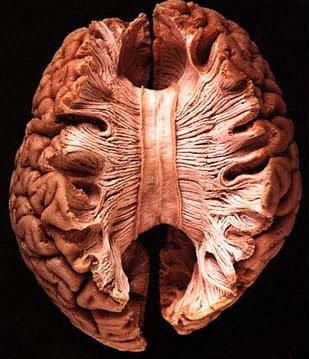
The split-brain procedure involves the cutting of this structure which separates the left and right hemispheres of the brain

1

Cerebral Cortex

2

Cerebellum

3

Corpus Callosum

4

Caudate Nucleus

16

Corpus Callosum

Connects and transmit signals between right and left hemisphere

Slide image

17

Multiple Choice

Which of the following is TRUE of reflexes?
1
They do not involve thought
2
They can be simple or complex
3
They help maintain homeostasis
4
All options are true

18

reflexes

automated response that does not reach the brain

Slide image

19

Multiple Choice

The part of the neuron that receives messages from adjacent neurons

1

axon

2

axon terminal

3

dendrite

4

neuron

20

Multiple Choice

The long, fiber like part of a neuron which the cell sends information to receiving neurons
1
axon 
2
dendrite
3
axon terminal
4
gene

21

Multiple Choice

The part of the neuron that integrates or sums up all the incoming impulses from the dendritic spines and can initiate the opening of the Na+ (firing the neuron)

1

nucleus

2

axon terminal

3

axon hillocks

4

neurotransmitter

22

Neuron

  • Dendrite- receives chemical messages from other nerve cells

  • Axon Hillocks- threshold of signal transduction (neuron firing)

  • Axon- carries the electrical signal

  • Axon terminal- where the electrical impulse results in the release of a neurotransmitter

Slide image

23

Multiple Choice

Gaps between Schwann cells that increase the speed of the transmission of the signal down the neuron are called

1

axon terminals

2

dendrites

3

myelin

4

nodes of Ranvier

24

Multiple Choice

This insulating material forms a layer, around the axon of a neuron.  It enables electrical signals to travel down the axon at higher speeds.
1
neuron
2
myelin sheath
3
dendrite
4
neurotransmitter

25

Schwann Cells

special cells that produce a myelin sheath that increases the speed of the electric impulse down the axon

Slide image

26

Multiple Choice

Question image

What is this integral protein referred as?

1

Na+ channel

2

K+ channel

3

sodium potassium pump

4

salty

27

Multiple Choice

What voltage gated integral protein only transports Na+ along the concentration gradient?

1

Sodium channel

2

Sodium Potassium pump

3

sodium pump

28

Multiple Choice

What voltage gated integral protein only transports K+ along the concentration gradient?

1

Potassium channel

2

Sodium Potassium pump

3

Potassium pump

4

potassium membrane

29

Axon Membrane Integral Proteins and Signal Transduction

  • Sodium Potassium Pump (Na+ K+)- maintains resting membrane potential

  • Na+ channel- depolarization of the membrane and signal

  • K+ channel- reestablishes the resting potential by releasing potassium out of the cell

Slide image

30

Multiple Choice

When a neuron is depolarized, what are the first channels to open?
1
Sodium
2
Potassium
3
Calcium
4
ACTH

31

Multiple Choice

At what stages do Sodium/Potassium Channels open?
1
Repolarization/ Repolarization
2
Depolarization/ Hyperpolarization
3
Hyperpolarization/ Repolarization
4
Depolarization/ Repolarization

32

Multiple Choice

When a neuron is resting, the inside of the axon has a ____________ charge.
1
positive
2
negative

33

Multiple Choice

When a neuron is not engaged in an impulse.
1
Resting potential
2
Action potential
3
Neural potential
4
Synaptic potential

34

Signal Transduction

  • -70 mv resting membrane potential

  • Na+ channel opens positive ions enter the cell

  • the Na+ channel closes

  • K+ channel opens positive ions leave the cell (slight hyperpolarization)

  • return to resting membrane potential

Slide image

35

Multiple Select

Question image

check all that apply

1

signal propagation (traveling) along an axon

2

the consecutive opening and closing of ion channels along an axon

3

the reversal of a signal along the axon

4

the malfunctioning of the sodium potassium pump

36

Signal propagation (movement along the axon)

  • domino effect

  • the integral proteins open and close along the axon until it reaches the axon terminal

Slide image

37

Multiple Choice

Question image

at point a

1

resting membrane potential

2

sodium channels open

3

potassium channels open

4

sodium channels close

5

potassium channels close

38

Multiple Select

Question image

at point c

1

resting membrane potential

2

sodium channels open

3

potassium channels open

4

sodium channels close

5

potassium channels close

39

Multiple Choice

Question image

b is also called

1

resting membrane potential

2

depolarization of the membrane

3

hyperpolarization of the membrane

40

Graphical representation of action potential

Slide image

Nervous System Review

Slide image

Show answer

Auto Play

Slide 1 / 40

SLIDE