Limiting Reactants
Presentation
•
Chemistry
•
9th - 12th Grade
•
Medium
+2
Standards-aligned
Benjamin Flo
Used 20+ times
FREE Resource
9 Slides • 11 Questions
1
Limiting Reactants
Essential Questions:
1. What does the amount of reactant have to do with the amount of product in a chemical reaction?
2. How can the limiting reactant be determined given only mole or gram amounts of a chemical reaction?
2
Multiple Choice
What type of reaction involves 2 substances combining to form 1 new compound?
Decomposition Reaction
Single Replacement Reaction
Double Replacement Reaction
Synthesis Reaction
3
Multiple Choice
What type of reaction involves the breaking down of a substance into simpler substances?
Single Replacement Reaction
Double Replacement Reaction
Synthesis Reaction
Decomposition Reaction
4
Multiple Choice
*Question from Yesterday!*
What is the largest number of moles of Al2O3 that
could result from reacting 6 moles of O2?
4 Al (s) + 3 O2 (g) → 2 Al2O3 (s)
2 mol
6 mol
4 mol
1 mol
5
Open Ended
What's your good thing for today OR one thing you're grateful for?
Please don't type N/A and don't forget to type your name after your entry!
6
7
Multiple Choice
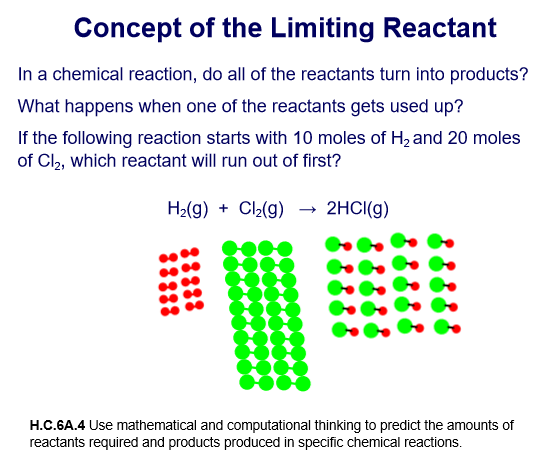
In the following reaction, which reactant will run out of first?
H2
Cl2
8
9
Open Ended
How would you describe what a limiting reactant is in your own words?
10
Open Ended
Based on what you understand about limiting reactants, when would a reaction stop?
11
12
13
14
15
16
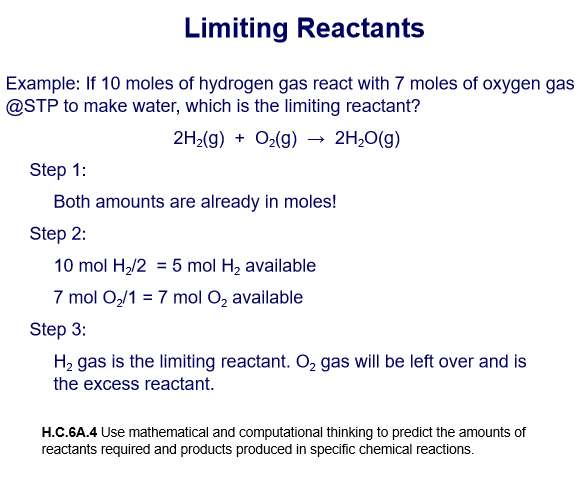
Fill in the Blank
In this example, ____ is the limiting reagent.
17
Multiple Choice
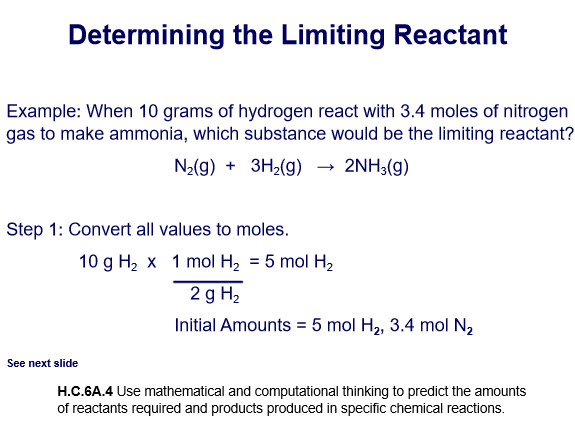
When 33 L of nitrogen gas react with 12 grams of
hydrogen gas to make ammonia @STP, the hydrogen
gas will be the excess reactant.
N2(g) + 3H2(g) → 2NH3(g)
True
False
18
Multiple Choice
4NH3+6NO --> 5N2 + 6H2O
19
Multiple Choice
20
Limiting Reactants
Essential Questions:
1. What does the amount of reactant have to do with the amount of product in a chemical reaction?
2. How can the limiting reactant be determined given only mole or gram amounts of a chemical reaction?

Show answer
Auto Play
Slide 1 / 20
SLIDE

Similar Resources on Wayground
17 questions
Solutions part 2: Dilutions, Solubility, and Saturation
Lesson
•
10th - 12th Grade
15 questions
Chemical Reactions in Action
Lesson
•
9th - 12th Grade
15 questions
Chemical Reactions
Lesson
•
9th - 12th Grade
16 questions
Unit 5 Concept 6 Notes - Reacting
Lesson
•
9th - 12th Grade
17 questions
Gas Laws - Dalton's Partial Pressure
Lesson
•
9th - 12th Grade
16 questions
The Transition Metals
Lesson
•
10th - 12th Grade
15 questions
05x06 - Quoziente di reazione
Lesson
•
9th - 12th Grade
15 questions
4.4 Physical and Chemical Changes
Lesson
•
9th - 12th Grade
Popular Resources on Wayground
10 questions
5.P.1.3 Distance/Time Graphs
Quiz
•
5th Grade
10 questions
Fire Drill
Quiz
•
2nd - 5th Grade
20 questions
Equivalent Fractions
Quiz
•
3rd Grade
15 questions
Hargrett House Quiz: Community & Service
Quiz
•
5th Grade
20 questions
Main Idea and Details
Quiz
•
5th Grade
20 questions
Context Clues
Quiz
•
6th Grade
20 questions
Inferences
Quiz
•
4th Grade
15 questions
Equivalent Fractions
Quiz
•
4th Grade
Discover more resources for Chemistry
20 questions
Acids and Bases
Quiz
•
10th Grade
30 questions
Element compound mixture review quiz
Quiz
•
10th - 12th Grade
10 questions
Determining Protons, Neutrons, and Electrons from the Periodic Table
Interactive video
•
6th - 10th Grade
10 questions
Identifying Types of Chemical Reactions
Interactive video
•
6th - 10th Grade
20 questions
U4 Reaction Types
Quiz
•
10th - 12th Grade
25 questions
Potential Energy Diagram Checkpoint
Quiz
•
11th Grade
46 questions
Quantum, E Config, Periodic Trends
Quiz
•
11th Grade
10 questions
Exploring Types of Chemical Reactions
Interactive video
•
6th - 10th Grade