
Search Header Logo
  1. Resource Library
  2. Science
  3. Biology
  4. Ecological Relationships
  5. Cluster 4 Day 2 Food Webs And Ecology
Cluster 4 Day 2-Food Webs and Ecology

Cluster 4 Day 2-Food Webs and Ecology

Assessment

Presentation

Science

8th Grade

Practice Problem

Medium

NGSS
MS-LS2-1, MS-LS2-2, MS-LS2-3

+2

Standards-aligned

Created by

Marchele Tucker

Used 90+ times

FREE Resource

14 Slides • 11 Questions

1

Cluster 4 Day 2-Food Webs and Ecology
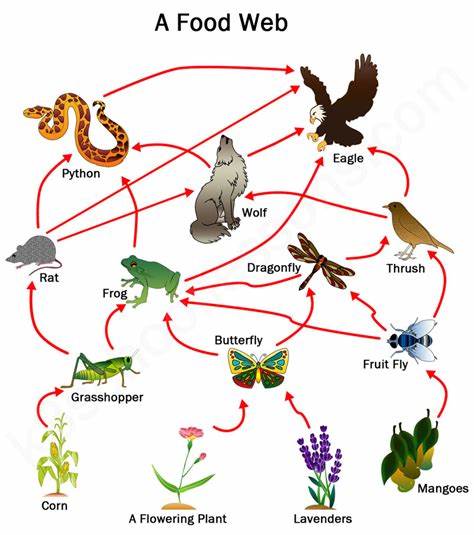
Slide image

2

Slide image

3

Multiple Choice

In a desert environment, cactus wrens often build their nests in cholla cacti to avoid predators. This behavior does not hurt the cacti. Which type of relationship do cactus wrens and cholla cacti demonstrate?

1

Competitive

2

Commensalism

3

Mutualism

4

Parasitism

4

Slide image

5

Slide image

6

Slide image

7

Slide image

8

Multiple Select

Which of the following are producers?

1

Autotrophs

2

Oak Tree

3

Heterotrophs

4

Bobcat

5

Arctic Fox

9

Slide image

10

Multiple Choice

Question image

Which of the following is a primary consumer in the food web pictured?

1

Snake

2

Grasshopper

3

Frog

4

Eagle

11

Slide image

12

Multiple Choice

Which is an example of a decomposer?
1
a hawk
2
a mouse
3
a flower
4
a mushroom

13

Multiple Choice

Which best describes how decomposers help support life in an ecosystem?
1
Decomposers add nutrients to the soil.
2
Decomposers provide a habitat in the ecosystem.
3
Decomposers add producers to the ecosystem.
4
Decomposers provide energy for consumers.

14

Multiple Choice

Question image

In this food web, if the hawk population increased, what would happen to the rabbit population?

1

Decrease

2

Increase

15

Multiple Choice

Question image

In this food web, which of the following might happen if the mouse population increased?

1

The rabbit population would increase

2

The rabbit population would decrease

3

The snake population would decrease

16

Slide image

17

Multiple Choice

Question image

One of the wolf populations begins to compete with a new bear population for the same herbivores. Over time, the herbivore population decreases. What is the limiting factor to the herbivore?

1

Predator-Prey Relationships

2

Herbivory Effect

3

Competition

4

Wolves and Bears

18

Multiple Choice

Question image

The wolf population gets reintroduced to the ecosystem. There is enough deer to go around, so they eat comfortably. The wolf population begins to grow out of control with so much food. The different wolf families then begin to compete for the few caves that exist. Not everyone has good shelter so some have to sleep in the forest floors. What is the limiting factor to the wolves?

1

Overcrowding

2

Competition

3

Weather

4

Lack of water

19

Multiple Choice

Sea turtles use beaches in Florida to lay their eggs. These beaches are now inhabited by humans and there are less places for the turtles to lay their eggs. This has resulted in a major reduction in the amount of turtles in the environment. Which of the following is a limiting factor in this ecosystem?

1

Predator-Prey Relationships

2

Competition

3

Destruction of nesting sites

4

Predation

20

Slide image

21

Multiple Choice

Question image

Use the food web below to answer the question. Which of the following would result if the population of grasshoppers increased?

1

The amount of grass and grains would increase

2

The population of birds would decrease

3

The amount of grasses and grains would decrease

4

The population of owls would decrease

22

Slide image

23

Slide image

24

Slide image

25

Slide image

Cluster 4 Day 2-Food Webs and Ecology

Slide image

Show answer

Auto Play

Slide 1 / 25

SLIDE
