

Entropy of Phases and Physical Changes

Presentation
•
Chemistry
•
9th - 12th Grade
•
Practice Problem
•
Medium
Standards-aligned

Matthew Martino
Used 98+ times
FREE Resource
9 Slides • 5 Questions
1
Comparing the freedom of the particles

2
Multiple Choice
True or False?
The particles of a liquid have more freedom of movement than the particles of a solid.
True
False
3
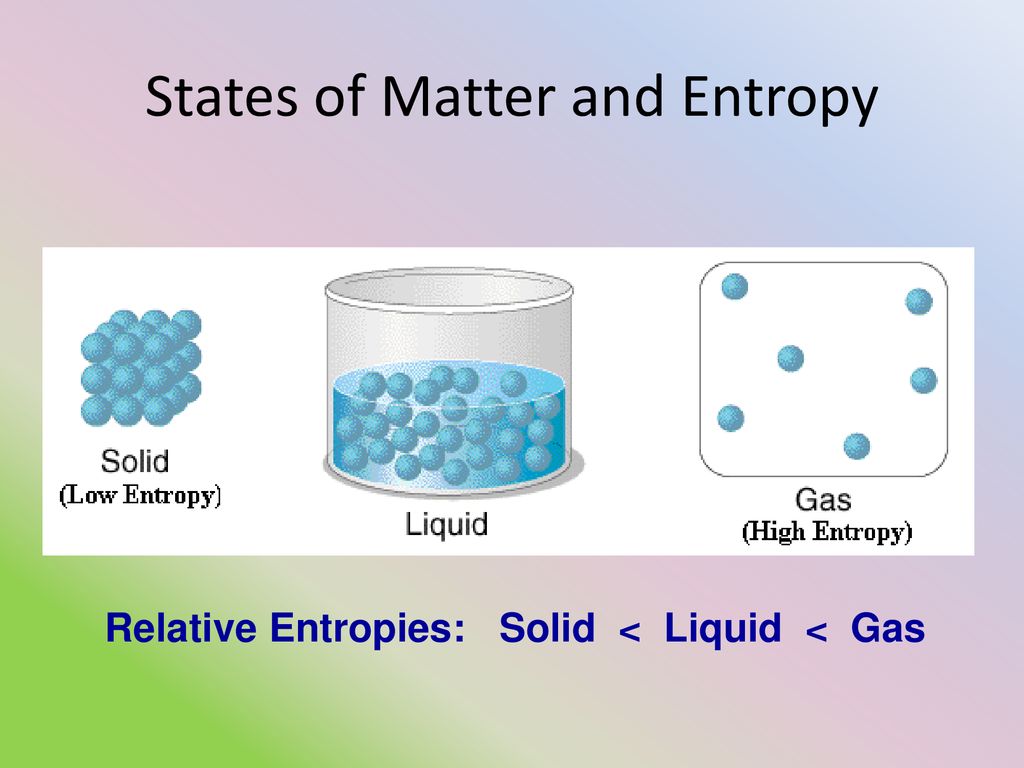
Solids can only vibrate. They cannot flow. They hold their shape
Liquids can flow, but are still tightly packed.
Gases flow and have lots of freedom of motion. Fills the entire container and feels little attraction to other particles.

FYI: Terms "state" and "phase" are often used interchangeably
4
The disorder, (randomness), of a system.
In chemistry, the amount of entropy is based on particle freedom.
IMPORTANT COMPARISONS
Solids < Liquids < Gases
Solids < Aqueous (dissolved)
Tie breaker can be # of moles if matter being compared is in same state
5
Multiple Choice

Which of the listed choices has the greatest (highest) entropy?
solid sodium
liquid mercury
liquid bromine
gaseous fluorine
6
Answer is choice 4
A sample of gas will have more randomness to its particle arrangement than liquid or solid.
What if question asked which had the least entropy?
Then, it would have been choice 1, the solid

7
Since the states have different entropy levels, changes from one state to another either increases entropy or decreases entropy.
When heat is absorbed (ex: melting), entropy increases
When heat is released (ex: condensing), entropy decreases

8
Multiple Choice

Which of the listed phase changes results in an increase in entropy? (ΔS= +)
precipitation of iodine
condensation of methane
vaporization of bromine
freezing of water
9
Answer Choice 3 (vaporization)
It is the only phase change in which the arrangement of particles becomes less ordered
(i.e. more random, more dispersed)
(All other changes result in greater order, thus less entropy)

10
Examples:
Dissolving salt in water
NaCl (s) --> Na+ (aq) + Cl- (aq)
or
dissolving solid sugar in water
C6H12O6 (s) --> C6H12O6 (aq)
aqueous > solid
in terms of entropy

11
(It takes work to undo chaos)
Changes (chemical and physical) that result in greater entropy tend to be spontaneous.

12
Greater freedom of particle motion = greater entropy
13
Multiple Choice
Exit Question 1:
Which sample of water has the greatest entropy?
H2O (g)
H2O (s)
H2O (l)
14
Multiple Choice
Which phase change involves a decrease in entropy?
melting
(solid to liquid)
vaporizing
(liquid to gas)
freezing
(liquid to solid)
sublimation
(solid to gas)
Comparing the freedom of the particles
Show answer
Auto Play
Slide 1 / 14
SLIDE
Similar Resources on Wayground

10 questions
Passe Compose avec Etre
Presentation
•
9th - 12th Grade
10 questions
Counterclaim and Rebuttal
Presentation
•
9th - 12th Grade
11 questions
Fusion vs. Fission
Presentation
•
9th - 12th Grade
11 questions
Bonding Notes / Lesson
Presentation
•
9th - 12th Grade
10 questions
Stoichiometry Lesson
Presentation
•
9th - 12th Grade
12 questions
The Mole & Gram to mole conversions
Presentation
•
9th - 12th Grade
13 questions
Ionic Versus Covalent
Presentation
•
9th - 12th Grade
9 questions
Moles - Percent Composition
Presentation
•
9th - 12th Grade
Popular Resources on Wayground
10 questions
Safety Day 2026 – Student Review

Quiz
•
9th Grade
21 questions
Continents and Oceans
Quiz
•
6th Grade
20 questions
Parts of Speech
Quiz
•
5th Grade
16 questions
Subject & Predicate
Quiz
•
5th Grade
25 questions
Multiplication Facts
Quiz
•
5th Grade
12 questions
Map Skills
Quiz
•
3rd Grade
22 questions
Continents and Oceans
Quiz
•
5th Grade
15 questions
Rounding Decimals
Quiz
•
5th Grade
Discover more resources for Chemistry
20 questions
electron configurations and orbital notation
Quiz
•
9th - 12th Grade
20 questions
Periodic Table Trends
Quiz
•
11th Grade
25 questions
Writing and Naming Binary Ionic compounds
Quiz
•
10th Grade
20 questions
COUNTING ATOMS
Quiz
•
10th Grade
50 questions
Unit 3: Atomic Assault Summative Review
Quiz
•
11th Grade
20 questions
Physical or Chemical Change/Phases
Quiz
•
8th Grade - University
15 questions
Periodicity Module Exam Practice Quiz
Quiz
•
9th - 12th Grade
20 questions
Naming Ionic Compounds
Quiz
•
10th Grade