

Weather Introduction

Presentation
•
Science
•
8th Grade
•
Medium
Standards-aligned

Dondria Smith
Used 31+ times
FREE Resource
12 Slides • 24 Questions
1
Weather Introduction

2
Convection Currents
Earth’s Mantle
Convection currents flow within the mantle
Causes the tectonic plates to move
Less dense hot magma moves upward
More dense cooler magma moves downward

3
Multiple Select
4
Earth’s Ocean Currents
Ocean Currents are caused by the uneven heating of the sun
The sun heats the equator directly
The water near the equator is warm and less dense so it rises and the water near the poles are cool more dense so it sinks.

5
Multiple Choice
6
Earth’s Atmosphere
Solar radiation heats the Earth’s surface unevenly
That heat is transferred to the air by conduction
Air touching the Earth’s surface expands, becomes less dense and rises.

7
Multiple Choice
8
High Pressure vs Low Pressure
As air masses cool, they becomes more dense and sinks toward the Earth’s surface.
As air masses warm, they becomes less dense and rises above the Earth’s surface

9
Multiple Choice
10
Air Masses
A large body of air that has relatively uniform temperature and humidity.
Originate over land (Continental) over water (Maritime).
Cold air masses tend to approach from the poles.
Warm air masses tend to approach from the equator.

11

12
Multiple Choice

How do we characterize an air mass that forms over the ocean?
13
Multiple Choice

How do we characterize an air mass that forms over near the equator?
14
Multiple Choice

How do we characterize an air mass that forms over the ocean?
15
Multiple Choice

How do we characterize an air mass that forms near the poles?
16
Multiple Choice

What types of air masses form over oceans?
17
Multiple Choice
18
Multiple Choice
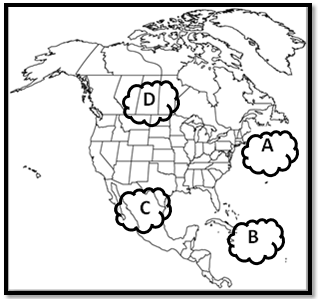
Which type of air would you find at air mass D?
19
Multiple Choice
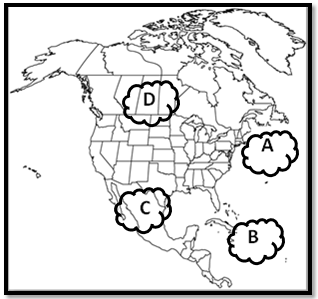
Which type of air would you find at air mass C?
20
Multiple Choice
21
Multiple Choice
22
Multiple Choice
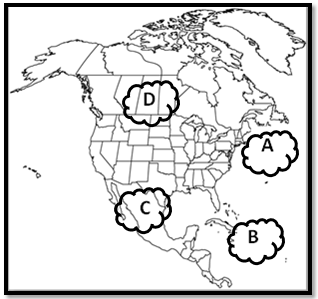
Which type of air would you find at air mass B?
23
Multiple Choice
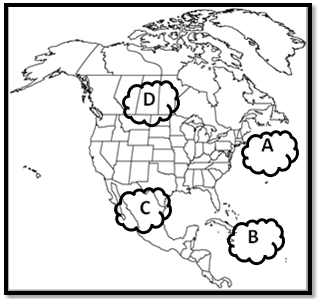
Which type of air would you find at air mass A?
24
Front
The boundary between two air masses.
Classified by which type of air mass (cold or warm) is replacing the other.
Map symbols point in direction front is moving.

25
Warm Front
A warm air mass is replacing a cold air mass.
Air behind the front is warm and moist.
Pressure goes down (L)
Slow moving, gradual rise of warm air over cold air.
Widespread, continuous light rain along and ahead of the front.

26
Multiple Choice
27
Multiple Choice
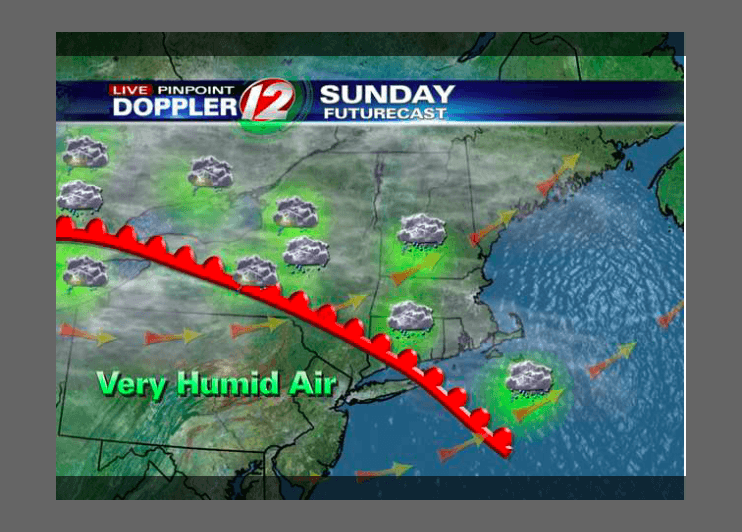
Name that symbol.
28
Multiple Choice
29
Cold Front
A cold air mass is replacing a warm air mass.
Air behind the front is colder and drier.
Pressure increases (H)
Moist air is pushed up over the cold air.
Showers and thunderstorms form along leading edge of front.

30
Multiple Choice
31
Multiple Choice
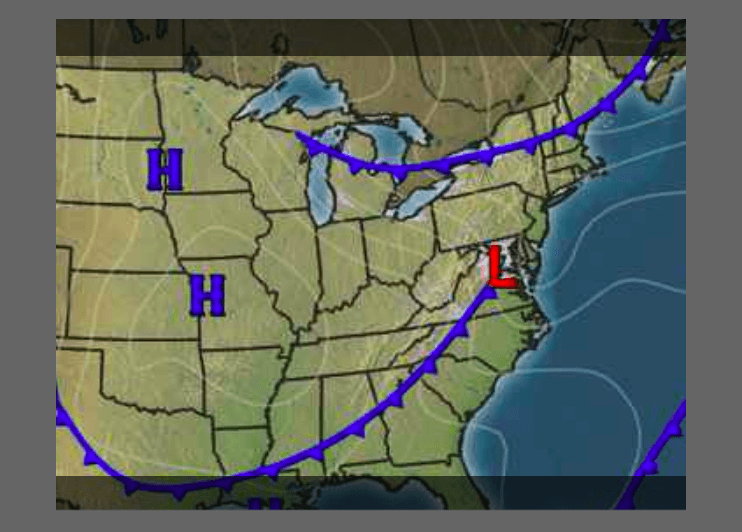
Name that symbol.
32
Stationary Front
- A warm and cold air mass meet trying to move in opposite directions
- Neither is moved
- Heavy storms & precipitation can last for days

33
Multiple Choice
34
Occluded Front
- A warm air mass is caught between 2 cold air masses
- Cold air masses rise over the warmer
- Strong winds and heavy precipitation result

35
Multiple Choice
36
Multiple Select
Weather Introduction
Show answer
Auto Play
Slide 1 / 36
SLIDE


