The Sun
Presentation
•
Science
•
8th Grade
•
Practice Problem
•
Medium
Standards-aligned
Jennifer LaSanta
Used 201+ times
FREE Resource
16 Slides • 13 Questions
1
2
Multiple Choice
What might change based on the DISTANCE of a star?
Apparent Magnitude
Absolute Brightness
3
Multiple Choice
Which is a measurement of a Star's actual brightness?
Absolute Brightness
Apparent Magnitude
4
Multiple Choice
Compared to other stars we observe, the Sun appears bigger and brighter because:
It is visible at night
It is much closer to Earth
It has more mass
It is Older
5
6
7
8
Multiple Choice
What two elements make up the Sun?
Hydrogen and Helium
Hydrogen and Oxygen
Carbon and Nitrogen
Oxygen and Carbon
9
10
Multiple Choice
In a nuclear fusion reaction, atoms
Split apart
Combine
Explode
Cool Down
11
12
13
Multiple Choice
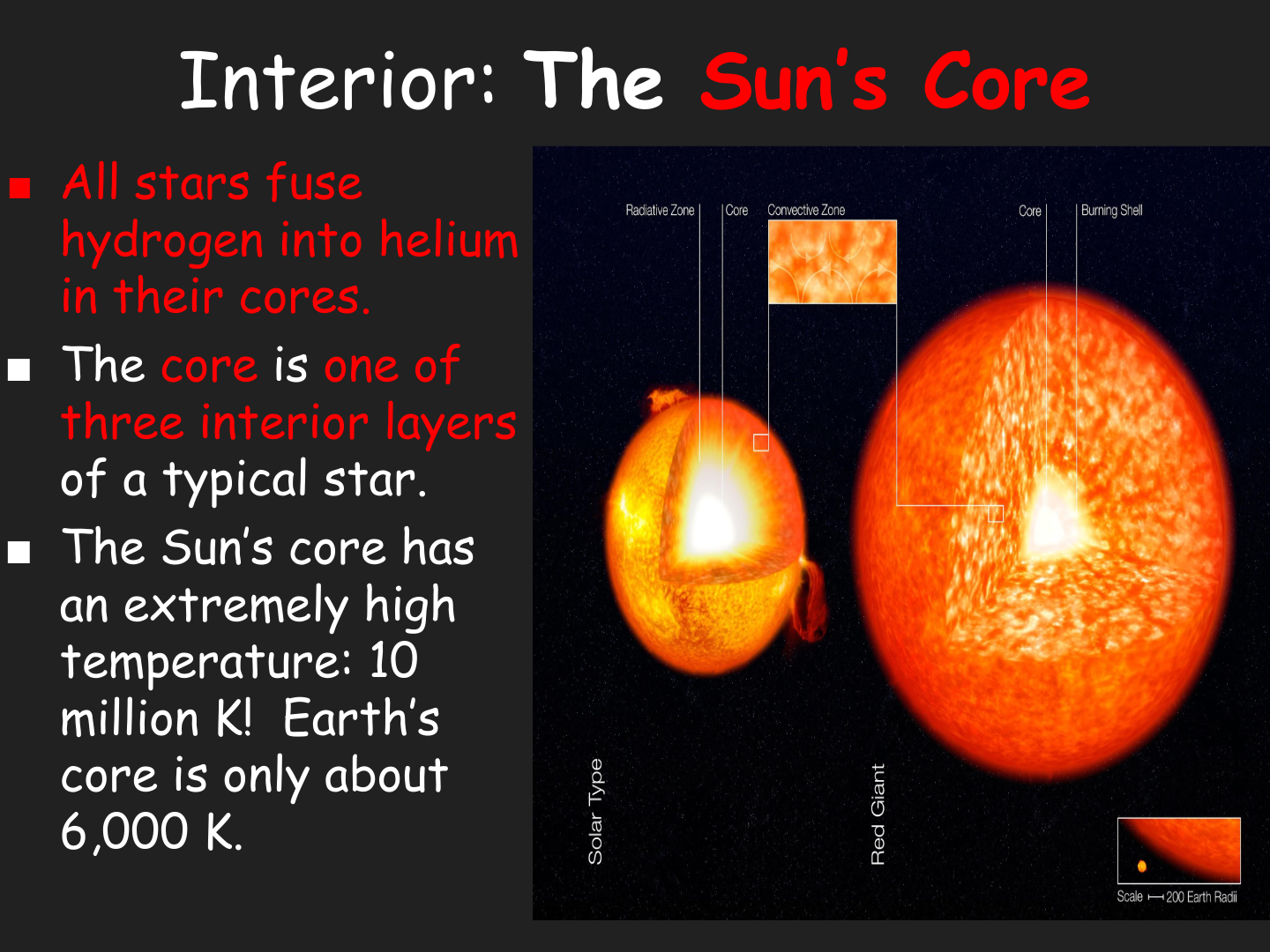
What are the inner layers of the Sun?
Core, Corona, Chromosphere
Corona, Core, Radiative Zone
Core, Radiative Zone, and Convection Zone.
Corona, Photosphere, and Chromosphere.
14
15
16
17
Multiple Choice
Which of the following lists some of the layers of the Sun in order from the center of the Sun outward?
radiation zone, convection zone, chromosphere, core, photosphere, corona
radiation zone, convection zone, core, photosphere, chromosphere, corona
core, radiation zone, convection zone, photosphere, corona, chromosphere
core, radiation zone, convection zone, photosphere, chromosphere, corona
18
Solar Prominence
A prominence is a bright, relatively dense, and relatively cool arched cloud of gas in the chromosphere and corona of the Sun. Looks like a Loop.
19
Solar Flares
A solar flare is a sudden, brief (typically lasting only a few minutes), and explosive release of solar magnetic energy that heats and accelerates the gas in the Sun's atmosphere.
Solar flares are brief explosions of solar magnetic energy.
20
What is happening in space
What we see
21
22
Multiple Choice
Prominences and sunspots are both:
Jets of burning gas
Patches on the Sun's surface
Caused by the Sun's electromagnetic field
Visible
23
24
Multiple Select
Which of the following correctly describes the rotation of the Sun?
All parts of the Sun rotate together.
The Sun rotates faster at its equator than at its pole.
The Sun rotates slower at its equator than at its pole.
The Sun does not rotate at all.
25
Earth's energy budget allows us to track how much energy is coming in and going out. Incoming solar energy is either: Reflected or Radiated back to space, or Absorbed. About 71% of the total incoming solar energy is absorbed by the Earth system.
Where Does ALL the Sun's Energy Go?!
26
Multiple Choice
Earth's energy budget tracks how much energy flows in and out of Earth's climate.
True
False
27
Multiple Choice
Label part 1
#1 Core
#1 Radiation zone
#1 Convection zone
#1 Photosphere
28
Multiple Choice
Label part 6
#6 Prominences
#6 Corona
#6 Sunspots
#6 Photosphere
29
Multiple Choice
Label Part 3
#3 Chromosphere
#3 Radiation zone
#3 Convection zone
#3 Photosphere
Show answer
Auto Play
Slide 1 / 29
SLIDE

Similar Resources on Wayground
18 questions
5B: Tides Lesson
Presentation
•
8th Grade
21 questions
Life Cycle of a Star
Presentation
•
8th Grade
23 questions
Plate Tectonics
Presentation
•
7th - 8th Grade
19 questions
Solar System
Presentation
•
8th Grade
26 questions
STAAR 8TH SCIENCE REVIEW
Presentation
•
8th Grade
21 questions
Ocean Currents
Presentation
•
7th Grade
22 questions
Greenhouse Effect and Global Warming
Presentation
•
8th Grade
19 questions
Water Cycle Notes
Presentation
•
7th - 8th Grade
Popular Resources on Wayground
20 questions
STAAR Review Quiz #3
Quiz
•
8th Grade
20 questions
Equivalent Fractions
Quiz
•
3rd Grade
6 questions
Marshmallow Farm Quiz
Quiz
•
2nd - 5th Grade
20 questions
Main Idea and Details
Quiz
•
5th Grade
20 questions
Context Clues
Quiz
•
6th Grade
20 questions
Inferences
Quiz
•
4th Grade
19 questions
Classifying Quadrilaterals
Quiz
•
3rd Grade
12 questions
What makes Nebraska's government unique?
Quiz
•
4th - 5th Grade
Discover more resources for Science
8 questions
Amoeba Sister Asexual vs Sexual Reproduction
Interactive video
•
8th Grade
19 questions
Introduction to Properties of Waves
Presentation
•
6th - 8th Grade
16 questions
Interactions within Ecosystems
Presentation
•
6th - 8th Grade
45 questions
Food Webs
Quiz
•
6th - 8th Grade
50 questions
Stars, Galaxies, HR Diagram
Quiz
•
8th Grade
40 questions
Unit F1 Review
Quiz
•
8th Grade
20 questions
Energy Transformations
Quiz
•
6th - 8th Grade
46 questions
8th Science STAAR Review
Quiz
•
8th Grade