

Natural Selection and Fitness

Presentation
•
Biology
•
10th Grade
•
Easy
+4
Standards-aligned

Erica Maresh
Used 24+ times
FREE Resource
3 Slides • 12 Questions
1
Natural Selection & Fitness
Basics
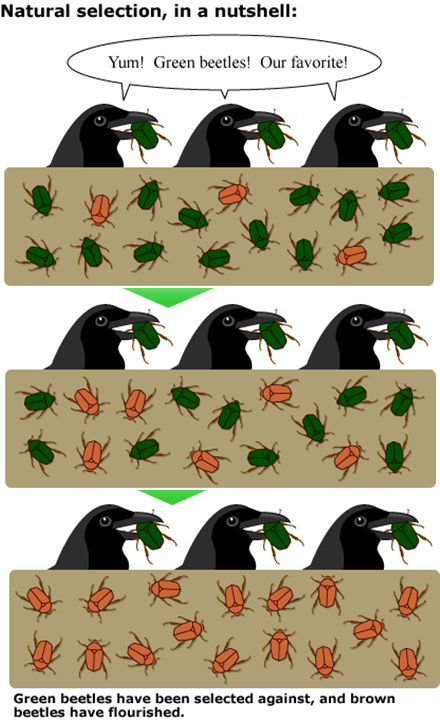
2
3
Highlights
Variations are differences between organisms
Fitness is the ability to survive long enough to reproduce and have offspring that will survive.
Adaptations are characteristics that improve the ability to survive and reproduce
Over time in a population, genes and characteristics that make a species more fit for the environment will occur more often in the population
Environmental stresses (predators, food sources, etc.) select for the characteristics that improve fitness which is Natural Selection
Natural selection can drive evolution
Evolution is changes in populations over time
4
Multiple Choice
What variation in the frogs improved their fitness in the scenario given in the video? Why did it?
Longer legs, jump farther
Bigger eyes, see predators coming
Body Color, blend in with environment
No croaking sound, will not be heard by predators
5
Multiple Select
Which 2 are required to be fit for a specific environment?
Ability to Survive
Ability to reproduce and have offspring
Ability to capture more sunlight
Ability to reach food high in trees
6
Multiple Choice
Traits and genes that are more fit for the environment will..
Increase in frequency
Decrease in frequency
Have a dangerous mutation for an organism
Have no effect on the offspring
7
Multiple Select
What are 2 processes that cause variation in a species?
Mutations
Crossing Over
Spermiogenesis
Translation
8
Multiple Choice
An adaptation is an advantageous characteristic that ...
improves the ability to survive and have offspring (reproduce)
is a skill that is acquired through experiences
is a talent that the organism has perfected through their life-span
9
Multiple Choice
Can an individual organism choose what adaptions they have?
Yes
No
10
Multiple Choice
Evolution is
changes in an individual
changes in a population over time
a static environment in an individual
a population that is in stasis
11
Multiple Choice
Sea turtles can lay anywhere from 70 to 190 eggs at a time. What does this over-reproduction ensure?
There will be competition for resources
Some offspring will survive long enough to reproduce
That all the offspring will be the same
12
Multiple Choice
Suppose a certain species of insect lives in the lush green canopy of the rain forest. Some of the insects are bright green in color, and some are bright yellow. Assume there is a natural predator of the insect in the area. What do you expect to happen to the populations of the green and the yellow insects over time?
The green insect population will increase and the yellow insect population will decrease.
The green insect population will decrease and the yellow insect population will increase.
Both insect populations will remain constant over time.
Both insect populations will increase over time.
13
Multiple Choice

What is the most likely explanation of the data shown below? (click the picture)
There has been a drought in the area that is affecting all life forms.
The population of natural predators of the moths has gotten smaller.
The moths are living in an environment with light trees.
The moths are living in an environment with dark trees.
14
Multiple Choice
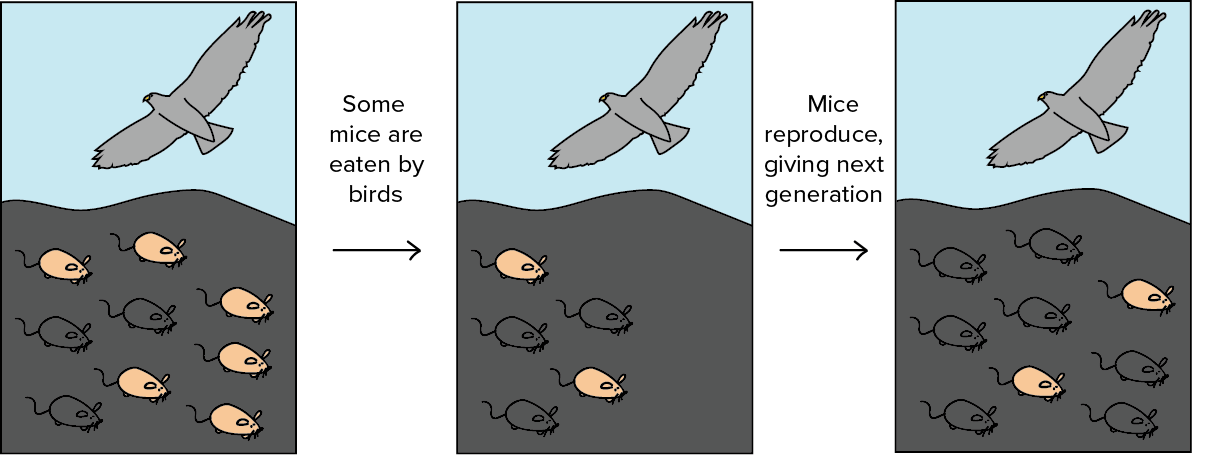
Why is the mouse population changing over time? (click the picture)
The light mice can reproduce more successfully than the dark mice
The hawks eat more dark mice than light mice because the dark mice taste better
The hawks eat more light mice than dark mice because they can see the light mice more easily
The hawks eat more dark mice than light mice because they can see the dark mice more easily
15
Multiple Choice
Why are advantageous traits more likely to be passed onto offspring?
Because they are more likely to survive and reproduce.
Because they come from dominant alleles.
Because they come from recessive alleles.
Because the trait is an acquired phenotype.
Natural Selection & Fitness
Basics
Show answer
Auto Play
Slide 1 / 15
SLIDE
Similar Resources on Wayground

10 questions
MATERI 6 : Modal in English
Presentation
•
10th Grade
11 questions
PSAT Orientation
Presentation
•
10th Grade
12 questions
Business Etiquette
Presentation
•
10th Grade
12 questions
Tangent and Secant Segment
Presentation
•
10th Grade
12 questions
Prepositions
Presentation
•
3rd Grade
10 questions
Cell Differentiation
Presentation
•
9th - 10th Grade
12 questions
Immune System
Presentation
•
9th - 10th Grade
10 questions
Unit 7.2 Mechanisms of Evolution Notes
Presentation
•
9th Grade
Popular Resources on Wayground
10 questions
How much do you know about our Portrait of an Eagle?

Quiz
•
10th Grade
10 questions
Fast Food Slogans
Quiz
•
6th - 8th Grade
21 questions
Continents and Oceans
Quiz
•
6th Grade
20 questions
Parts of Speech
Quiz
•
5th Grade
16 questions
Subject & Predicate
Quiz
•
5th Grade
25 questions
Multiplication Facts
Quiz
•
5th Grade
12 questions
Map Skills
Quiz
•
3rd Grade
22 questions
Continents and Oceans
Quiz
•
5th Grade
Discover more resources for Biology
20 questions
Characteristics of Life
Quiz
•
9th - 10th Grade
10 questions
Exploring the 4 Major Macromolecules and Their Functions

Interactive video
•
9th - 12th Grade
20 questions
Cell organelles and functions
Quiz
•
10th Grade
20 questions
Cell Transport
Quiz
•
9th - 12th Grade
20 questions
Macromolecules
Quiz
•
10th Grade
16 questions
Population Ecology
Quiz
•
9th - 12th Grade
16 questions
AP Biology: Unit 1 Review (CED)
Quiz
•
9th - 12th Grade
10 questions
Quick 10Q: Carbohydrates
Quiz
•
9th - 12th Grade