
Search Header Logo
  1. Resource Library
  2. Science
  3. Physics
  4. Convection
  5. Convection Currents And Winds
Convection Currents and Winds

Convection Currents and Winds

Assessment

Presentation

Science

6th Grade

Practice Problem

Medium

NGSS
MS-ESS2-6, MS-PS3-4, MS-PS1-4

+1

Standards-aligned

Created by

Julie Rowan-Wolford

Used 303+ times

FREE Resource

9 Slides • 11 Questions

1

Convection Currents and Winds

A Review
Slide image

2

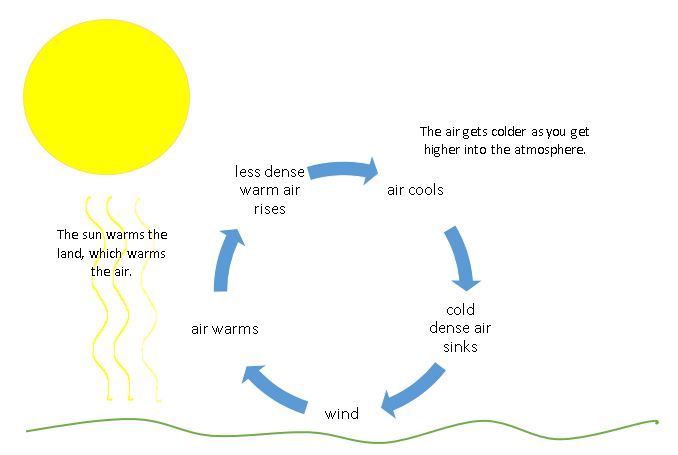
Convection Currents

  • On our planet, air is always on the move.

  • This movement is caused by changes in air pressure.

  • Warmer, less dense air rises.

  • Cooler, more dense air sinks.

  • The sun's energy provides heat, but Earth does not heat evenly.

3

High-Pressure Systems

In a high-pressure system, the molecules of cooled air are dense and create "weight" that pushes the air down towards the surface of the Earth.

Slide image

4

Low-Pressure Systems

In a low-pressure system, the warmed air molecules spread out, become less dense, and rise above Earth's surface.

Slide image

5

Multiple Choice

All locations on the planet do NOT heat evenly.

Where would we expect to find warmer areas on Earth?

1

Near the equator

2

Near the poles

6

Multiple Choice

What parts of the planet would be cooler?

1

Near the equator

2

Near the poles

7

Multiple Choice

What surfaces on Earth heat more slowly?

1

Areas over land heat more slowly

2

Areas over water heat more slowly.

8

Multiple Choice

What does air do as it is heated?

1

Heated air rises.

2

Heated air sinks.

9

Multiple Choice

What does air do as it cools?

1

Cooled air rises.

2

Cooled air sinks.

10

Multiple Choice

What areas on Earth lose heat quickest?

1

Areas over land lose heat quickest.

2

Areas over water lose heat quickest.

11

Multiple Choice

Air that cools becomes ___

1

less dense and rises.

2

more dense and sinks.

3

less dense and sinks.

4

more dense and rises.

12

Multiple Choice

The cooling and sinking of air creates ___ that usually brings light winds, fair weather, and sunny skies.

1

high pressure

2

low pressure

13

Multiple Choice

Air that is heated becomes ___.

1

less dense and rises.

2

more dense and sinks.

3

less dense and sinks.

4

more dense and rises.

14

Multiple Choice

Warming and rising air creates ___ that usually brings stormy or windy weather.

1

high pressure

2

low pressure

15

Local Winds

  • Local winds happen in smaller areas of the planet.

  • The are caused by areas on the planet that heat at different rates.

  • Water and land heat and cool differently.

  • High and low altitudes also heat at different rates.

16

Sea Breezes

  • Sea breezes occur in coastal areas during the daytime.

  • The wind blows from the sea to the land.

  • As the cool, dense ocean air sinks it pushes up the air over the land that has been warmed by the sun.

Slide image

17

Land Breezes

  • Land breezes occur during the night time in coastal areas.

  • Wind blows from the land to the water.

  • As the land loses heat the air cools more quickly than the water, becomes dense, and sinks. This pushes the warmer ocean air up.

Slide image

18

Mountain Breezes

  • At night the cooler air

    sinks from the mountain to the valley below.

  • The air on the mountain top cools quickly once the sun goes down.

  • The cool, dense, high altitude air slides down the mountainside to the valley below.

Slide image

19

Valley Breezes

  • During the day the slope of the mountain heats up more quickly than the valley below.

  • Cooler air from the valley pushes the warmer air up the hillside.

Slide image

20

Multiple Choice

Local breezes are created because ___.

1

of differences in air temperature

2

of differences in cloud cover

3

of differences in humidity

Convection Currents and Winds

A Review

Slide image

Show answer

Auto Play

Slide 1 / 20

SLIDE
