


Continental Drift
Presentation
•
Science
•
6th - 8th Grade
•
Medium
+1
Standards-aligned
Lauren Houston
Used 181+ times
FREE Resource
3 Slides • 15 Questions
1
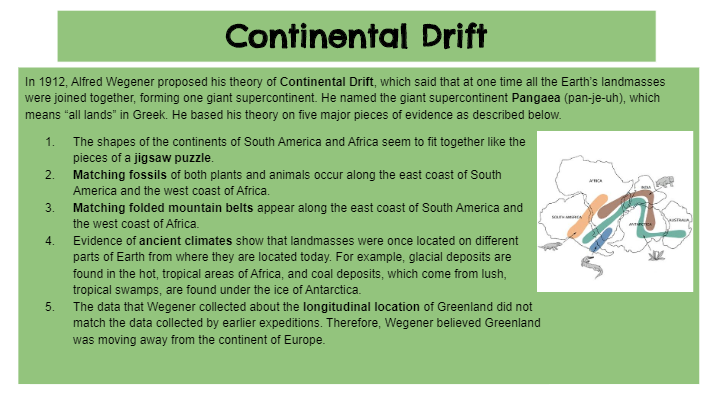
Continental Drift
2
3
4
Multiple Choice
5
Multiple Choice
What was Pangaea?
It was a supercontinent, made of all of the landmasses on Earth.
It was 2 separate landmasses, one on the Northern Hemisphere and one on the Southern Hemisphere.
It was a supercontinent made of 3 landmasses
It was the name of an ancient organism
6
Multiple Choice
7
Multiple Choice
8
Multiple Choice
What evidence did Wegener use in his theory?
Continents and fossils fitting together/matching-up like puzzle pieces
tropical rain forests were found in different locations
divergent boundaries were found in different locations.
sea floor spreading caused new crusts to be formed.
9
Multiple Choice
Alfred Wegener thought South America and Africa have similar coastlines because...
the mesosaurus fossils were found on both continents
He noticed that similar rocks were found on both continents
he thought that the continents used be be joined together
Pangaea was 250 million years ago
10
Multiple Choice
What geologic feature was evidence to support the theory that the continents used to be joined?
Same rocks and mountain ranges were found on different continents
Glacial grooves were found on different continents
Fossilized evidence of the same organism found on different continents
Africa and South America look like puzzle pieces that fit together
11
Multiple Choice
What cold environment feature was evidence to support the theory that the continents used to be joined?
Same rocks were found on different continents
Glacial grooves were found on different continents
Fossilized evidence of the same organism found on different continents
Africa and South America look like puzzle pieces that fit together
12
Multiple Choice
What evidence of an ancient organism was used to support the theory that the continents used to be joined?
Same rocks were found on different continents
Glacial grooves were found on different continents
Fossilized evidence of the same organism found on different continents
Africa and South America look like puzzle pieces that fit together
13
Multiple Choice
Originally the Continental drift theory was not well received by other scientist. Why?
There was a competing theory at the time that was more believable.
There was no data showing the continents ever moved.
The scientists did not know the force responsible for moving the continents.
The scientist presenting the data was unreliable.
14
Multiple Choice
15
Multiple Choice
16
Multiple Choice
Look at this image. Which explanation best summarizes the hypothesis shown in the figure?
The present continents will gradually move to form a single landmass called Pangaea.
The continents were once a large landmass name Pangaea, which broke apart and gradually drifted to the present-day locations of the continents.
The continents were once a large landmass, but the north and south magnetic poles pulled the continents apart toward the poles
The continents were once a large landmass, but the ocean levels rose, and these oceans separate today's continents.
17
Multiple Choice
The Atlas Mountains in Africa are part of the same mountain chain as the Appalachian Mountains in North America, indicating that they were once connected. How does this evidence relate to the hypothesis of Continental Drift?
This evidence shows that the two continents have similar landforms.
This evidence shows that the mountains contain fossil evidence.
This evidence shows that sea-floor spreading occurs, and magnetic reversal patterns exist on the sea floor.
This evidence shows that they were once a single mountain range when the continents were connected and were later separated as the continents drifted apart.
18
Multiple Choice
___________ is the process by which
new oceanic lithosphere (sea floor) forms as magma rises to Earth’s surface and solidifies at a mid-ocean ridge.
Continental drift
Sea-floor spreading
Plate tectonics
Mid-ocean range
Continental Drift
Show answer
Auto Play
Slide 1 / 18
SLIDE

Similar Resources on Wayground
12 questions
Living Things
Lesson
•
KG
15 questions
Muscular System Review
Lesson
•
6th - 8th Grade
14 questions
Homeostasis and Cellular Transport
Lesson
•
6th - 8th Grade
14 questions
Homologous Structures and Superposition
Lesson
•
6th - 8th Grade
16 questions
Catastrophic Events & Aquatic Biomes
Lesson
•
6th - 8th Grade
16 questions
Identifying Variables, Control and Experimental Groups
Lesson
•
6th - 8th Grade
10 questions
Homeostasis
Lesson
•
6th - 8th Grade
12 questions
Biotechnology - GMO - 1/5/2020
Lesson
•
6th - 7th Grade
Popular Resources on Wayground
10 questions
5.P.1.3 Distance/Time Graphs
Quiz
•
5th Grade
10 questions
Fire Drill
Quiz
•
2nd - 5th Grade
20 questions
Equivalent Fractions
Quiz
•
3rd Grade
15 questions
Hargrett House Quiz: Community & Service
Quiz
•
5th Grade
20 questions
Main Idea and Details
Quiz
•
5th Grade
20 questions
Context Clues
Quiz
•
6th Grade
20 questions
Inferences
Quiz
•
4th Grade
15 questions
Equivalent Fractions
Quiz
•
4th Grade
Discover more resources for Science
20 questions
Recognizing Violence and Being an Upstander
Quiz
•
8th Grade
20 questions
Rocks and The Rock Cycle
Quiz
•
6th Grade
19 questions
Introduction to Properties of Waves
Lesson
•
6th - 8th Grade
16 questions
Interactions within Ecosystems
Lesson
•
6th - 8th Grade
10 questions
Exploring the Layers of the Earth
Interactive video
•
6th - 10th Grade
20 questions
Electricity and Circuits
Quiz
•
7th Grade
20 questions
Newton's Laws of Motion
Quiz
•
8th Grade
16 questions
Photosynthesis and Cellular Respiration Review
Quiz
•
7th Grade