Types of current, resistivity and electricity
Presentation
•
Physics, Science
•
8th - 12th Grade
•
Medium
Standards-aligned
B Taylor
Used 9+ times
FREE Resource
10 Slides • 16 Questions
1
Electrical Resistance and Ohms Law

2
3
Types of current
Current flowing in a circuit can take the form of AC or DC current.
Alternating current (AC) the standard electricity that comes out of power outlets and is defined as a flow of charge that exhibits a periodic change in direction.
Direct current (DC) power,, is a linear electrical current—it moves in a straight line.
Direct current can come from multiple sources, including batteries, solar cells, fuel cells, and some modified alternators. Many devices, household appliances, especially, such as lamps, washing machines, and refrigerators, all use AC power, which is delivered directly from the power grid via power outlets.
Today our electricity is still predominantly powered by alternating current, but computers, LEDs, solar cells and electric vehicles all run on DC power.
4
AC vs DC
All power outlets bring power into buildings in the form of AC, even where the current may need to be immediately converted into DC power. This is because DC is not capable of traveling the same long distances from power plants to buildings that AC is.
DC primarily comes into play, where a device needs to store power in batteries for future use. Smartphones, laptops, portable generators, torches, outdoor CCTV camera systems… you name it, anything battery-powered relies on storing DC power. When batteries are charged from the mains supply, AC is converted to DC by a rectifier and stored in the battery.
5
Multiple Choice
6
Multiple Choice
7
Multiple Choice
What type of current is flowing in the circuit ?
Alternating current
Direct current
Both
None
8
Multiple Choice
Which type of current is flowing ?
Alternating current
Direct current
Both
None
9
Multiple Choice
Alternating current is produced in most power stations.
True
False
10
11
12
13
14
Multiple Choice
If you needed a long extension cord, how could you decrease the resistance in the cord?
make the wire in the cord thinner
make the wire in the cord thicker
15
16
Multiple Choice
If you increase the length of a wire then the resistance will.....
decrease
increase
stay the same
17
Multiple Select
Choose all that apply.
The longer the extension cord,
the greater the resistance.
the less resistance.
the warmer the cord will become in use.
the more material the electrons have to flow through.
the less material the electrons have to flow through.
18
Multiple Choice
In which of the above wires would electrons experience the least amount of resistance as they flowed through the wire?
black one on the left
red one in the middle
black on on the right
19
Multiple Choice
The unit which resistance is measured is .....
Volts
Amps
Coulombs
Ohms
20
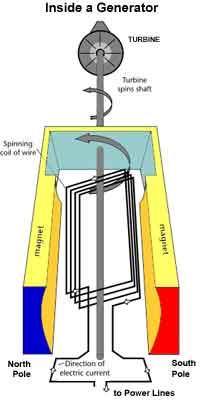
Generators and Electric Motors
Both are made of magnets and involve electrical source to give electromagnetic induction.
Generator is a device that transforms MECHNICAL ebnergy into ELECTRICAL energy.
Ex. Used in hydropowerplants to produce electricity as the turbines spn(mechnical) to give electricity that powers homes
An electrical motor is functionally opposite to a generator.
Electric motors produce MECHANCAL enrfgy from ELECTRICAL energy.
Ex. used in fans to cause the blades to spin
21
Multiple Choice
Which is NOT a distinctive attribute of an electrical generator?
Electric generator turns mechanical energy into electric energy
Electric generator turns electric power into mechanical energy.
It provides electricity
It is based upon the electromagnetic induction theory
22
Multiple Choice
23
Multiple Choice
24
Multiple Choice
What energy transformation takes place in an electric fan's motor?
electrical energy into mechanical energy
mechanical energy into electrical energy
alternating current to direct current
direct current to alternating current
25
Multiple Choice
If you increase the width of a wire then the resistance will.....
decrease
increase
stay the same
26
Multiple Choice
Which of the situation below shows how a basic electric motor works?
The energy contained in the batteries of the vehicle is transformed into wheel rotation.
Electrical energy converted into blade rotation in the food processor and cut down food.
Both A and B
None of these
Electrical Resistance and Ohms Law

Show answer
Auto Play
Slide 1 / 26
SLIDE

Similar Resources on Wayground
19 questions
SPEED, VELOCITY & ACCELERATION
Lesson
•
8th - 12th Grade
20 questions
Waves Intro pt 2: Waves and Energy Relations
Lesson
•
8th - 12th Grade
22 questions
Metals, Nonmetals, & Metalloids
Lesson
•
8th - 12th Grade
20 questions
Anatomical Directional Terms
Lesson
•
9th - 12th Grade
23 questions
Friction and Gravitational Interactions
Lesson
•
8th Grade - University
23 questions
3.3 Fluids
Lesson
•
9th - 12th Grade
23 questions
Forensics: Observation pt 2
Lesson
•
9th - 12th Grade
20 questions
Chemical Reactions
Lesson
•
8th - 11th Grade
Popular Resources on Wayground
10 questions
5.P.1.3 Distance/Time Graphs
Quiz
•
5th Grade
10 questions
Fire Drill
Quiz
•
2nd - 5th Grade
20 questions
Equivalent Fractions
Quiz
•
3rd Grade
15 questions
Hargrett House Quiz: Community & Service
Quiz
•
5th Grade
20 questions
Main Idea and Details
Quiz
•
5th Grade
20 questions
Context Clues
Quiz
•
6th Grade
20 questions
Inferences
Quiz
•
4th Grade
15 questions
Equivalent Fractions
Quiz
•
4th Grade
Discover more resources for Physics
17 questions
Newtons Laws
Quiz
•
8th Grade
20 questions
Measuring Speed, Distance, and Time Learning Check
Quiz
•
6th - 8th Grade
28 questions
Lenses
Quiz
•
10th Grade
25 questions
Newton's Laws of Motion
Quiz
•
9th Grade
20 questions
Friction and Gravity
Quiz
•
6th - 8th Grade
20 questions
Unit 10 - Acceleration Mini-Test
Quiz
•
9th Grade
32 questions
Quiz#2 Optics/EMS study guide
Quiz
•
8th Grade
10 questions
E-M Wave Formation
Quiz
•
11th Grade