Search Header Logo
8.7A, 8.8B

8.7A, 8.8B

Assessment

Presentation

Science

8th Grade

Medium

NGSS
MS-ESS1-1, MS-ESS1-2, MS-ESS1-3

+2

Standards-aligned

Created by

Frankey Brewer

Used 37+ times

FREE Resource

9 Slides • 25 Questions

1

8.7A, 8.8B

8.7A The Earth rotating on its tilted axis causes day and night, and revolving around the sun creates seasons


8.8B The Sun is a medium sized star located at the edge of the Milky Way galaxy, and thousands of times closer to Earth than any other star

media

2

Earth's Rotation

  • Earth's rotation, or spinning, causes day and night to occur

  • Earth completes one rotation every 24 hours

media

3

Multiple Choice

Question image

A student wants to use a spinning basketball to model the day and night cycle on Earth.

What should the student do in order to best model the cause of the day and night cycle?

1

Spin the ball in different directions

2

Tilt the ball while it is spinning

3

Paint one half of the ball b lack and the other half white

4

Shine a bright light on one side of the ball

4

Multiple Choice

As the Earth rotates, the part of the Earth facing away from the sun has ________.

1

daylight

2

darkness (night)

3

summer

4

nice weather

5

Multiple Choice

As the Earth rotates, the part of the Earth facing the sun has ________.
1
an axis
2
darkness (night)
3
daylight
4
winter

6

Multiple Choice

What causes day & night?

1

Earth's rotation on the equator

2

Earth's revolution around the Sun

3

The Moon's rotation around the Sun

4

Earth's rotation on its axis

7

Multiple Choice

Question image
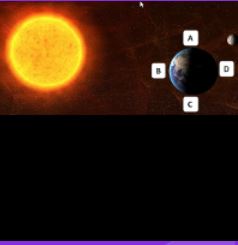
Which part of Earth is experiencing night?
1
A
2
B
3
C
4
D

8

Multiple Choice

Question image

Which of these changes would likely occur if the rate of the Earth's rotation on its axis increased?

1

The length of the seasons would be shorter.

2

The length of the seasons would be longer.

3

The length of the day would be shorter.

4

The length of the day would be longer.

9

Revolution

  • The action of one object moving around another

  • Orbit - the path an object takes as it revolves around another object

  • It takes the Earth 365 days (1 year) to revolve around the Sun one time

media

10

Earth's tilt

  • Earth's axis is tilted 23.5 degrees

  • the hemisphere tilted toward the sun gets more direct sunlight - warmer- than hemisphere tilted away

  • Days are longest and shortest toward the poles

11

Multiple Choice

What causes more heat,  indirect sunlight or direct sunlight?
1
indirect
2
direct

12

Multiple Choice

Question image

The hemisphere where you live

1

equator

2

southern

3

northern

4

eastern

13

Revolution + Tilt= Seasons

  • Seasons occur due to the Earth’s tilt on its axis and revolution around the Sun

  • The northern and southern hemispheres experience opposite seasons

  • The hemisphere tilted toward the sun gets more direct sunlight= summer

  • hemisphere tilted away from sun is having winter

media

14

Multiple Choice

Question image

When the Northern Hemisphere of Earth is Leaning away from the Sun, What season is the Southern Hemisphere experiencing?

1

Summer

2

Winter

3

Spring

4

Fall

15

Multiple Choice

How long does it take the Earth to make one REVOLUTION around the Sun?
1
12 hours
2
24 hours
3
365.25 days
4
29.5 days

16

Multiple Choice

Question image

At position A, which hemisphere would have summer?

1

Northern hemisphere

2

Southern hemisphere

17

Multiple Choice

Question image
At position C, which hemisphere would have winter?
1
Northern hemisphere
2
Southern hemisphere

18

Multiple Choice

Question image

Earth would no longer have seasons if it...

1

no longer tilted on its axis.

2

stopped rotating on its axis.

3

took an additional month to orbit the Sun.

4

revolved around the Sun in the opposite direction.

19

Multiple Choice

Question image

A student draws the model shown in the picture. Which of these best compares the conditions at Location X and Location Y?

1

It is day at Location X and night at Location Y.

2

It is winter at Location X and summer at Location Y.

3

There are more hours of daylight at Location X than at Location Y.

4

The moon is brighter when viewed from Location X than when viewed from Location Y.

20

Multiple Choice

Question image

In the summer, many people enjoy going to the beach. The photograph shows a beach in Argentina, which is located in the Southern Hemisphere.

Which diagram shows the position of the Earth when it is summer in Argentina.

1

A

2

B

3

C

4

D

21

The Sun

  • medium sized star at the center of our solar system

  • Thousands of times closer to Earth than any other star

  • 8.4 light minutes from Earth

  • next closest star is Proxima Centauri- 4.2 light years away

media

22

The Sun

  • Located at the edge of the Milky Way galaxy

  • Milky way is about 100,000 light years in diameter and contains about 200 billion other stars

  • The galaxy is held together by a super-massive black hole at the center


media

23

Galaxies- systems of stars, gas and dust held together by gravity

  • There are many other galaxies in the universe

  • astronomers estimate at least 100 billion


media

24

Galaxies

  • classified by their shape•– spiral, elliptical, and irregular


media

25

Multiple Choice

The Milky Way galaxy is an example of an irregular galaxy
1
true
2
false

26

Multiple Choice

How far is the sun from the earth?
1
4.3 light-minutes
2
680 light-years
3
8.4 light-minutes
4
9 light years

27

Multiple Choice

Distance measurement used by astronomers for distant objects.
1
Kilometers
2
Light Years
3
Miles
4
Light Seconds

28

Multiple Choice

What holds a galaxy together?

1

pressure

2

glue

3

gravity

4

planets

29

Multiple Choice

Galaxies are composed of (best answer)
1
stars
2
stars and gas
3
stars, dust, and gas
4
stars, dust, and gas held together by gravity

30

Multiple Choice

Place these objects in order from smallest to largest.
1
Planets, solar system, universe, galaxy
2
Solar system, planets, galaxy, universe
3
Planets, solar system, galaxy, universe
4
Galaxy, solar system, planets, universe

31

Multiple Choice

Question image

Which type of galaxy is shown in the image?

1

Spiral

2

Elliptical

3

Irregular

32

Multiple Choice

We have discovered ___ of galaxies.

1

hundreds

2

millions

3

billions

33

Multiple Choice

We can't see all of the stars in our galaxy because they
1
are too far away
2
are too hot
3
are revolving too quickly

34

Multiple Choice

How many stars make up our galaxy?
1
200
2
200,000
3
200 million
4
200 billion

8.7A, 8.8B

8.7A The Earth rotating on its tilted axis causes day and night, and revolving around the sun creates seasons


8.8B The Sun is a medium sized star located at the edge of the Milky Way galaxy, and thousands of times closer to Earth than any other star

media

Show answer

Auto Play

Slide 1 / 34

SLIDE