Centripetal Force
Presentation
•
Physics
•
9th Grade
•
Practice Problem
•
Medium
Standards-aligned
Benjamin Flo
Used 33+ times
FREE Resource
11 Slides • 10 Questions
1
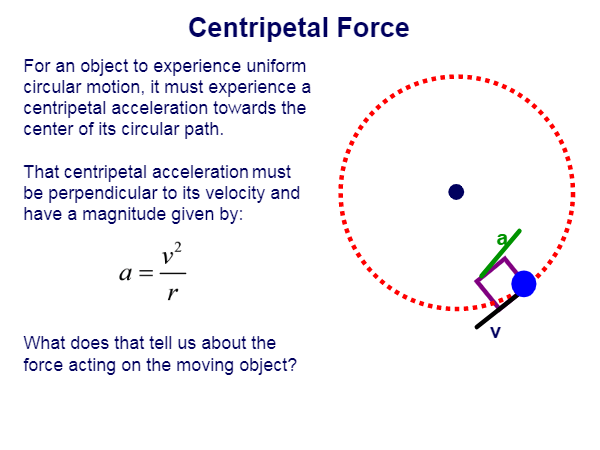
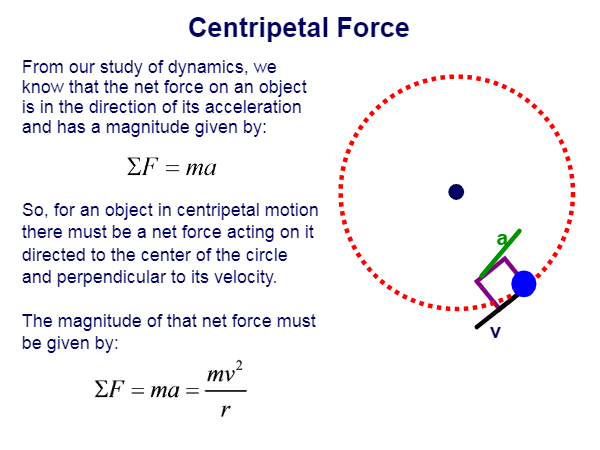
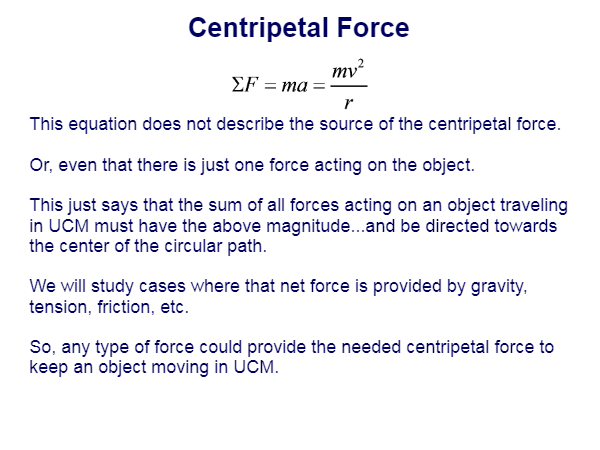
Centripetal Force
E.Q. What forces act on objects that are spinning?
H.P.2B.8 Develop and use models (such as a computer simulation, drawing, or demonstration) and Newton’s Second Law of Motion to construct explanations for why an object moving at a constant speed in a circle is accelerating.
2
Multiple Choice
3
Multiple Choice
4
Multiple Choice
5
Open Ended
What's your good thing for today, how are you feeling (1-10) or Would you rather read an awesome book or watch a good movie?
6
7
8
9
10
11
12
13
14
15
16
Multiple Choice
What force is needed to make an object move in a
circle?
kinetic friction
static friction
centripetal force
weight
17
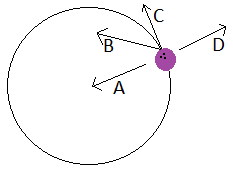
Multiple Choice
When an object experiences uniform circular
motion, the direction of the net force is
in the same direction as the motion of the object
in the opposite direction of the motion of the object
is directed toward the center of the circular path
is directed away from the center of the
circular path
18
Multiple Choice
A car with a mass of 1800 kg goes around an 18
m radius turn at a speed of 35 m/s. What is the
centripetal force on the car?
25,000 N
75,000 N
122,500 N
250,000 N
19
Multiple Choice
A ball on a string spins in a horizontal circle of
radius 2.5 m with a speed of 3.0 m/s. The tension in
the string is 5.4 N. What is the mass of the ball?
1.5 kg
3.0 kg
3.6 kg
4.8 kg
20
Multiple Choice
A 75 kg mass is attached to the end of a 5.0 m
long metal rod string which rotates in a horizontal
circular path. If the maximum force that the rod can
withstand is 8500 N. What is the maximum speed
that the mass can attain without breaking the rod?
15 m/s
24 m/s
25 m/s
110 m/s
21
Multiple Choice
What is the net force on a 2.0 kg mass spinning in a
circle with radius 1.5 m with a frequency of 4.0 Hz?
3.0 N
19 N
380 N
1900 N
Centripetal Force
E.Q. What forces act on objects that are spinning?
H.P.2B.8 Develop and use models (such as a computer simulation, drawing, or demonstration) and Newton’s Second Law of Motion to construct explanations for why an object moving at a constant speed in a circle is accelerating.

Show answer
Auto Play
Slide 1 / 21
SLIDE

Similar Resources on Wayground
18 questions
Measuring mass
Presentation
•
9th - 10th Grade
16 questions
Position time Graphs, Distance and Displacement
Presentation
•
9th - 10th Grade
18 questions
Refraction and Reflection
Presentation
•
8th Grade
16 questions
Polynomials: Vocabulary & Classifying
Presentation
•
9th Grade
16 questions
Saber vs Conocer
Presentation
•
9th Grade
16 questions
Colons and Semicolons
Presentation
•
9th Grade
16 questions
Multiplying Binomials
Presentation
•
9th Grade
15 questions
Velocity Time Graphs
Presentation
•
10th Grade
Popular Resources on Wayground
16 questions
Grade 3 Simulation Assessment 2
Quiz
•
3rd Grade
19 questions
HCS Grade 5 Simulation Assessment_1 2526sy
Quiz
•
5th Grade
10 questions
Cinco de Mayo Trivia Questions
Interactive video
•
3rd - 5th Grade
17 questions
HCS Grade 4 Simulation Assessment_2 2526sy
Quiz
•
4th Grade
24 questions
HCS Grade 5 Simulation Assessment_2 2526sy
Quiz
•
5th Grade
13 questions
Cinco de mayo
Interactive video
•
6th - 8th Grade
20 questions
Math Review
Quiz
•
3rd Grade
30 questions
GVMS House Trivia 2026
Quiz
•
6th - 8th Grade
Discover more resources for Physics
11 questions
Electricity Explained
Interactive video
•
9th - 12th Grade
18 questions
Series and Parallel Circuits
Quiz
•
9th Grade
15 questions
waves and wave properties
Quiz
•
9th - 12th Grade
35 questions
Electricity and Magnetism SPS10
Quiz
•
8th - 10th Grade
10 questions
Exit Check 7.1 Intro to Waves
Quiz
•
9th Grade
10 questions
Exit Check 7.2: Electromagnetic Waves
Quiz
•
9th Grade
10 questions
Exit Check 7.3 - Analog and Digital
Quiz
•
9th Grade
18 questions
Unit 1 and 2 Concepts Review
Quiz
•
9th - 12th Grade