

Exponential Growth and Decay

Presentation
•
Mathematics
•
9th - 12th Grade
•
Medium
+3
Standards-aligned

Susan Joyce
Used 42+ times
FREE Resource
35 Slides • 13 Questions
1
Exponential Growth and Decay

2
What does exponential growth and decay look like on a graph?
Not all functions increase by the same rate of change value/slope
Only linear functions have a constant rate of change
For linear functions, the graph forms a straight line, either rising or falling from left to right
Exponential growth and decay are exponential functions, forming a curved line. If it rises from left to right it is growth. If it falls from left o right it is decay.

3
Exponential Function Review
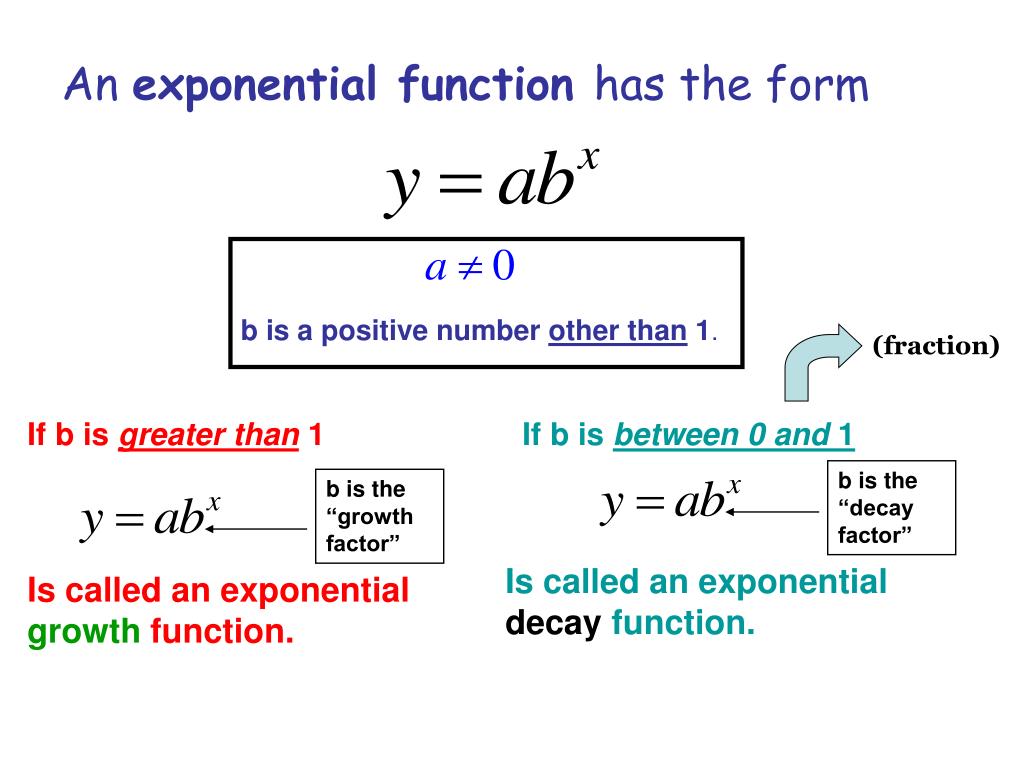
Equation is f(x) = a , where b 1.
Why does b have to be > 1? 1 to any power is always 1.
"a" is the initial value when x = 0. It can be 1, but it cannot be 0.
The rate of change is measured in the quotients of the y-values, not the differences of the y-values. The quotient will be the value of "b".

4

5

6
7
Exponential Growth
f(x) = (a) , where b>1, a 0.
growth rate = rate at which the function is growing
rate can be given in percent, but is always converted to its decimal form to be used algebraically.
growth factor = 1 + (growth rate)
b = growth factor

8
9
10

Microorganisms in cultures
11

Pandemics, like corona virus
12

Food Spoilage
13

Compound Interest
14
Example of Exponential Growth Problem
Initial value = 77
Growth factor is given = 2 (doubles)
Time = x = 17 weeks/2 (every 2 weeks it doubles = 17/2
population in 17 weeks = initial value (growth factor) raised to the time divided by time it takes to double
Final equation: f(x) = 77(2)17/2 = 27,877 zombies

15
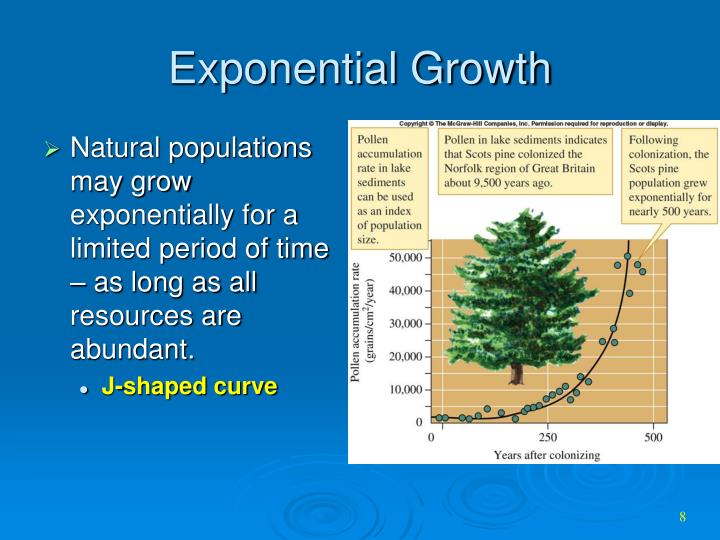
Jordan plants a tree that is 5 feet tall. How tall will the tree be in 15 years if it grows at a rate of 10% each year?
Initial height = 5 feet = a
Growth rate = 10% = .10
Time = 15 years; Grows 10% each year, so time = 15/1 = 15
Growth factor = 1 + rate = 1 + .10 = 1.1
Height after 15 years = f(x)
f(x) = initial value (growth factor)time
f(x) = 5 (1.1)15 = 20.886 feet
16
What would happen if we kept growing at the same rate until we die?????
Suppose we start out life at 21 inches and grow at a rate of 10% per year
growth rate = 10% = .1; growth factor = 1 + .1 = 1.1
let's say life expectancy is 85 years
Height in 85 years = (21) (1.1)85 = 69, 278.35
That's inches! Divide by 12 to find the number of feet.

17
Okay, that is still 5773.2 feet. We would be very tall people if we didn't stop growing!!!!!

18
How to calculate exponential growth
1. Determine the initial value. This is the value when x =0, or the amount you start out with.
2. If the growth rate is given as a percent, convert to decimal form.
3. Determine the growth factor. Growth factor is (1 + growth rate)

19
How to calculate Exponential Growth
4. Determine time. Time = total time / repeats per cycle
Doubling every other week for 29 weeks would be 29/2
5. Substitute the values into the formula: f(x) = a (b)x, where a = initial value, b = growth factor, and x = time
In the example, a = 5000, rate = 5.5% = 0.055, growth factor = b = 1+0.055, and time = t (unknown)

20
21
Multiple Choice
22
Multiple Choice
23
Multiple Choice
24
Multiple Choice
25
Multiple Choice

Is this exponential growth or decay?
26
Multiple Choice
27
Multiple Choice
28
Multiple Choice
29
Exponential Decay
Formula is the same as exponential growth (y = a (b)x ) EXCEPT
Instead of adding the rate of growth/decay to 1, you SUBTRACT it from 1.
Decay factors will always be less than 1; growth factors will always be greater than 1
If the decay rate is 15%, the decay factor is 1 - .15, or .85

30
How to Set Exponential Decay Problems
1. Determine the initial value. This is what you start with, and the value when x = 0. In the example the initial value is $23,000.
2. Determine the decay rate. If the decay rate is given as a percent, change to a decimal. In the example the decay rate is 15% or .15
3. Determine the decay factor. The decay factor is (1 - decay rate), In the example the decay factor is 1 - .15 or .85

31
4. Determine the time. This would be the number of days, months, years, etc. If your item decays more than 1 unit/decay, divide the time by that number. In the example the time is the variable "t"
ie. If it decays 10% every 2 years, then you would express time as t/2, or x/2
5. Substitute your values into the formula: f(x) = y = (a) (b)x, where a = initial value, b = decay factor, and x = time: f(x) = 23000 (.85)t

32

Exponential Growth: Factor > 1; Exponential Decay: Factor <1 (but greater than 0)
33

All exponential decay functions will have this downward curve
34
35
Car Depreciation
The minute you drive a car off the sales lot, it begins to depreciate (lose value)
The "Blue Book" value of a car tells you your cars value based on depreciation and the condition the car is in (excellent, good, fair, poor)

36

Radioactive Decay
37
Decrease in Population in a Community/Country
Populations within a given area can decrease
This happens in rural areas when the young people leave after graduation and do not return to the area
This can also happen in a city when an industry shuts down
There are more people moving out than are staying and repopulating

38
Atmospheric Pressure Decreases as the Altitude Increases
Atmospheric pressure (the pressure of air around you) decreases as you go higher.
It decreases about 12% for every 1000 m: an exponential decay.
The pressure at sea level is about 1013 hPa (depending on weather). (from MathBits)
y = 1013 (1-.12)x = 1013(.88)x

39
Multiple Choice
40
Multiple Choice
41
Multiple Choice
42
Multiple Choice
43
Multiple Choice
44
45
46
47
48
Exponential Growth and Decay
Show answer
Auto Play
Slide 1 / 48
SLIDE


