American Legal System
Presentation
•
Social Studies
•
8th Grade
•
Practice Problem
•
Hard
Stacy Dascoli
Used 8+ times
FREE Resource
20 Slides • 0 Questions
1
American Legal System
2
Guiding Questions
What basic legal rights are provided to all Americans?
What legal protections does the U.S. Constitution offer a citizen who is accused of a crime?
3
Vocabulary Words
double jeopardy
bail
due process
presumption
search warrant
exclusionary rule
Miranda Warnings
4
American Legal System
In many schools, officials or police officers sometimes search students’ lockers, book bags, and other belongings
They cannot, however, look through students’ things whenever they wish.
This is because you are protected from such unreasonable searches by the U.S. Constitution.
The Constitution establishes this and many other important rights concerning individuals and the law.
5
Writ of Habeas Corpus
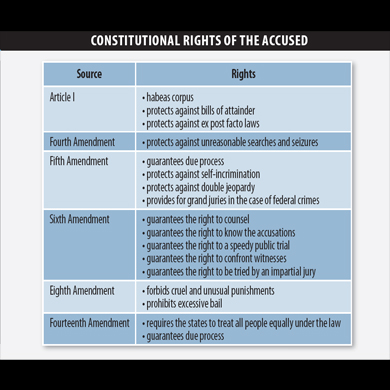
One of the most important protections, found in Article I
a prisoner has the right to ask for a writ of habeas corpus.
A prison official must bring the prisoner before a judge. The judge will then decide whether the accused was lawfully imprisoned
Habeas corpus safeguards individuals against being kept in jail unlawfully.
6
Article I in Constitution
Write of Habeas Corpus is found here
Forbids the government from issuing bills of attainder and ex post facto laws.
A bill of attainder is a law that punishes a person accused of a crime without a trial or a fair hearing in court.
An ex post facto law is a law that would allow a person to be punished for an action that was not against the law when it was committed. It means "after the fact"
7
Administration of Justice
The Constitution makes sure that the government respects our individual rights as it carries out the law.
The Fourteenth Amendment granted civil rights to formerly enslaved people. This amendment requires the states to treat all people equally under the law. It bans unequal treatment based on factors such as gender, race, and religion.
The Fourteenth Amendment also strengthens the Fifth Amendment right of due process
Due process means that the government may not take our lives, liberty, or property without following legal procedure.
8
9
Rights of the Accused
The Constitution makes sure that people accused of crimes receive fair treatment.
They must also have every chance to defend themselves. The rights it grants are based upon the presumption of innocence.
You are innocent until proven in the court of law
10
Fourth Amendment Rights
Protects citizens against “unreasonable searches and seizures.
No police officer or other government agent can search your home or take your property without probable cause
They need a search warrant. A search warrant is a judge’s authorization for a search. It describes the exact place to be searched and what objects may be seized, or taken.
If police find evidence of a crime through an illegal search, the evidence may not be used in court.
This the exclusionary rule. In other words, evidence gained in a way that violates the Fourth Amendment may not be used in a trial.
11
12
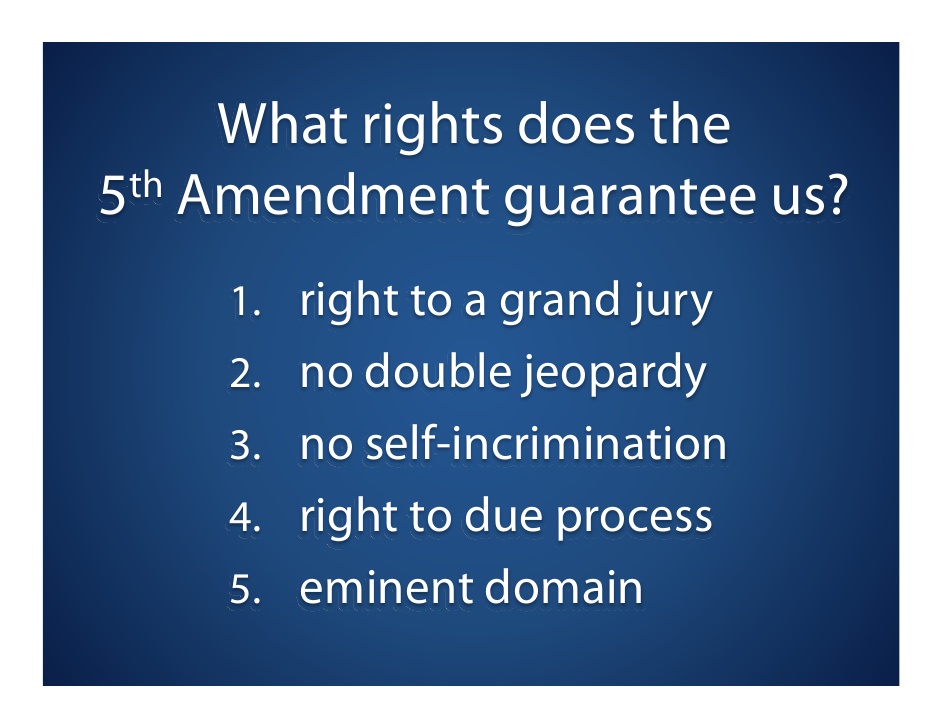
Fifth Amendment Rights
States that no person can be forced “to be a witness against himself”
It protects individuals against self-incrimination. This means that individuals do not have to answer questions that might show they were involved in a crime.
Before 1960's the police pressured suspects into confessing to a crime but Miranda v. Arizona put an end to that. The Court ruled that police must inform suspects of their right to refuse to answer police questions.
13
Miranda Warning
police must now issue what is known as a Miranda Warning.
they have the right to remain silent anything they say may be used against them as evidence
they have the right to an attorney; if they cannot afford one, the court will provide one
14
15
Fifth Amendment
The Fifth Amendment also protects the accused from double jeopardy.
Jeopardy means “to be put at risk of criminal penalty.” A person who is tried for a crime and found not guilty may not be tried again for the same crime.
Entitles people accused of serious federal crimes to be brought before a grand jury
A grand jury is a group that hears evidence presented by a prosecutor and decides if the government has enough evidence to bring a suspect to trial.they find enough evidence to justify a trial, it indicts, or formally charges, the suspect.
16
17
Sixth Amendment
The Sixth Amendment grants the accused the right to be defended by a lawyer.
In the 1963 Supreme Court case Gideon v. Wainwright provided this right
The accused have the right to know the accusations against them. They can question witnesses against them in court.
They have the right to be tried by an impartial, or fair, jury.
Grants the right to a speedy and public trial. This protects defendants from being held in jail for an unreasonably long time.
18
19
20
American Legal System
Show answer
Auto Play
Slide 1 / 20
SLIDE

Similar Resources on Wayground
16 questions
Washington Leads a New Nation
Presentation
•
8th Grade
16 questions
Introduction to the Age of Exploration
Presentation
•
8th Grade
13 questions
The Monroe Doctrine
Presentation
•
8th Grade
13 questions
Mini Lesson One (American Revolution)
Presentation
•
8th Grade
18 questions
American Revolution and Georgia
Presentation
•
8th Grade
16 questions
11/6 Art. of Conf. and Daniel Shay's
Presentation
•
8th Grade
13 questions
Concept 5: Westward Expansion SS8H4e.
Presentation
•
8th Grade
15 questions
#CON - Principles of the Constitution
Presentation
•
8th Grade
Popular Resources on Wayground
16 questions
Grade 3 Simulation Assessment 2
Quiz
•
3rd Grade
19 questions
HCS Grade 5 Simulation Assessment_1 2526sy
Quiz
•
5th Grade
10 questions
Cinco de Mayo Trivia Questions
Interactive video
•
3rd - 5th Grade
17 questions
HCS Grade 4 Simulation Assessment_2 2526sy
Quiz
•
4th Grade
24 questions
HCS Grade 5 Simulation Assessment_2 2526sy
Quiz
•
5th Grade
13 questions
Cinco de mayo
Interactive video
•
6th - 8th Grade
20 questions
Math Review
Quiz
•
3rd Grade
30 questions
GVMS House Trivia 2026
Quiz
•
6th - 8th Grade
Discover more resources for Social Studies
18 questions
SS8H9 GMAS PREP
Quiz
•
8th Grade
6 questions
N2Y: May the 4th be with You
Presentation
•
5th - 8th Grade
51 questions
Civics EOC Review
Quiz
•
7th - 8th Grade
10 questions
Exploring the Age of Exploration: Key Events and Figures
Interactive video
•
6th - 10th Grade
7 questions
20th Century Texas Politics Lesson
Presentation
•
6th - 8th Grade
25 questions
Civics EOC Review
Quiz
•
6th - 8th Grade
48 questions
Georgia Studies Milestone Review
Quiz
•
8th Grade
34 questions
SE Asia Study Guide
Quiz
•
6th - 8th Grade