Search Header Logo
Chemistry Semester 1 Credit Recovery

Chemistry Semester 1 Credit Recovery

Assessment

Presentation

Chemistry

10th - 12th Grade

Medium

Created by

Alison Bowers

Used 1+ times

FREE Resource

20 Slides • 84 Questions

1

Chemistry Semester 1 Credit Recovery

Work through this Quizizz, watching videos and clicking on any links that you need to use. There are questions embedded as you go and you must get above an 80% to gain your credit back.
Slide image

2

Big Idea #1: Stuff is made of atoms.

Anything in the universe that has mass and takes up space is called matter. Matter can be converted to energy and energy can be converted to matter, but neither can be created or destroyed.

The smallest particles of matter that we want to understand through chemistry are called atoms. Atoms have particular properties, depending on the number and arrangement of their protons, neutrons, and electrons.

3

4

Multiple Choice

Which best describes a theory?

1

A guess

2

A well-tested set of ideas that explains many disparate observations

3

an educated guess

5

Multiple Choice

The constant, random movement of atoms/molecules/particles smacking into each other is called

1

Brownian motion

2

Einstein's theory of relativity

3

kinetic molecular theory

4

thermodynamics

6

Multiple Choice

The word "atoms" comes from the Greek atomos, which means "_______."

1

inedible

2

irrefutable

3

indivisible

4

invisible

7

Multiple Choice

Which is NOT one of the three subatomic particles?

1

electrons

2

protons

3

neutrons

4

diatoms

8

Multiple Select

The word root "sub" means

1

below

2

within

3

outside of

4

above

9

Multiple Choice

Which two subatomic particles are found in the nucleus of an atom?

1

protons and electrons

2

electrons and neutrons

3

protons and neutrons

10

Multiple Choice

Which best describes the relationship between protons and neutrons?

1

They are roughly the same mass, but have different charges.

2

They have the same charges, but different masses.

3

They have different masses and different charges.

11

Multiple Choice

Which particle has a mass of 1amu and a positive charge?

1

protons

2

neutrons

3

electrons

12

Multiple Choice

Which particle has a mass of 1amu and a neutral charge?

1

protons

2

neutrons

3

electrons

13

Magnesium's Spot on the Periodic Table

  • Name

  • Atomic Number (= # of protons)

  • Symbol (always 1-2 letters, 1st letter always capitalized)

  • Relative atomic mass (number of protons + number of neutrons, averaged between the most common isotopes)

Slide image

14

Multiple Choice

Which number determines what element an atom is?

1

its mass number

2

its oxidation number

3

its atomic number

4

its electronegativity number

15

Multiple Choice

Looking at your periodic table, an atom that has 18 protons would be

1

oxygen

2

neon

3

fluorine

4

carbon

16

Multiple Choice

Looking at your periodic table, how many protons does lithium have?

1

1

2

3

3

4

4

6.94

17

Multiple Choice

T/F: An atom of oxygen always maintains its chemical properties, even when it is bonded to something else to form a compound.

1

True

2

False

18

Multiple Choice

What is the chemical symbol for the element with 5 protons?

1

Ar

2

B

3

C

4

F

19

Multiple Choice

When can the nucleus of an atom change?

1

During physical changes

2

During chemical reactions

3

During nuclear reactions

4

Never

20

Multiple Select

Which best describes what it means to be an isotope?

1

Two elements with similar chemical properties

2

Two atoms of the same element

3

Two atoms of the same element, but with different numbers of neutrons

4

Two atoms of the same element, but with different mass numbers

21

Multiple Choice

How do you find an atom's mass number?

1

Number of protons + electrons

2

Number of protons + neutrons

3

Number of electrons + neutrons

22

Multiple Select

Which are TRUE about Carbon-12 and Carbon-14?

1

They are both the element carbon.

2

They both have 12 or 14 protons.

3

They both have 6 protons.

4

They have different numbers of electrons.

5

They have different numbers of neutrons.

23

Big Idea #2: Fundamental Laws

  • Mass is never created or destroyed, but it can change from one form to another.


24

25

Multiple Choice

The Law of Conservation of Mass used to be called

1

Einstein's Law

2

Lavoisier's Law

3

Coulomb's Law

4

Mendeleev's Law

26

Multiple Choice

Matter can not be created nor destroyed: it can only be
1
Destroyed a little bit
2
Invisible
3
Transformed, changed
4
None of the above

27

Multiple Choice

Proust expanded on Lavoisier's work and noticed that chemical compounds always contain the same proportions of elements. This is now called the

1

Law of Chemical Compounds

2

Law of Definite Proportions

3

Law of Proportional Change

4

Law of Chemical Proportions

28

Multiple Select

Dalton was the first person to show evidence that chemical compounds exist and the Law of Definite Proportions worked. However, he

1

did the math incorrectly.

2

didn't believe that chemical compounds existed.

3

thought atoms were the same thing as molecules.

4

believed that two atoms could combine to form one new atom, rather than two atoms bonding together to make a compound.

29

Multiple Choice

Gay-Lussac gets credit for collecting air samples and figuring out which piece of info that is obvious to us today?

1

Oxygen is a gas

2

Oxygen is O2, or two atoms of oxygen bonded together to act like a compound

3

Oxygen is a key ingredient for combustion

4

Oxygen is necessarily for animals' survival

30

Multiple Choice

Whose law states that any two gases at equal temperature, pressure, and volume would have the same number of gas particles?

1

Gay-Lussac's

2

Dalton's

3

Charles'

4

Avogadro's

31

Multiple Choice

A substance that is made up of two or more elements bonded together in definite proportions is called a(n)

1

compound

2

allotrope

3

element

4

mixture

32

Multiple Choice

A substance that is made up of one substance that cannot be broken down any further during a chemical reaction or process is a(N)

1

compound

2

allotrope

3

element

4

mixture

33

Multiple Choice

A substance that is made up of multiple atoms of the same element, but acts differently than an individual atom of that element, is a(n)

1

compound

2

allotrope

3

element

4

mixture

34

Multiple Choice

Oxygen gas is O2 (two oxygen atoms bonded together), but ozone is O3 (three atoms of oxygen bonded together). These are examples of

1

compounds

2

allotropes

3

elements

4

mixtures

35

Multiple Choice

Oxygen and hydrogen atoms can bond together to form water (H2O) and hydrogen peroxide (H2O2). These are examples of

1

compounds

2

allotropes

3

elements

4

mixtures

36

Multiple Choice

Hydrogen atoms have 1 proton and helium atoms have 2. They have different atomic numbers, different masses, and different chemical properties. These are

1

compounds

2

allotropes

3

elements

4

mixtures

37

38

Multiple Select

Which are TRUE about Mendeleev's childhood?

1

Father passed away

2

Mother re-opens an abandoned tavern to support the family

3

House burns down

4

Mom thinks he's a smarty-pants, gets him enrolled in a university

5

Mom immediately dies

39

Multiple Choice

Mendeleev began to notice similarities between the chemical behaviors of different elements. Noticing repeated properties or events in science is the cross-cutting concept

1

patterns.

2

energy & matter.

3

systems and system models.

4

cause and effect.

40

Multiple Select

Mendeleev became so certain that he understood the pattern that he did what? Select ALL that are true.

1

left gaps where new elements would/should exist

2

argued with some French scientist that he himself had pre-discovered one of these elements IN HIS OWN MIND

3

published a paper saying the French scientist's data was WRONG

4

created new elements in his lab to fill these gaps.

41

Multiple Choice

Which of the following groups is inert? 
1
Alkali
2
Transition Metals
3
Halogens
4
Noble Gas

42

Multiple Choice

Which of the following is the most reactive group of non-metals? 
1
Alkali
2
Alkali Earth
3
Halogen
4
Noble Gas

43

Multiple Choice

Which of the following is a transition metal? 
1
Iron
2
Oxygen
3
Neon
4
Barium

44

Multiple Choice

Which of the following is an Alkaline Earth Metal? 
1
Calcium
2
Lithium
3
Phosphorus
4
Copper 

45

Multiple Choice

Which of the following is an Alkali Metal? 
1
Magnesium
2
Chromium
3
Sodium
4
Fluorine 

46

Multiple Choice

Question image
what does the 6 represent?
1
Atomic mass
2
atomic number
3
chemical symbol
4
element name

47

Multiple Choice

Question image
The atomic number of this pictured element is
1
28
2
58.6934
3
Ni
4
Nickel

48

Multiple Choice

Atoms with similar properties are most likely located...
1
in the same period.
2
in the same group.
3
in different periods.
4
to the right and left of each other.

49

Multiple Choice

If an atom had the same properties as fluorine (F), it would probably be located in
1
period 1.
2
period 2.
3
group 2.
4
group 17.

50

Multiple Choice

Which is an alkali metal?
1
Magnesium
2
Iron
3
Sodium
4
Europium

51

Multiple Choice

Which is a halogen?
1
Helium
2
Chlorine
3
Oxygen
4
Neptune

52

Multiple Choice

The atomic number tells you what?
1
number of electrons
2
number of protons
3
number of neutrons
4
both electrons and protons in an atom.

53

Multiple Choice

Elements which are shiny, conduct electricity and heat are called

1

metal

2

nonmetal

3

metalloid

4

nonexistent

54

Multiple Select

Which are TRUE about the periodic table?

1

You can find an element's number of protons on it.

2

You can find out which elements are similar to each other in chemical properties.

3

You can use the periodic table to help balance equations.

4

Groups are horizontal, periods are vertical.

5

The patterns in the periodic table are caused by electron behavior.

55

56

Electron Configuration

  • Where electrons are arranged around the nucleus

  • Found in orbitals

  • Each orbital holds 2 electrons

57

Arrangement of Orbitals

- Lowest levels are closest to the nucleus

- Number refers to energy level

- Letter refers to shape of the orbitals

Slide image

58

Rules for Filling Orbitals

  • Aufbau Principle: Electrons will fill the lowest energy level first

  • Hund's Rule: Electrons will fill each orbital before combining

59

Writing Electron Configuration

  • Write the energy level (1s, 2s, 2p, etc.)

  • Write the number of electrons in the level as an exponent

60

Multiple Choice

How many electrons can the first energy level hold?

1

1

2

2

3

8

4

0

61

Multiple Choice

What atom matches this electron configuration?
1s22s22p63s2
1
Neon
2
Magnesium
3
Aluminum
4
Potassium

62

Multiple Choice

Question image

What's the electron configuration for this atom?

1


1s21s^2

2

1s22s11s^{2^{ }}2s^1

3

1s11s^1

4

1s22s22p11s^22s^22p^1

63

Multiple Choice

Question image

What's the electron configuration for this atom?

1


1s21s^2

2

1s22s11s^{2^{ }}2s^1

3

1s11s^1

4

1s22s22p11s^22s^22p^1

64

Multiple Choice

Which of these is Li? *Atomic Number 3*

1
2
3
4

65

Multiple Choice

Question image

How many electrons are in this atom?

1

5

2

8

3

10

4

12

66

Multiple Choice

Question image

Which rule is broken here?

1

Aufbau Principle

2

Hund's Rule

3

No Rule is Broken

67

Multiple Choice

How many electrons are in each orbital

1

1

2

2

3

3

4

4

68

Multiple Choice

Question image

Which rule is broken here?

1

Aufbau Principle

2

Hund's Rule

3

No rule is broken

4

Both

69

Multiple Choice

What does the 1 in

 3p13p^1  stand for?

1

Energy Level

2

Shape

3

Number of electrons

70

Multiple Choice

What does the p in

 3p13p^1  stand for?

1

Energy Level

2

Shape

3

Number of electrons

71

Multiple Choice

What does the 3 in

 3p13p^1  stand for?

1

Energy Level

2

Shape

3

Number of electrons

72

73

Chemical Bonds

  • Bonds form when electrons from one atom are interacting with another atom

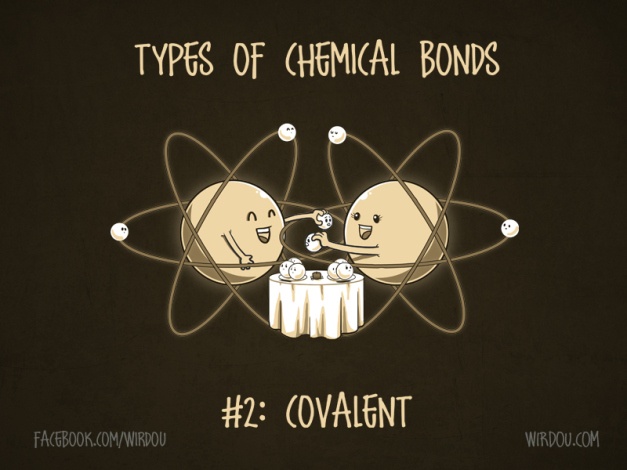
  • Two atoms sharing pair(s) of electrons = covalent

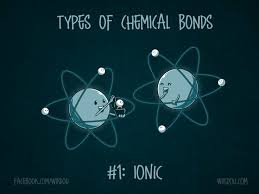
  • One atom transferring 1 or more valence electron to another atom = ionic

  • Sharing very equally = nonpolar

  • Sharing very unequally = polar; one side of the molecule hogs the electrons and gets a negative charge. The other side gets little electron attention and gets a positive charge.

74

Multiple Choice

Atoms always try to reduce their "stress" by being in the lowest possible energy state. They do this by

1

removing all of their electrons

2

balancing repulsive and attractive forces

3

emitting nuclear radiation

4

forming negatively charged ions

75

Multiple Choice

What happens when two nuclei are too close (or when two protons are too close to each other in the nucleus)?

1

Like charges attract

2

Like charges repel

3

Opposite charges attract

4

Opposite charges repel

76

Multiple Choice

Predict the bond that will form between Se and Cl.
1
Ionic
2
Covalent

77

Multiple Choice

Predict the bond that will form between Be and F.
1
Ionic
2
Covalent

78

Multiple Choice

Question image
An ionic bond forms when 
1
Valence electrons are shared
2
a sea of mobile electrons surround the cations
3
valence electrons are transferred between atoms
4
none of the above

79

Multiple Choice

Question image
In chemical compounds, covalent bonds form when
1
the electronegativity difference between two atoms is very large.
2
electrons are completely transferred between two metals.
3
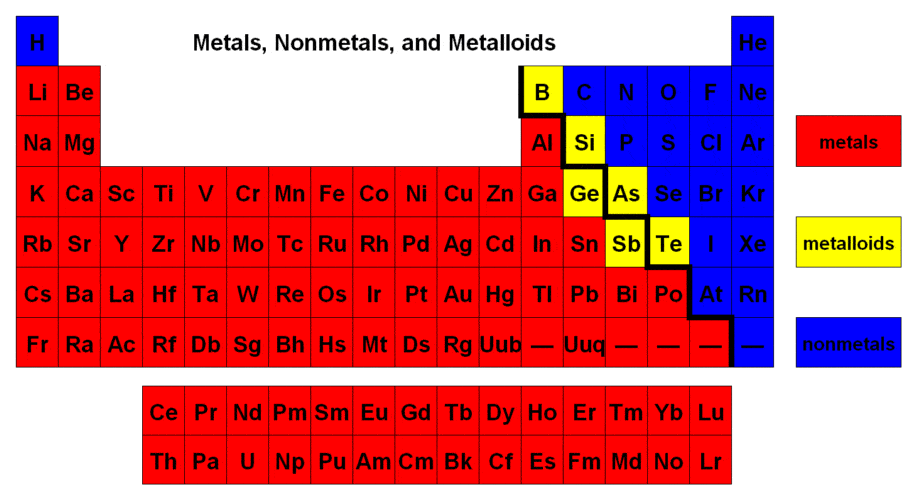
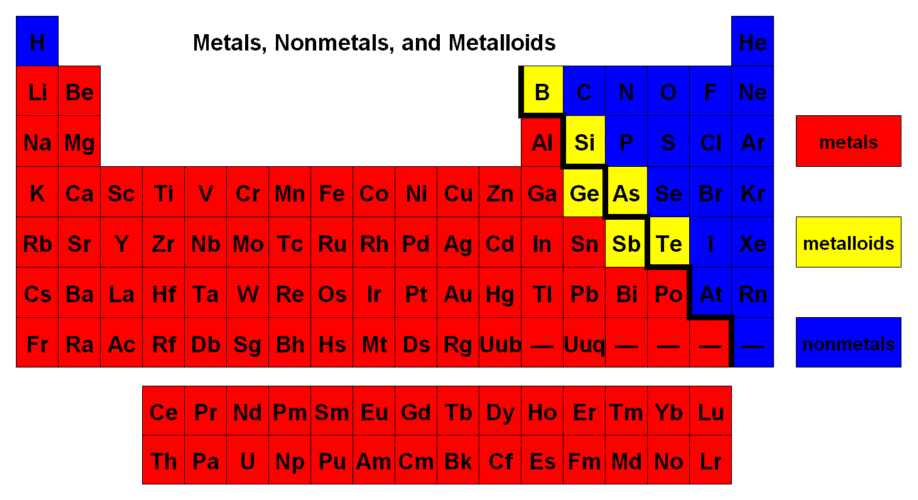
pairs of electrons are shared between two nonmetal atoms.
4
two nonmetal atoms are attracted to each other by opposite charges.

80

Multiple Choice

Question image
What elements generally make a covalent bond?
1
metal and nonmetal
2
2 or more nonmetals
3
metal
4
none of the above

81

Multiple Choice

Question image

What elements generally make an ionic bond?

1

metal and nonmetal

2

2 or more nonmetals

3

metal

4

none of the above

82

Multiple Choice

Question image

When you have H-Cl, what is the polarity?

1

nonpolar

2

polar

3

ionic

83

Multiple Choice

Question image

When you have Br-Br, what is the polarity?

1

Polar

2

nonpolar

3

Ionic

84

Chemical Reactions

  • Chemical reactions occur when old bonds are broken and/or new bonds are formed.

  • This involves electrons being transferred and/or shared, but the nucleus of each atom STAYS THE SAME.

  • Reactants (right side) have their bonds broken and the new bonds created form new products (left side).

  • Example: Hydrogen gas and oxygen gas (H2 and O2) react to form water (H2O).

  • The H-H bond and the O-O bond are broken, the H-O-H bonds are formed.

85

Chemical Equations

  • Must be balanced! The same number of atoms of each element MUST be the same on either side of the arrow.

  • If you start with 2 oxygen atoms on the right, you better have 2 oxygen atoms on the left.

  • Mass cannot be created or destroyed!


86

Chemical Equations

  • Coefficient is the number in front of each chemical formula

  • Subscripts are the small numbers behind each chemical symbol

  • EX: 6 H2O

  • 6 = coefficient; 2 = subscript

  • There are 6 molecules of the compound, H2O.

  • Therefore there are 6x2= 12 atoms of hydrgen and 6x1=6 atoms of oxygen.

87

Multiple Choice

What is the number before a chemical formula called?
Ex: 2H2 + O2 --> 2H2O
1
Coefficient
2
Subscript
3
Atom
4
Equation

88

Multiple Choice

How many Mn atoms are found in the reactants of the following equation as indicated by the coefficients?

3 Cr(MnO4)6 + 6 Na3N ----> ______________

1

3

2

4

3

6

4

18

89

Multiple Choice

Is the following equation balanced?
4Fe + 3O2 --> 2Fe2O3
1
yes
2
no

90

Multiple Choice

Is the following equation balanced?...
Al + O2 --> 2Al2O3
1
Yes!
2
No!

91

Multiple Choice

What does the Law of Conservation of Mass state?
1
Matter cannot be gained or lost in a chemical reaction.
2
Matter can only be lost in a chemical reaction.
3
Matter can only be gained in a chemical reaction.
4
Matter can be gained and lost in a chemical reaction. 

92

Multiple Choice

How many iron (Ag) atoms are reactants in this equation?

4Ag + 3O2 → 2Ag2O

1

4

2

2

3

3

4

0

93

Multiple Choice

Identify the product(s) in the following chemical reaction:


Chromium oxide + Carbon → Chromium + Carbon monoxide

1

Chromium and carbon.

2

Chromium and carbon monoxide.

3

Chromium and carbon dioxide.

4

Chromium oxide and carbon.

94

Multiple Choice

tells us the number of atoms of each element in a compound
1
Coeffecient
2
Exponent
3
Chemical Formula
4
Calculator

95

Multiple Choice

a substance formed when two or more elements are chemically bonded together
1
Element Soup
2
Pure Element
3
Ion
4
Compound

96

Multiple Choice

a substance that is formed as the result of a chemical reaction
1
Product 
2
Reactant
3
Starters
4
Enders

97

Multiple Choice

the starting materials in a chemical reaction
1
Products
2
Reactants
3
Starters
4
Enders

98

Stoichiometry

  • Creates a bridge between looking at individual atoms and molecules in a reaction to macroscopic quantities that we can actually measure in the lab, such as grams or kilograms

  • 1 mole of a substance = 6.022x10²³ particles of that substance

  • We know equations must be balanced because mass can't be created or destroyed. Stoichiometry allows us to know what quantity of tiny particles we are working with when we use larger measuring quantities such as grams.

99

Multiple Choice

Balance this equation:

Li + Cl2 → LiCl

1

2Li + Cl2 → 4LiCl2

2

2Li + Cl2 → LiCl2

3

2Li + Cl2 → 2LiCl

4

2Li + 2Cl2 → 2 LiCl2

100

Multiple Choice

If the balanced equation 2Li + Cl2 → 2LiCl is accurate, how many ATOMS of Li must react with 1 molecule of Cl2?

1

1 atom of Li per 1 molecule of Cl2

2

2 atoms of Li per 1 molecule of Cl2

3

1 atom of Li per 2 molecules of Cl2

4

2 atoms of Li per 2 molecules of Cl2

101

Multiple Choice

If the balanced equation 2Li + Cl2 → 2LiCl is accurate, how many MOLES of Li must react with 1 MOLE of Cl2?

1

1 mole of Li per 1 mole of Cl2

2

2 moles of Li per 1 mole of Cl2

3

1 mole of Li per 2 moles of Cl2

4

2 moles of Li per 2 moles of Cl2

102

Molar Mass

  • pretty straightforward, it's just the mass (in grams) of 1 mole of a substance

  • Find it by adding up all of the atomic masses for each atom in an element

  • Atomic masses are found on your periodic table

  • You'll need this for gas laws in Semester 2, so you may wish to take a picture of the next slide or screenshot it

103

Slide image

104

Multiple Choice

Calculate the molar mass of HNO3.

1

63.01

2

4

3

32

4

18.04

Chemistry Semester 1 Credit Recovery

Work through this Quizizz, watching videos and clicking on any links that you need to use. There are questions embedded as you go and you must get above an 80% to gain your credit back.

Slide image

Show answer

Auto Play

Slide 1 / 104

SLIDE