

Microorganism- friend and foe

Presentation
•
Science
•
8th Grade
•
Medium
+3
Standards-aligned

dorjee dolma
Used 14+ times
FREE Resource
10 Slides • 41 Questions
1
Microorganism- friend and foe
class 8

2
Microorganisms
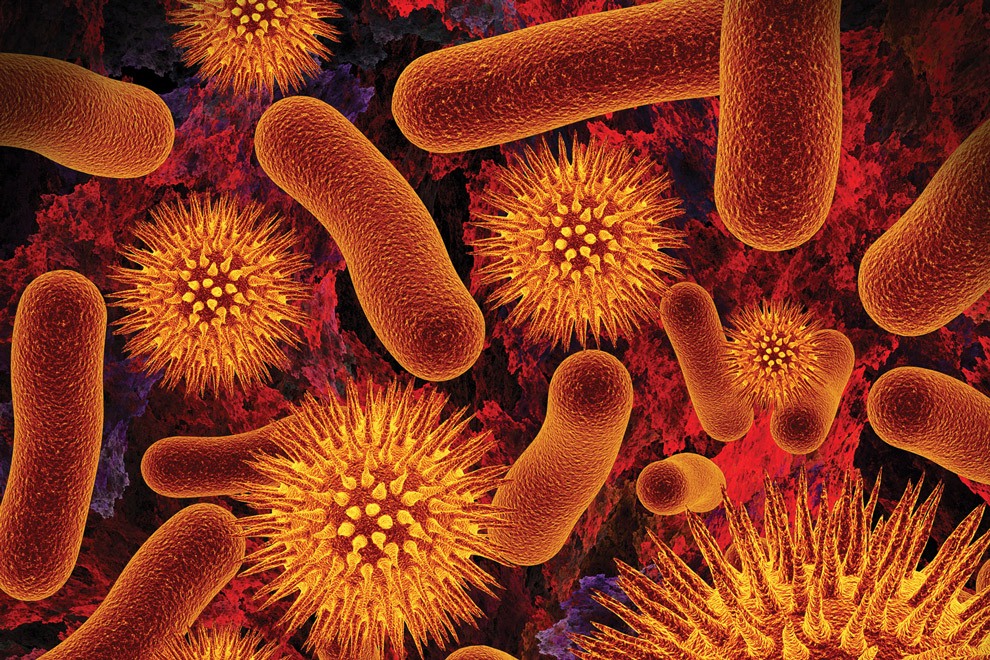
Microorganisms- The living organism around us that normally cannot seen with the naked eyes are known as Microorganisms or Microbes.
Microorganism can be seen with the help of magnifying glass or microscope.
3
Classification of Microorganism-
Bacteria- lactobacciluss, E.Coil etc
Fungi-Chlamydomonas, Spirogyra etc
Protozoans- Amoeba, Paramaecium etc
Algae-Bread mould, Penicillium, Aspergilles etc
Viruses
4
Viruses
Viruses are also considered as microorganisms
They are different from other microorganisms because they reproduce only in the body of host organisms like bacteria, plants or animals
Example : covid19 viruses etc
Virus is smallest microorganism on earth
Common aliments like cold, influenza (flu) and most coughs are also caused by viruses.
5
Multiple Choice
Amoeba belongs to
Algae
Fungi
Virus
Protozoa
6
Multiple Choice
Mushroom belongs to
Algae
Virus
Fungi
None of the above
7
Multiple Choice
What do you think microbe means ?
A microorganism, or microbe, is a microscopic organism, which may exist in its single-celled form or in a colony of cells.
It is a thing that enters the human body or an animal .
It is an insect
It is something that we found it in the ocean
8
Multiple Choice

What science tool is used to view organisms too small to see with a magnifying lens?
telescope
binoculars
microscope
netherscope
9
Multiple Choice
Cold, influenza and most cough are caused by ___?
Bacteria
Viruses
Fungi
None of these
10
Multiple Choice
11
Multiple Choice
12
Microorganism- friend
Making of curd from milk: The bacterium called Lactobacillus reproduces in milk and helps to convert into curd.
Making bread: The fungus called yeast reproduces in flour dough and produce carbon dioxide during respiration which makes the dough soft and helps in making bread, cakes, biscuits, pastries etc
13
Commercial use of microorganism
Microorganism are used for the large scale production of alcohol, wine, and vinegar. Yeast used for commercial production of alcohol and wine.
The process of conversion of sugar into alcohol is known as fermentation.
louis Pasteur discovered fermentation in 1857
14
Medicinal use of Microorganisms
Making Antibiotics that produced from bacteria and fungi. Streptomycin, tetracyline, penicillin and erythromycin are some of the commonly known antibiotics.
The medicines kill or stop the growth of the disease- causing microorganisms.
Alexander Fleming discovered penicillin.
Making Vaccine.
Edward Jenner discovered the vaccine for small pox in 1788
15
Increasing soil fertility
Some bacteria and blue green algae are able to fix nitrigen from the atmosphere to enrich soil with nitrogen and increase its fertility. These microbes are commonly called biological nitrogen fixers
16
Cleaning the environment
You often see large amounts of dead organic matter in the form of decaying plants and sometimes dead animals on the ground. You find that they disappear after sometime. This is because the microorganisms decompose dead organic waste of plants and animals coverting them into simple substances.
17
Multiple Choice
The algae that fixes atmospheric nitrogen from air and thus enriches the soil with nitrogenous compound for plants is
Blue green algae
Chlorella
Diatoms
Chlamydomonas
18
Fill in the Blanks
A bacteria responsible for curdling of milk is:
Type answer...
19
Multiple Choice

20
Multiple Choice
21
Multiple Choice
Who discovered Fermentation ?
Edward Jenner
Alexander Fleming
Louis Pasteur
Selman Waksman
22
Multiple Choice
The process of conversion of sugar into alcohol is known as ...
Budding
Fusion
Fermentation
Fixation
23
Multiple Choice
Antibiotics
kill disease-causing microorganisms
slow down the growth of disease-causing microorganisms
convert sugar into alcohol
speed up the growth of micoorganisms
24
Multiple Choice
Fungi is beneficial to us beacause of the following reason
They are a source of oxygen
They can clean up pollution
They are a source of antibiotics
They help to clean run off from waste
25
Multiple Choice
Who discovered vaccine for smallpox?
Robert Koch
Edward Jenner
Louis Pasteur
Alexander Fleming
26
Multiple Choice
Penicillin was discovered by
Edward Jenner
Louis Pasteur
Alexander Fleming
Robert Brown
27
Harmful Microorganism
Microorganisms are harmful in many ways. Some of the microorganisms cause diseases in human beings, plants and animals. Such disease-causing microorganisms are called pathogens.
28
Multiple Choice
29
Multiple Choice
Gas that makes up almost 78% of Earth's atmosphere
Oxygen
Carbon dioxide
Nitrogen
Hydrogen
30
Multiple Choice
Organism that breaks down dead plants & animals and releases nitrogen back into atmosphere
Bacteria
Plants
Animals
Producers
31
Multiple Choice
How nitrogen is "fixed" into useable form for plants
Only through action of bacteria
Only through lightning
Through action of bacteria & lightning
Through photosynthesis
32
Multiple Choice
Which of these is an example of an antibiotic?
Pencillin
Tylenol
Advil
Tumms
33
Multiple Choice
Nitrogen-fixing bacteria are important because...
They are decomposers
They are salt lovers
They provide protection for plants from diseases
They make nitrogen available to plants in form they can use
34
Multiple Choice

_________________ bacteria are in your _________________ to help digest food.
Helpful; throat
Helpful; stomach
Harmful; esophagus
Harmful; lungs
35
Multiple Choice
36
Multiple Choice
37
Multiple Choice
Which is not an example of a harmful microorganism?
Mold growing on a kitchen sponge
Bacteria found in yogurt
Bacteria that causes turberculosis
Salmonella on uncooked chicken
38
Multiple Choice
39
Multiple Choice
40
Multiple Choice
Rhizobium bacteria
Help in Digestion
Help in nitrogen fixation
Cause diseases
All the above
41
Multiple Choice
Diseases anthrax caused by
Virus
Bacteria
Fungi
None of these
42
Multiple Choice
Female Aedes mosquito is the carrier of
Corona virus
Dengue virus
Common cold virus
Measles virus
43
Multiple Choice
Plant diseases rust of wheat is caused by
Bacteria
Virus
Fungi
Protozoa
44
Multiple Choice
The most common carrier of communicable diseases is
Ant
Housefly
Dragonfly
Spider
45
Multiple Choice
Cholera is caused by
Bacteria
Protozoa
Virus
Fungi
46
Multiple Choice
Carrier of malaria causing protozoan is
Female Anopheles mosquito
Cockroach
Housefly
Butterfly
47
Multiple Choice
The algae that fixes atmospheric nitrogen from air and thus enriches the soil with nitrogenous compound for plants is
Blue green algae
Chlorella
Diatoms
Chlamydomonas
48
Multiple Choice
Food preservation can not be done by
adding salt
adding sugar
drying under the sun
adding kerosene
49
Multiple Choice
The microorganisms that cause diseases in human beings, plants and animals are called _
Carriers
Spirogyra
Pathogens
Antibodies
50
Multiple Choice
Conversion of nitrogen to ammonia is
nitrification
phosphorylation
denitrification
nitrogen fixation
51
Multiple Choice
Consumption of food spoiled by some micro-organisms causes ____.
Food-poisoning
Cancer
Lungs
None of these
Microorganism- friend and foe
class 8
Show answer
Auto Play
Slide 1 / 51
SLIDE
Similar Resources on Wayground

45 questions
Periodic Table Doodle Notes
Presentation
•
8th Grade
44 questions
12/2 - Newton's 3rd Law of Motion
Presentation
•
8th Grade
48 questions
Lesson: Electricity Introduction
Presentation
•
9th Grade
47 questions
Review of Plate Tectonic Theory
Presentation
•
8th Grade
46 questions
Introduction to Adaptation
Presentation
•
8th Grade
46 questions
Free Body Diagrams, Speed, Velocity, Acceleration
Presentation
•
8th Grade
46 questions
It's Electrifying! Notes
Presentation
•
8th Grade
44 questions
Ecological Relationship
Presentation
•
8th Grade
Popular Resources on Wayground
10 questions
Safety Day 2026 – Student Review

Quiz
•
9th Grade
21 questions
Continents and Oceans
Quiz
•
6th Grade
20 questions
Parts of Speech
Quiz
•
5th Grade
16 questions
Subject & Predicate
Quiz
•
5th Grade
25 questions
Multiplication Facts
Quiz
•
5th Grade
12 questions
Map Skills
Quiz
•
3rd Grade
22 questions
Continents and Oceans
Quiz
•
5th Grade
15 questions
Rounding Decimals
Quiz
•
5th Grade
Discover more resources for Science
20 questions
Newton's Laws of Motion
Quiz
•
8th Grade
15 questions
potential and kinetic energy
Quiz
•
8th Grade
21 questions
Newton's Laws of Motion
Quiz
•
8th Grade
20 questions
Elements, Compounds and Mixtures
Quiz
•
8th Grade
10 questions
Exploring Chemical and Physical Changes

Interactive video
•
6th - 10th Grade
20 questions
Physical vs Chemical Changes
Quiz
•
8th Grade
20 questions
Conduction, convection, and Radiation Practice
Quiz
•
8th Grade
21 questions
Waves and Wave Properties
Quiz
•
6th - 8th Grade