

Galaxy Formation

Presentation
•
Physics
•
9th Grade
•
Medium
Standards-aligned

g Custer
Used 33+ times
FREE Resource
12 Slides • 9 Questions
1
Galaxy Formation

2
3
Multiple Choice
4
Multiple Choice
5
Multiple Choice
6
What is a Galaxy?
A group of billions of stars and their planets, gas, and dust that extends over many light-years and forms a unit within the universe.
Held together by gravitational forces

7
"Discovery" of Galaxies
Early astronomers observed these “spiral nebulae” and most believed them to be clouds of gas and stars within our own galaxy.
In 1924, Edwin Hubble was able to measure the distance to the “Great Nebula in Andromeda” and found its distance to be much larger than the size of the Milky Way.

8
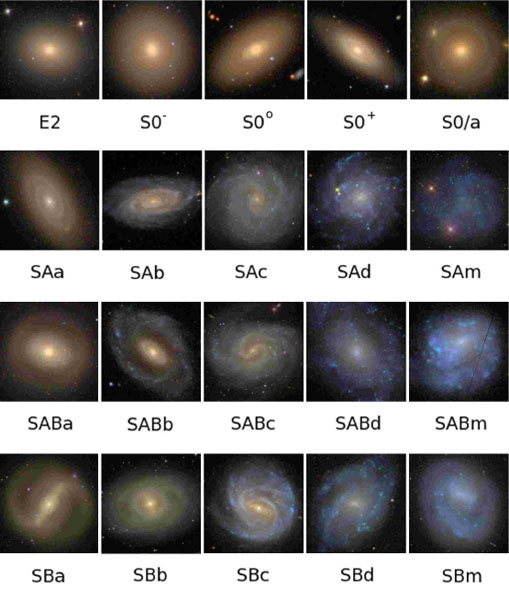
Galaxy Classification
Hubble divided galaxies into different “classes” based on their appearance.
These are part of the "basic language" of Physics.

9
10

11
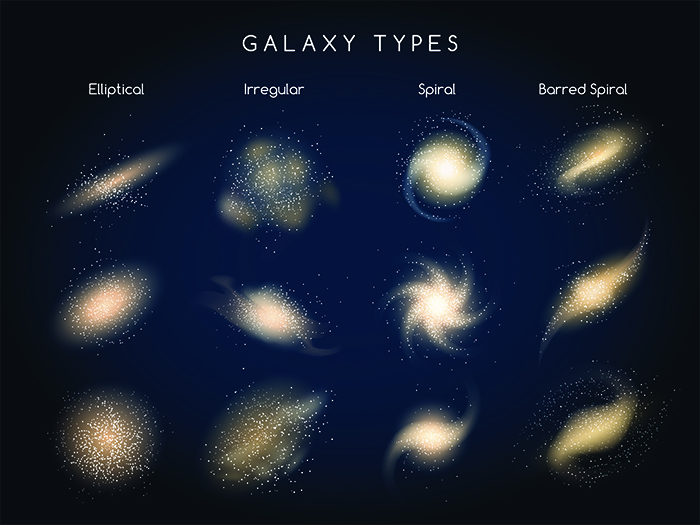
Spiral Galaxies
Have long arms winding toward a bright bulge at the center.
The difference between tightly and loosely wound spirals can be used to classify spiral galaxies.
About 77% of the observed galaxies in the universe are spiral galaxies.

12
Elliptical Galaxies
Shaped like a squished circle.
Elliptical galaxies are classified by how stretched out they are.
The most abundant type of galaxies found in the universe but because of their dim qualities, they're often outshone by other galaxies

13
Irregular Galaxies
The catchall name given to any galaxy that does not neatly fit into one of the other categories.
They have no defined shape nor structure and may have formed from collisions or violent activity.
Some of the smallest galaxies and are full of gas and dust, signifying star formation.

14
15
16
Multiple Select
17
Multiple Choice
18
Multiple Choice

Irregular galaxies are defined as having
19
Multiple Choice

Spiral galaxies are best described as
20
Multiple Choice

Elliptical galaxies can be described as having
21
Multiple Choice
Galaxy Formation
Show answer
Auto Play
Slide 1 / 21
SLIDE

