A Whale of a Tale
Presentation
•
Biology
•
11th Grade - University
•
Practice Problem
•
Hard
Cheryl Graves
Used 1+ times
FREE Resource
41 Slides • 7 Questions
1
A Whale of a Tale
2
3
This was removed from "The Origin of Species"
4
1980's --creationists lamented the lack of whale fossils
5
6
Multiple Choice
Which statement best describes your understanding of the origin of whales?
Whales were created in their current form and did not evolve from four-legged, terrestrial (land-dwelling) ancestors.
Whales evolved from four-legged, terrestrial ancestors over millions of years.
Whales evolved, but only in terms of adapting to better survive in their current environment; they did not evolve from a terrestrial creature.
7
8
9
Multiple Choice
If you could imagine a “missing link” for whale evolution, how might you describe its appearance?
Half whale, half land animal.
Like a whale or fish, but with legs.
Like a land animal, such as a bear, wolf, or hippo.
None of the above.
10
11
12
13
14
15
16
17
Multiple Choice
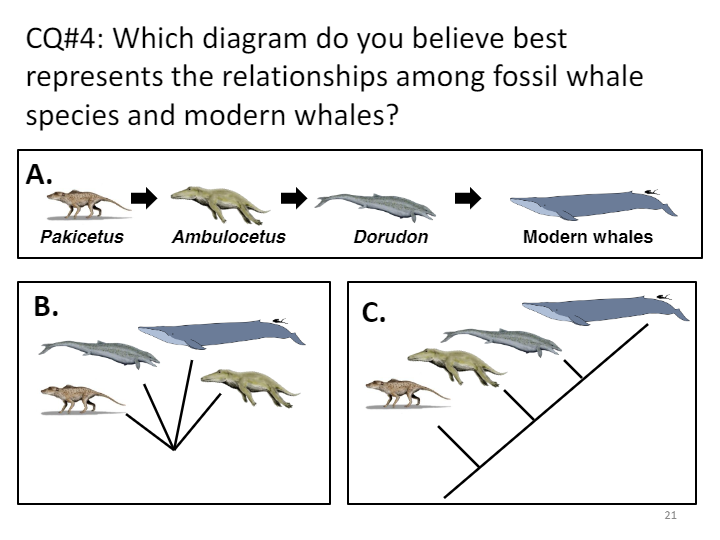
Which diagram best resembles the sketch / relationships you envisioned?
[Diagram showing a “creative burst” of family relationships.]
[Diagram showing a “branching tree” of family relationships.]
[Diagram showing a “linear progression” of family relationships.]
18
19
20
21
22
23
24
Multiple Choice
Which diagram best resembles the sketch / relationships you envisioned?
[Diagram showing a “linear progression” of evolutionary relationships.]
[Diagram showing a “creative burst” of evolutionary relationships.]
[Diagram showing a “branching tree” of evolutionary relationships.]
25
26
27
28
29
30
31
32
33
34
Multiple Choice
Using the simple tree, which of the following statements is true?
Taxa C is more closely related to B than to D.
Taxon B descended from A.
Time proceeds from left to right (A → D).
Taxa A and B are close relatives, as are C and D.
35
36
37
38
39
40
Multiple Choice
Using the concept of human evolution, which of the following statements reflects a branching, rather than a linear process
Chimpanzees are the simpler, more primitive ancestors of humans, which are their descendants.
Humans will eventually be replaced by a more advanced organism.
Humans and chimpanzees are evolutionary cousins; one is not the direct descendant of the other.
If we evolved from chimps, there should not be anymore chimps.
41
42
43
44
45
46
47
48
Multiple Choice
Now what do you think? Which statement best describes your current understanding of the origin of whales?
Whales were created in their current form and did not evolve from four-legged, terrestrial (land-dwelling) ancestors.
Whales evolved from four-legged, terrestrial ancestors.
Whales evolved, but only in terms of adapting to better survive in their current environment; they did not evolve from a terrestrial creature.
A Whale of a Tale

Show answer
Auto Play
Slide 1 / 48
SLIDE

Similar Resources on Wayground
41 questions
Mental Health
Presentation
•
9th - 12th Grade
38 questions
Unit 12 Organic lesson 2: isomers, branching alkanes, alkenes,
Presentation
•
10th Grade - University
47 questions
Evolution and Speciation Review AP Bio
Presentation
•
9th Grade - University
41 questions
Biochemical Evidence for Evolution
Presentation
•
9th - 12th Grade
41 questions
A Global Conflict
Presentation
•
10th Grade - University
38 questions
Unit 7.1: Evidence for Evolution Notes
Presentation
•
9th - 12th Grade
43 questions
English 1 UNIT 3 Extended Family
Presentation
•
University
45 questions
Promotion
Presentation
•
12th Grade
Popular Resources on Wayground
10 questions
Safety Day 2026 – Student Review
Quiz
•
9th Grade
21 questions
Continents and Oceans
Quiz
•
6th Grade
20 questions
Parts of Speech
Quiz
•
5th Grade
16 questions
Subject & Predicate
Quiz
•
5th Grade
25 questions
Multiplication Facts
Quiz
•
5th Grade
12 questions
Map Skills
Quiz
•
3rd Grade
22 questions
Continents and Oceans
Quiz
•
5th Grade
15 questions
Rounding Decimals
Quiz
•
5th Grade
Discover more resources for Biology
20 questions
Cell Transport
Quiz
•
9th - 12th Grade
8 questions
DNA vs. RNA
Presentation
•
9th - 12th Grade
16 questions
Epithelial tissues
Quiz
•
11th - 12th Grade
15 questions
DNA Structure and Replication
Quiz
•
9th - 12th Grade
20 questions
Ecological Succession Review
Quiz
•
9th - 12th Grade
22 questions
Photosynthesis and Cellular Respiration Review
Quiz
•
9th - 11th Grade
3 questions
Enzymes & Energy
Quiz
•
9th - 12th Grade
38 questions
Mitosis & Meiosis
Quiz
•
9th - 12th Grade