


SAMPLING TECHNIQUE
Presentation
•
English
•
11th Grade
•
Practice Problem
•
Medium
Ellainne Jumalon
Used 9+ times
FREE Resource
25 Slides • 27 Questions
1
SAMPLING TECHNIQUE
Prepared by: Ms. Ellainne Mae Joy S. Jumalon
2
At the end of this lesson, you should be able to:
Expand your vocabulary
Communicate your world perceptions
Define sampling ad other technical terms about sampling
Compare-contrast the sampling methods
Give a graphical presentation of sampling categories
Pick out an appropriate sampling method for your chosen research topic
3
Linking Old and New Knowledge
Activity 1: Making Words Meaningful
Choose the word that corresponds in the meaning to the italicized word in the sentence. Be guided by the contextual clues
4
Multiple Choice
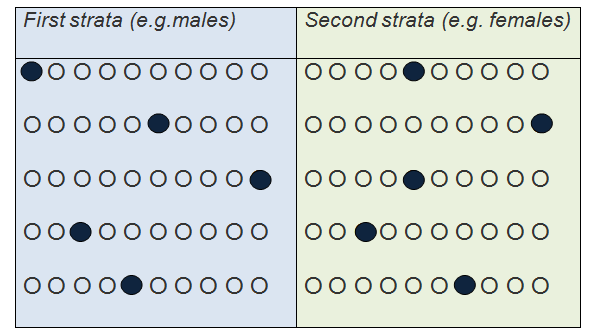
Doing business is my parents' way to derive our family income
keep
get
display
budget
5
Multiple Choice
Name the islands that constitute the town of Hundred Islands in Pangasinan
represent
advertise
compose
popularize
6
Multiple Choice
To lands as top-paying is the impetus behind his desire to graduate as cumlaude
clue
reward
force
secret
7
Multiple Choice
The cabinet members are ready to tackle issues propounded by the businessmen.
questioned
forwarded for mailing
contrasted
written for recording
8
Multiple Choice
Please categorize the books based on subject area.
classify
count
mark
arrange
9
Multiple Choice
Her religiosity was manifested by her regular attending of Holy Mass.
pictures
shown
stressed
signalled
10
Multiple Choice
Numerous stars blossom in the sky.
glittering
a big number
twinkling
a small number of
11
Multiple Choice
Give him more time to mull over your proposal
remember
question
criticize
ponder
12
Multiple Choice
Give the mendicant on the street food rather than money.
janitor
beggar
street laborer
street vendor
13
Multiple Choice
Students getting grades of 75, 82, 88, 92, and 96 belong to a heterogeneous group; the same grade of 95-96, to a homogenous group
varied abilities
little ability
same abilities
zero ability
14
Stirring up Imagination
Accomplish the following KWL about sampling. Do KW
15
Open Ended
What I already know
16
Open Ended
What I want to know
17
SAMPLING
In research, sampling is a word that refers to your method or process of selecting respondents or people to answer questions meant to yield data for a research study.
18
SAMPLING
The chosen ones constitute the sample through which you will derive facts and evidence to support the claims or conclusions propounded by your research problem.
19
20
Sampling Frame
It is the term used to mean the list of members of such population from where you will get the sample. (Paris, 2013)
21
History
The beginning of sampling could be traced back to the early political activities of the Americans in 1920 when Literary digest did a pioneering survey about the America Citizens' favorite among the 1920 presidential candidates. This was the very first survey that served as the impetus for the discovery by academic researchers of other sampling strategies that they categorized into two classes: probability sampling or unbiased sampling and non-probability sampling. (Babbie 2013)
22
Probability Sampling or Unbiased Sampling
Probability Sampling involved all members listed in the sampling frame representing a certain population focused on by your study. An equal chance of participation in the sampling or selection process is given to every member listed in the sampling frame.
23
Sampling Error
Crops up if the selection does not take place in the way it is planned. Such sampling error is manifested by strong dissimilarity between the errors are depends on the size of the sample.
24
Types of Probability Sampling
Identify the probability sampling that corresponds to the picture
25
Multiple Choice
Simple Random Sampling
Systematic Sampling
Stratified Sampling
Cluster Sampling
26
Multiple Choice
Simple Random Sampling
Systematic Sampling
Stratified Sampling
Cluster Sampling
27
Multiple Choice
Simple Random Sampling
Systematic Sampling
Stratified Sampling
Cluster Sampling
28
Multiple Choice
Simple Random Sampling
Systematic Sampling
Stratified Sampling
Cluster Sampling
29
Simple Random Sampling is the best type of probability sampling through which you can choose the sample from a population. Using a pure-chance selection, you assure every member the same opportunity to be in the sample.
30
Chance and system are the ones to determine who should compose the sample. For instance, if you want to have a sample of 150, you may select set of numbers like 1 to 15, and out of a list of 1500 students, take every 15th name on the list until you complete the total number of respondents to constitute your sample
31
The group comprising the sample is chosen in a way that such group is liable to subdivision during the data analysis stage. A study needing group-by-group analysis finds stratified sampling the right probability sampling to use.
32
This is a probability sampling that makes you isolate a set of persons instead of individual members to serve as sample members. For example, if you want to have a sample of 120 out of 1000 students, you can randomly select three sections with 40 students each to constitute the sample.
33
Non Probability Sampling
Disregards random selection of subjects. The subjects are chosen based on their availability or the purpose of the study and in some cases, on the sole direction of the researcher.
34
Qouta Sampling
You tend to choose sample members possessing or indicating the characteristics of the target population.
35
Voluntary Sampling
There is no need for you to do any selection process
36
Purposive Sampling
You choose people whom you are sure could correspond to the objectives of your study, like selecting those with rich experience or interest in your study.
37
Availability Sampling
The willingness of a person as your subject to interact with you counts a lot in this non-probability sampling method.
38
Snowball Sampling
does not give a specific set of sample.
39
ACTIVITY 2
Choose Probability is the sentence talks about probability sampling; otherwise, choose Non Probability
40
Multiple Choice
Checking every 10th student in the list
Probability
Non Probability
41
Multiple Choice
Interviewing some persons you meet on the campus
Probability
Non Probability
42
Multiple Choice
Dividing 100 persons into groups
Probability
Non Probability
43
Multiple Choice
Choosing subjects behaving like the majority members of NPC town
Probability
Non Probability
44
Multiple Choice
Choosing a group of subjects among several groups
Probability
Non Probability
45
Multiple Choice
Choosing a subjects capable of helping you meet the aim of your study
Probability
Non Probability
46
Multiple Choice
Choosing samples by chance but through organizational pattern
Probability
Non Probability
47
Multiple Choice
Letting all members in the population join in the selection process.
Probability
Non Probability
48
Multiple Choice
Having people willing to be chosen as respondents
Probability
Non Probability
49
Multiple Choice
Matching people's traits with the population members' traits
Probability
Non Probability
50
Open Ended
What have you learned?
51
52
SAMPLING TECHNIQUE
Prepared by: Ms. Ellainne Mae Joy S. Jumalon

Show answer
Auto Play
Slide 1 / 52
SLIDE

Similar Resources on Wayground
46 questions
MP Reading Lesson 13 - Summarize Key Ideas and Details Pt. 2
Presentation
•
11th Grade
45 questions
Unit 10 Revision M5
Presentation
•
11th Grade
45 questions
Clauses
Presentation
•
11th Grade
47 questions
Archetypes Intro
Presentation
•
12th Grade
43 questions
Unit 1 Lord of the Flies Vocabulary
Presentation
•
11th Grade
45 questions
Thanksgiving!
Presentation
•
10th - 12th Grade
43 questions
Clase 12_07_2023- INGLÉS
Presentation
•
11th Grade
42 questions
Grade 2 - Unit 5, 6, 7
Presentation
•
KG
Popular Resources on Wayground
20 questions
STAAR Review Quiz #3
Quiz
•
8th Grade
20 questions
Equivalent Fractions
Quiz
•
3rd Grade
6 questions
Marshmallow Farm Quiz
Quiz
•
2nd - 5th Grade
20 questions
Main Idea and Details
Quiz
•
5th Grade
20 questions
Context Clues
Quiz
•
6th Grade
20 questions
Inferences
Quiz
•
4th Grade
19 questions
Classifying Quadrilaterals
Quiz
•
3rd Grade
12 questions
What makes Nebraska's government unique?
Quiz
•
4th - 5th Grade
Discover more resources for English
20 questions
Grammar
Quiz
•
9th - 12th Grade
18 questions
Review: Counterclaim & Rebuttal Quiz (Due 2/8/21)
Quiz
•
9th - 12th Grade
20 questions
Figurative Language Review
Quiz
•
6th - 12th Grade
10 questions
GMAS ELA Review
Quiz
•
KG - University
20 questions
English 2 STAAR Grammar Review
Quiz
•
9th - 11th Grade
24 questions
English I/II STAAR Review
Presentation
•
9th - 12th Grade
25 questions
STAAR Review: Revising and Editing
Quiz
•
9th - 12th Grade
20 questions
Advanced Punctuation
Quiz
•
10th - 11th Grade