

Chemistry: Unit 1 Module 2 - What is Chemistry

Presentation
•
Chemistry
•
9th - 12th Grade
•
Medium
+1
Standards-aligned

Ryan McCluskey
Used 52+ times
FREE Resource
27 Slides • 9 Questions
1
Unit 1 Lesson 2
2

3

4

5

Chemistry-and Physics
Physics is the study of energy and motion.
6

Chemistry-and Physics
Chemistry can be defined as the study of matter and all of it’s interactions.
7
Basically Matter is defined as anything that has MASS and takes up SPACE.
But I think it is sometimes easier to describe what isn't matter
Everything is matter except for ENERGY. I.E. Heat, Light, Electricity.
8
9
Besides mass matter all takes up some sort of space.
This space is defined as the volume of matter.
We will measure volume in several different ways but it is simply a measure of the space occupied by a from of matter.

10
Multiple Choice

Which of these would be a measure of mass?
10 meters
10 grams
10 pounds
10 seconds
11
Multiple Choice

Chemistry is often defined as the study of __________.
Matter
Energy
Magic
Motion
12

In chemistry we strive to identify matter and separate it by it's properties.
Chemistry Measurements
Properties can be sorted into two categories.
Intensive - Don't change based on amount
Extensive - Do change based on amount
13
Intensive properties are very important for separating matter or classifying it. In chemistry one of the most common intensive properties used is Density.
Chemistry Measurements
Properties can be sorted into two categories.
Intensive - Don't change based on amount
Extensive - Do change based on amount
14

Density is the ratio of a substances mass to it's volume. Two very common measurements taken in a chemistry lab.
Chemistry Measurements
Density is intensive because the ratio stays the same no matter how much or how little of a substance you have.
Density is commonly used to separate substances that look very similar.
15

Chemistry Measurements
A gold sluice can separate the gold from sand because of it's very high density.

16

17

18

19

20

21
Multiple Choice
The volume of a candy bar is 55cm3.The mass of the candy bar is 70g. What is the density of the candy bar?
2.3g/cm3
3850g/cm3
.8g/cm3
1.3g/cm3
22
Multiple Choice

2 g/cm3
4 g/cm3
6 g/cm3
8 g/cm3
23
Multiple Choice

Show all your work on your answer document. D=m/v
0.33 g/cm3
15 g/cm3
3 g/cm3
9 g/cm3
24
Multiple Choice
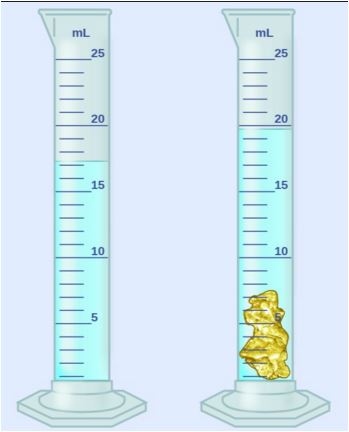
9 g/mL
10.5 g/mL
6.5 g/mL
8 g/mL
25

26
In order to classify matter we have to be able to identify properties of matter.
These properties can be measured with our senses or with chemical processes and equipment.

27
Anything you can observe about an object or substance without changing the substance which makes it up.
Examples: Density, shape, size, color, magnetism, melting and boiling point

28
Physical Properties can be Qualitative or Quantitative.
Qualitative properties are described without using numbers or value. They describe the quality of the sample.
29
Physical Properties can be Qualitative or Quantitative.
Quantitative properties are described by using numbers or value. They measure some quantity of the sample.
30
Physical changes are those changes which do not change the composition of the substance only the shape or state.
The most commonly mistaken are phase changes. Boiling water till it evaporates is only a physical change.

31
Chemical properties are those properties which indicate whether a substance will undergo specific chemical processes.
Examples: Flammability, reactivity with acids or bases or combustibility.

32
Any change that can change the composition of the substance.
Since we can't see the composition of the substance we look for common evidence of a chemical change.

33
Evidence a chemical change has occurred:
Production of gas - smoke, bubbles, odor
Production of light - flames, sparks, glow sticks
Change in temperature - hot or cold without added source
Formation of a precipitate - a solid forms when two liquids are mixed
Change in color - color is not added but is result of reaction
34
Multiple Select
Which of the following is an intensive property?
Freezing Point
Mass
Color
Length
Volume
35
Multiple Choice
An ice cream cone melts in a kid's hand while walking outside on a hot summer day. What is this an example of?
Physical property
Chemical property
Physical change
Chemical change
36
Multiple Choice
Water boils at 100˚C. What is this an example of?
Physical property
Chemical property
Physical change
Chemical change
Unit 1 Lesson 2
Show answer
Auto Play
Slide 1 / 36
SLIDE
Similar Resources on Wayground

30 questions
Ohm's Law in Series and Parallel Circuits
Presentation
•
9th - 12th Grade
28 questions
Intermolecular Forces & Physical Properties
Presentation
•
9th - 12th Grade
30 questions
Unit 2.6: Fossil Fuels
Presentation
•
9th - 12th Grade
35 questions
Chemistry Math Basics
Presentation
•
9th - 12th Grade
25 questions
Balancing Chemical Reactions
Presentation
•
9th - 12th Grade
33 questions
Specific Heat Review Lesson
Presentation
•
9th - 12th Grade
31 questions
Phases and Phase Changes
Presentation
•
9th - 12th Grade
Popular Resources on Wayground
10 questions
Safety Day 2026 – Student Review

Quiz
•
9th Grade
21 questions
Continents and Oceans
Quiz
•
6th Grade
20 questions
Parts of Speech
Quiz
•
5th Grade
16 questions
Subject & Predicate
Quiz
•
5th Grade
25 questions
Multiplication Facts
Quiz
•
5th Grade
12 questions
Map Skills
Quiz
•
3rd Grade
22 questions
Continents and Oceans
Quiz
•
5th Grade
15 questions
Rounding Decimals
Quiz
•
5th Grade
Discover more resources for Chemistry
20 questions
electron configurations and orbital notation
Quiz
•
9th - 12th Grade
20 questions
Periodic Table Trends
Quiz
•
11th Grade
25 questions
Writing and Naming Binary Ionic compounds
Quiz
•
10th Grade
20 questions
COUNTING ATOMS
Quiz
•
10th Grade
50 questions
Unit 3: Atomic Assault Summative Review
Quiz
•
11th Grade
20 questions
Physical or Chemical Change/Phases
Quiz
•
8th Grade - University
15 questions
Periodicity Module Exam Practice Quiz
Quiz
•
9th - 12th Grade
20 questions
Naming Ionic Compounds
Quiz
•
10th Grade