

Transport in Plants

Presentation
•
Biology
•
8th Grade
•
Medium

Lita Yuanita
Used 39+ times
FREE Resource
28 Slides • 12 Questions
1
Transport in Plants
Grade 8th
2
Plant Transport System

3
8.1 Plant Transport System
The roots, stem and leaves form a plant organ system for the transport of substances around the plant
Plants also possess two specialist transport vessels called the xylem and phloem
The xylem and phloem are arranged throughout the root, stem and leaves in groups called vascular bundles
4
Structure and function of the xylem
Xylem vessels transport water and minerals from the roots to the stem and leaves
The xylem has some key structural features
A substance called lignin is deposited in the cell walls which causes the xylem cells to die
Lignin strengthens the plant to help it withstand the pressure of the water movement
These cells then become hollow (as they lose all their organelles and cytoplasm) and join end-to-end to form a continuous tube for water and mineral ions to travel through from the roots
5
Structure and function of the phloem
Phloem vessels transport food materials (mainly sucrose and amino acids) made by the plant from photosynthesising leaves to non-photosynthesising regions in the roots and stem.
The phloem has structural features different to the xylem
The cells are living cells and are not hollow
The cells are joined end to end and contain pores in the end cell walls (called sieve plates) which allow easy flow of substances from one cell to the next
6

Xylem?
Phloem?
7
Vascular tissue in a dicotyledonous plant

8
Multiple Choice
The plant tissue that carries food materials DOWNWARD from the leaves to the rest of the plant is the ______.
Phloem
Stomata
Chlorophyll
Xylem
9
Multiple Choice
Vascular tissue that transports water and minerals UPWARDS from a plant's roots is know as ______.
Chlorophyll
Phloem
Stomata
Xylem
10
Multiple Choice
Which of the following is paired correctly:
xylem : vessels
phloem : sieve tubes
xylem : sieve tubes
phloem : vessels
11

12
Which one dicot stem cross section


A
B
13
8.2 Water uptake
Root hair cells are adapted for the efficient uptake of water (by osmosis) and mineral ions (by active transport)
Root hairs are single-celled extensions of epidermis cells in the root
They grow between soil particles and absorb water and minerals from the soil
Root hairs increase the surface area to volume ratio significantly
This increases the rate of the absorption of mineral ions by active transport
The high proportion of dissolved minerals and sugars in the cytoplasm (of the root hair cell) give it a low water potential (less watery)
Water moves into the root hair cell by osmosis
14
The route of water through the plant
Water moves, by osmosis, into the root hair cells, through the root cortex and into the xylem vessels:
Once the water gets into the xylem, it is carried up to the leaves where it enters mesophyll cells
So the pathway is:
root hair cell → root cortex cells → xylem → leaf mesophyll cells

15
Multiple Choice
How do water enter the roots from the soil?
diffusion
osmosis
transpiration
active transport
16
Multiple Choice
This is the definition for which word: The movement of particles down a concentration gradient (from a high concentration to a low concentration)
Osmosis
Diffusion
Active transport
Transpiration
17
8.3 Transpiration
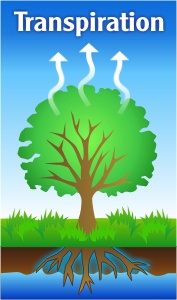
Transpiration is defined as the loss of water vapour from the parts of the plant that are above ground (leaves, stem, flowers)
Loss of water occurs through evaporation of water at the surfaces of the spongy mesophyll cells followed by diffusion of water vapour through the stomata
The many interconnecting air spaces between the mesophyll cells and the stomata creates a large surface area
This means evaporation can happen rapidly when the stomata are open
18
Multiple Choice
Transpiration is
the movement of water through a plant from the roots up the stem
the loss of water from the leaves of a plant by the process of evaporation
the flow of water into plant roots by osmosis from the soil
the process of minerals and sugars moving through plant veins
19
The effect of Transpiration
Water moves through the xylem vessels in a continuous transpiration stream from the roots to the leaves via the stem to replace the water that has been lost due to transpiration
Due to cohesion, the water in the xylem creates a continuous unbroken column (each individual molecule ‘pulls’ on the one below it)
Transpiration produces tension or ‘pulls’ on the water in the xylem vessels
If the rate of transpiration from the leaves increases, water molecules are pulled up the xylem vessels quicker
20
Multiple Choice
Why is the evaporation of water from leaves important?
It cools leaves and helps move water up the plant.
It makes the plant wilt
It helps the plant to respire
21
Movement water from root to leaf


22
Structure of a plant is adapted to help it to take up water and move it up to plant
The root hair cells provide a huge surface area which water can be absorbed
The hollow, narrow xylem vessel provide an easy pathway for water to flow up
Many air spaces inside leaf mean there is a large surface area of wet cells which water can evaporate
The stomata when open allow water vapor diffuse easily out of leaf that creates low water potential
23

Open and Close Stomata
24
Review


25
There are several environmental conditions which have an impact on the rate of transpiration
Temperature
Humidity
Air movement
Light intensity
Water supply
26
Multiple Choice
What happens to the transpiration rate as light intensity increases?
It increases
It stays the same
It decreases
27
Multiple Choice
What happens to the transpiration rate as humidity increases?
It increases
It stays the same
It decreases
28
Transpiration has several functions in plants:
Transporting mineral ions
Providing water to keep cells turgid in order to support the structure of the plant
Providing water to leaf cells for photosynthesis
Keeping the leaves cool, the conversion of water (liquid) into water vapour (gas) as it leaves the cells and enters the airspace requires heat energy. The use of heat to convert water into water vapour helps to cool the plant down
29
Measuring transpiration rate
A bubble potometer measures the uptake of water by a stem as a measure of the amount of water that is being lost by evaporation consequently pulling water up through the stem to replace

30
Activity 8.2
To see which part of a stem transport water and solutes

31
Activity 8.4
To measure the rate of transpiration of a potted plant

32
Activity 8.3
To see which surface of a leaf loses most water

33
Uptake of ions in root
Minerals cannot be absorbed by osmosis because this is the movement of water only. They cannot be absorbed by diffusion, because the minerals are in very low concentration. Instead, active transport is used.
The root hair cells have carrier proteins in their cell membranes. These pick up the mineral ions and move them across the membrane into the cell against the concentration gradient.
34
8.4 Translocation
The soluble products of photosynthesis are sugars (mainly sucrose) and amino acids; collectively they are referred to as cell sap
Phloem tissue transports dissolved sugars from the leaves to the rest of the plant for immediate use or storage
The transport of sucrose and amino acids in phloem, from regions of production to regions of storage or use, is called translocation
35
8.4 Translocation
Transport in the phloem goes in many different directions depending on the stage of development of the plant or the time of year; however, dissolved food is always transported from source (where it’s made) to sink (where it’s stored or used

36
8.4 Translocation
During winter, when many plants have no leaves, the phloem tubes may transport dissolved sucrose and amino acids from the storage organs to other parts of the plant so that respiration can continue
During a growth period (eg. during the spring), the storage organs (eg roots) would be the source and the many growing areas of the plant would be the sinks
After the plant has grown (usually during the summer), the leaves are photosynthesizing and producing large quantities of sugars; so they become the source and the roots become the sinks – storing sucrose as starch until it is needed again
37
Multiple Choice
Where does sugar transport begin?
Roots
Leaves
Root hairs
Vascular bundles
38
8.4 Translocation


39
Multiple Choice
Plant transports food made in the leaves to __________.
roots
stem
flowers
all of the above
40
Multiple Choice
What is the best words to describe sugar source and sugar sink
Both are plants organ and act as storage
Sugar sink can be either roots, fruit or mature leaves and sugar source is shoots
Sugar source act as site for sugar production and sugar sink will store sugar
Companion tube carry food from a sugar source to a sugar sink
Transport in Plants
Grade 8th
Show answer
Auto Play
Slide 1 / 40
SLIDE
Similar Resources on Wayground

36 questions
Cell Membranes (Diffusion and Osmosis)
Presentation
•
8th Grade
36 questions
Transformations Review
Presentation
•
8th Grade
37 questions
Chemistry EOG Review
Presentation
•
8th Grade
38 questions
Taxonomy and Three Domains
Presentation
•
9th Grade
33 questions
Figurative Language & Literary Elements
Presentation
•
8th Grade
34 questions
Lesson 6.2: The Relative Age of Rocks
Presentation
•
8th Grade
38 questions
Tax Acts - Causes of the American Revolution
Presentation
•
8th Grade
32 questions
Brown v Board of Education
Presentation
•
8th Grade
Popular Resources on Wayground
21 questions
Continents and Oceans

Quiz
•
6th Grade
20 questions
Parts of Speech
Quiz
•
5th Grade
16 questions
Subject & Predicate
Quiz
•
5th Grade
25 questions
Multiplication Facts
Quiz
•
5th Grade
6 questions
Rule of Law
Quiz
•
6th - 12th Grade
22 questions
Continents and Oceans
Quiz
•
5th Grade
10 questions
Movie Trivia
Quiz
•
KG - 2nd Grade
15 questions
Rounding Decimals
Quiz
•
5th Grade
Discover more resources for Biology
20 questions
Characteristics of Life
Quiz
•
7th - 10th Grade
10 questions
Comparing Prokaryotic and Eukaryotic Cells

Interactive video
•
6th - 10th Grade
10 questions
The Cellular Defense Against Viruses
Interactive video
•
6th - 10th Grade
10 questions
Exploring Enzyme Activity: Effects of Temperature and pH
Interactive video
•
6th - 10th Grade
10 questions
Exploring the Water Cycle
Interactive video
•
6th - 10th Grade
16 questions
Photosynthesis and Cellular Respiration
Quiz
•
8th Grade
10 questions
Exploring Levels of Organization in Animals
Interactive video
•
6th - 10th Grade
10 questions
Comparing Photosynthesis and Cellular Respiration
Interactive video
•
6th - 10th Grade