

DB014 Chapter 5: Expression of Biological Information

Presentation
•
Biology
•
11th Grade - University
•
Medium

Helmina Kmrzmn
Used 14+ times
FREE Resource
40 Slides • 40 Questions
1
2
Learning outcomes:
Describe semi-conservative replication of DNA.
State the enzymes and proteins involved in DNA replication.
Describe the mechanism of DNA replication and the enzyme involved.
3

4
Both DNA strands become templates.

5
This step is necessary because unwound DNA strands have high tendency to re-wind and re-form the double helix.

6

7
The purpose of this is to make a free 3' end available.

8
A growing DNA strand only elongate in the 5'-3' direction because new nucleotides can only be added to the 3' end.

9

10
8. Each Okazaki fragment of the lagging strand requires an RNA primer.

11

12
Note: be very careful with the spelling of
phos-pho-di-es-ter bond.

13
This is known as the semiconservative replication.

14

15
Get your notes ready.
16
Multiple Choice
Which one of these will unwind a double helix DNA molecule prior to replication?
Topoisomerases
DNA helicase
Single stranded DNA binding protein
DNA ligase
17
Fill in the Blanks
RNA
Type answer...
18
Multiple Choice
Which sequence of DNA bases would pair with this partial strand CAT TCA CTG
ATG TGA CAG
TAC ACT GTC
GTA AGT GAC
CAT TCA CTG
19
Multiple Choice

What will the first four bases of the new DNA strand look like after the template strand is copied?
TGGT
ACCA
GTTG
CAAC
20
Multiple Choice
Site where replication begins
Polymerase action site
Replication fork
Replication origin
In the front
21
Multiple Choice
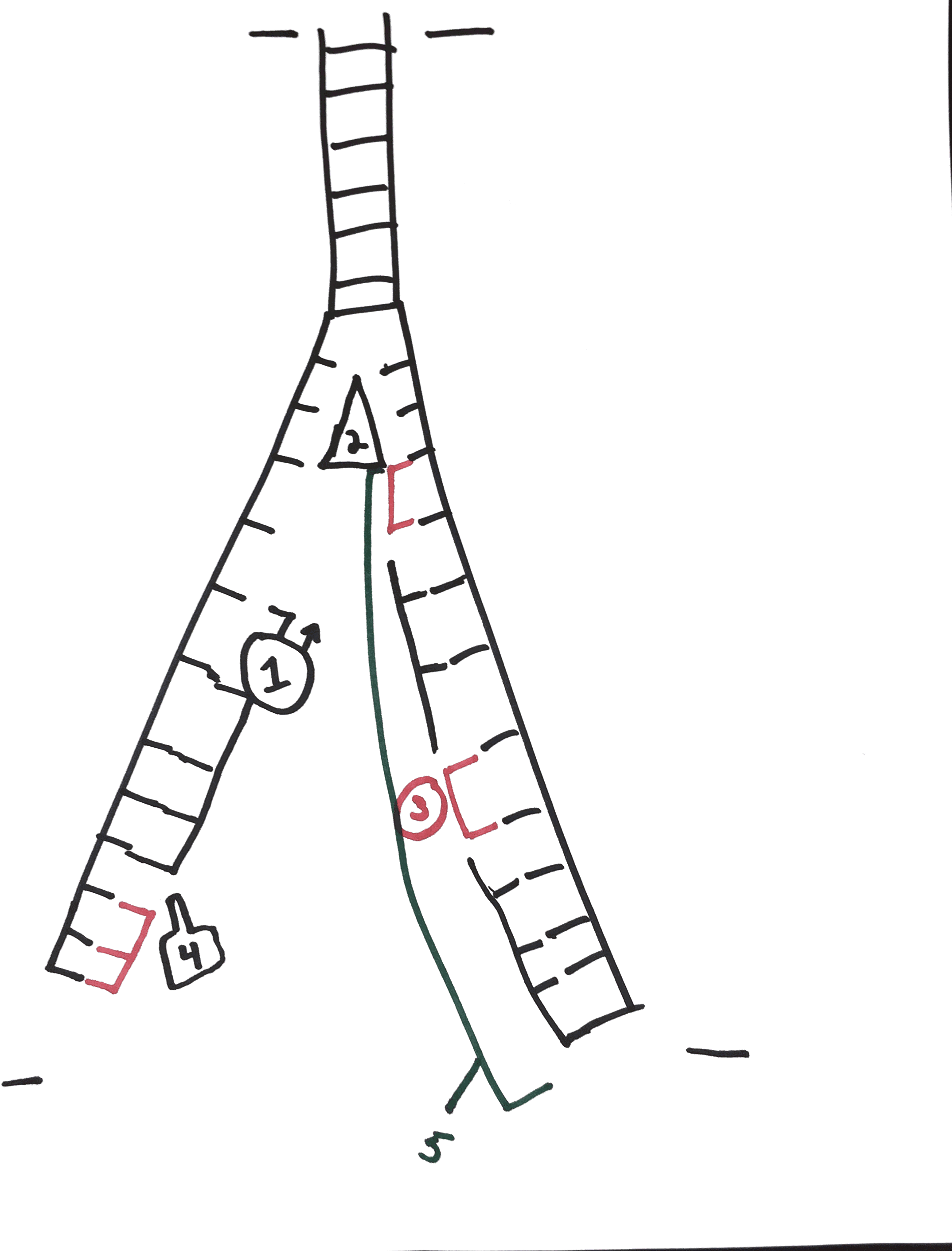
Object numbered as 2 in the picture is a
Polymerase
Primase
Helicase
Ligase
22
Multiple Choice
DNA strands elongate in the direction of
5' - 3'
3' - 5'
23
Fill in the Blanks
Eukaryotic DNA replication conforms to a model called the
Type answer...
24
Multiple Choice
The lagging strands elongate _____ in the _____ direction as the replication fork.
continuously;
same
continuously;
opposite
discontinuously;
same
discontinuously;
opposite
25
Multiple Choice
The leading strands elongate _____ in the _____ direction as the replication fork.
continuously;
same
continuously;
opposite
discontinuously;
same
discontinuously;
opposite
26
Fill in the Blanks
DNA ligase synthesises
Type answer...
27
Learning outcomes:
Give an overview of the relationship between DNA and protein synthesis.
Explain transcription which involves RNA polymerase to form mRNA.
28

29
1. RNA Polymerase (RNAP) binds to the promoter region.
Start signal is found within the promoter region.
Start signal is the point where transcription begins.

30
2. RNAP will unwind the parental DNA helix. Only one DNA strand acts as a template.
The template DNA strand is known as the non-coding strand.
The non-template DNA strand is known as the coding strand.
31
3. RNAP starts the synthesis of RNA transcript complementary to the DNA template strand.
Adenine will be transcribed with uracil, while cytosine with guanine.

32
4. RNAP moves downstream, elongating the RNA transcript in the 5' - 3' direction.
Note:
Elongation of transcript: 5'-3'
Reading of DNA template: 3'-5'
33
5. Behind the point of transcription (or transcription bubble), the unwound DNA will re-wind to form double helix.
34
6. RNAP detects the terminator region.
Stop signal is found within the terminator region.
7. RNA transcript will be released from the transcription bubble. RNAP and sigma factor will detach from DNA strand.

35

36
Get your notes ready.
37
Multiple Choice
Which of these bases does not exist in RNA?
Cytosine
Thymine
Uracil
Adenine
38
Multiple Choice
What happens to the mRNA sequence after it has been synthesised?
stays in the nucleus
leaves the cell
leaves the nucleus
separates into smaller pieces
39
Multiple Choice
During protein synthesis, an RNA strand is transcribed from one strand of DNA (GCG TTA CCT) What is the complementary RNA strand?
CGC UUT CCT
CGC AAU GGA
GCG UUA CCU
CGC AAT GGA
40
Multiple Choice
Which enzyme creates the new mRNA polyer by adding the complementary free RNA nucleotides?
RNA polymerase
DNA polymerase
Exonuclease
DNA Helicase
41
Multiple Choice
Where does transcription begin?
Transcription origin
Promoter region
Start signal
Start codon
42
Multiple Choice
Where does transcription end?
Terminator region
Stop signal
Stop codon
At the end of the gene sequence
43
Multiple Choice
Transcribe the following DNA sequence to the complementary mRNA sequence.
TAC CGG CTG
AUG GCC GAC
AUG GCC GAG
AUG CGG GAC
GUA GCC GAC
44
Multiple Choice
Which type of RNA is synthesised during transcription?
messenger RNA (mRNA)
transfer RNA (tRNA)
ribosomal RNA (rRNA)
small nuclear RNA (snRNA)
45
Multiple Choice
A eukaryotic transcription takes place in the ____, while a prokaryotic transcription takes place in the ____.
Cytoplasm;
nucleus
Cytoplasm;
cytoplasm
Nucleus;
cytoplasm
Nucleus;
nucleus
46
Fill in the Blanks
Sigma factor is the
Type answer...
*Clue: helps enzyme functions better
47
Learning outcomes:
Show the relationship between codon on mRNA with sequence of amino acid using genetic code table.
Explain translation of mRNA forming polypeptide chain.
48

49
1. The translational initiation complex will assemble.
The complex comprises of:
small ribosomal subunit
large ribosomal subunit
mRNA strand
initiator tRNA with UAC anticodon & carrying Met amino acid

50
2. The codon AUG will bind to the P-site of the ribosome.
tRNA with anticodon UAC will base-pair with codon AUG.
51
3. Elongation of translation comprises of three sub-steps:
i. Codon recognition
ii. Peptide bond formation
iii. Translocation

52
4. During codon recognition, tRNA with anticodon will base-pair with the complementary codon in A-site.
Example:
If the codon in A-site is AUG, then the tRNA with UAC anticodon will base-pair with the codon.

53
5. Peptide bond will be formed between the new amino acid in A-site and the existing ones in P-site.
As a result, the polypeptide strand in P-site will be removed and bonded to the amino acid in A-site.

54
6. The tRNA in A-site will be translocated to P-site.
7. This will push the empty tRNA in P-site into the E-site. Eventually, it is released from the translational complex.
These series of events will repeat until stop codon binds to A-site.

55
8. Termination of translation begins when the stop codon binds to the A-site of ribosome.
Note:
Stop codon (on mRNA):
UAG
UAA
UGA

56
9. Instead of a tRNA, a release factor will base-pair with the stop codon in A-site.
This results in the disassembly of the translational machinery.
57

58
Polypeptide chains are synthesised based on the codon that are read on the mRNA strands.
The corresponding amino acid is determined based on the genetic code table.

59
Some examples:
AUG: Methionine (starting amino acid)
GAU: Tyrosine
CUA: Leucine
AAA: Lysine
UGA: Stop codon - release factor
60
Get your notes ready.
61
Multiple Choice
When the mRNA sequence leave the nucleus, what organelle does it travel to?
mitochondria
smooth ER
ribosome
vacuole
62
Multiple Choice
What does tRNA "transfer"?
amino acids
nucleic acids
nucleotides
AUG
63
Multiple Choice
A polypeptide only becomes a functioning protein after it has folded into its exact 3D shape.
True
False
64
Multiple Choice
Codons are located on __________
mRNA
tRNA
rRNA
snRNA
65
Multiple Choice
Anticodons are located on __________
mRNA
tRNA
rRNA
snRNA
66
Multiple Choice
How many nucleotides make up a single codon?
3
5
4
1
67
Multiple Choice
Where does translation begin?
Translation origin
Start signal
Codon AUG
First codon on mRNA
68
Multiple Choice
Which one of these will stop translation?
Terminator region
Stop signal
The last codon on mRNA strand
Codon UAA
69
Multiple Choice
Which mRNA sequence always marks the beginning of a new polypeptide chain?
UAG
AUG
GAU
UGA
70
Multiple Choice

How many codons code are there for phenylalanine?
2
3
4
1
71
Multiple Choice
The following codon is translated into which amino acid?
AUU
Methionine
Isoleucine
Histidine
Arginine
72
Multiple Choice
The following codon is translated into which amino acid?
CAU
Methionine
Isoleucine
Histidine
Arginine
73
Multiple Choice
The following codon is translated into which amino acid?
UUU
STOP
Phenylalanine
Valine
Aspartic acid
74
Multiple Choice
The following codon is translated into which amino acid?
AGU
Methionine
Isoleucine
Serine
Arginine
75
Multiple Choice
The following codon is translated into which amino acid?
UAA
STOP
Phenylalanine
Valine
Aspartic acid
76
Multiple Choice
The following codon is translated into which amino acid?
ACA
Threonine
Phenylalanine
Valine
Aspartic acid
77
Multiple Choice
If an mRNA sequence consist of 171 nucleotides, how many amino acids can be synthesised for the polypeptide chain?
57
71
55
171
78

79
Poll
How confident are you with this chapter?
0-25%
26-50%
51-75%
76-100%
80
Open Ended
Which part(s) of this chapter that you feel like you need most work on?
Note: be specific and not just write down the subtopic
Show answer
Auto Play
Slide 1 / 80
SLIDE
Similar Resources on Wayground

74 questions
External Parts of Computer
Presentation
•
11th Grade - University
78 questions
25S1 W3 Enzymes and Macromolecules
Presentation
•
11th Grade - University
76 questions
Price Ceilings
Presentation
•
12th Grade
75 questions
2/12 Industrialization Extension
Presentation
•
KG - University
74 questions
shampoo from Pp 1
Presentation
•
KG - University
71 questions
👀 A&Physio U1 Digestion Test Review
Presentation
•
10th Grade - University
78 questions
N5 3.5 Food Production
Presentation
•
10th - 12th Grade
77 questions
End of Term Christmas Quiz
Presentation
•
KG - University
Popular Resources on Wayground
10 questions
Safety Day 2026 – Student Review

Quiz
•
9th Grade
21 questions
Continents and Oceans
Quiz
•
6th Grade
20 questions
Parts of Speech
Quiz
•
5th Grade
16 questions
Subject & Predicate
Quiz
•
5th Grade
25 questions
Multiplication Facts
Quiz
•
5th Grade
12 questions
Map Skills
Quiz
•
3rd Grade
22 questions
Continents and Oceans
Quiz
•
5th Grade
15 questions
Rounding Decimals
Quiz
•
5th Grade
Discover more resources for Biology
20 questions
Cell Transport
Quiz
•
9th - 12th Grade
8 questions
DNA vs. RNA
Presentation
•
9th - 12th Grade
16 questions
Epithelial tissues
Quiz
•
11th - 12th Grade
15 questions
DNA Structure and Replication
Quiz
•
9th - 12th Grade
20 questions
Ecological Succession Review
Quiz
•
9th - 12th Grade
22 questions
Photosynthesis and Cellular Respiration Review
Quiz
•
9th - 11th Grade
3 questions
Enzymes & Energy
Quiz
•
9th - 12th Grade
38 questions
Mitosis & Meiosis
Quiz
•
9th - 12th Grade