

The History of the Caribbean lesson

Presentation
•
•
Practice Problem
•
Hard

JL Fisher
Used 1+ times
FREE Resource
37 Slides • 41 Questions
1
Topic 3 Lesson 8 Lesson Check Questions

2
Multiple Choice
How do creole languages reflect the region's history?
They developed from a single language.
They blend elements from languages of the different peoples who have lived in the region.
They blend the religion of the different colonies.
The region's history is dominated by native cultural influences.
3
Blending Cultures
The Caribbean has a rich history of many cultures merging together. This can reflect its varied colonial past.
In Haiti, many people speak Haitian Creole, which is a blend of French and African elements.
In Jamaica, an English-based creole is spoken.
4
Multiple Select
What impact do hurricanes have on the region?
increase in tourism
economic damage
destruction of homes and businesses
death or serious injury
5

The Caribbean is vulnerable to earthquakes, volcanic eruptions, and hurricanes. The people of the Caribbean face an average of 8 hurricanes per year.
The destruction of these forces cause death, injuries, loss of jobs and businesses, and economic setbacks.
Natural Disasters
6

Which two countries seem to have the strongest economies?
Look at the GDP to help you find the correct answer.
7
Multiple Select
After looking at the country databank, which two countries seem to have the strongest economies?
Trinidad and Tobago
Jamaica
Saint Kitts and Nevis
Dominican Republic
8
32,597 GDP
Trinidad and Tobago
24,369 GDP
Saint Kitts and Nevis
9
Multiple Choice
What can you infer about a Caribbean country's colonial history from the language spoken?
Their biggest enemy
Their political practices and preferences.
Which European power(s) once ruled the country
absolutely nothing
10

As different countries colonized the area, they brought with them their languages. As those languages blended with native languages, the regions created new blended languages that reflect the different influences from colonizing nations.
The history of regional language
11
Multiple Select
Select all that are TRUE about Presidential Democracies.
Legislature is elected through voting
President is selected by legislature
President is elected through voting
Legislature is selected by the president
12
Multiple Select
Select all that are TRUE about Parliamentary Democracies.
Legislature is elected through voting
Prime Minister is selected by legislature
Prime minister is elected through voting
Legislature is selected by the Prime Minister
13
Multiple Select
Select all that are TRUE about Constitutional Monarchies.
Legislature is elected through voting
Prime Minister is selected by legislature
King or Queen is head of state
Prime Minister is head of government
14
Multiple Select
Select all that are TRUE about Dictatorships.
Citizens vote for their leader
A dictator is the head of government and has absolute control
King or Queen is head of state
Little to no political freedom or choice
15
Three Main Types
Presidential Democracy: Dominican Republic
Parliamentary Democracy/Constitutional Monarchy: Most of the islands, Jamaica for instance.
Dictatorship: Cuba
16
Multiple Select
What makes people leave the Caribbean islands to live somewhere else?
poverty
economic problems
natural disasters
the amount of sunlight
tourism
17
Poverty
The economies are not typically very strong in this region due to lack of resources, small populations, and lack of capital.
Many people in these countries live in poverty, this poverty is a push factor to move to other countries such as the United States to find work.
18
19
identify and describe common traits that define cultures and culture regions (13A)
20
Early Peoples of the Caribbean Islands
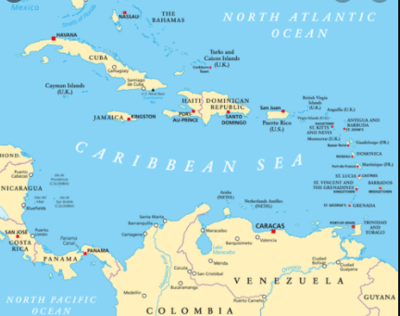
Taino - (also called the Arawak) - farmed on the islands of the Greater Antilles: Cuba, Jamaica, Hispaniola and Puerto Rico
Carib - lived in the Lesser Antilles and were the most feared warriors of the Caribbean


21
Christopher Columbus
On October 12, 1492 arrived in the Bahamas.
He called the people he met “Indians” because he thought he was in the East Indies.
He opened the way for European sailing ships to come to the Americas.
Europeans changed the way of life for the Caribbean peoples.
Many died from diseases carried by the Europeans.
Europeans also overworked and or starved the Caribbean peoples.
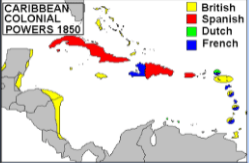
The Spanish set up colonies in Cuba, the Dominican Republic and Puerto Rico. The French settled what is now Haiti and some smaller islands. The British and Dutch also had island colonies.
22

23
24
Multiple Choice

25
Multiple Select
What are the islands in the Greater Antilles?
Cuba
Dominican Republic
Jamaica
Puerto Rico
Hispaniola
26
Puerto Rico was given to the United States when Spain lost the Spanish-American War in 1898. (Commonwealth)
27
Multiple Choice

28
The biggest challenge the Caribbean Islands face is to develop economically.
Poverty and unemployment are constant challenges.
People in the Caribbean Islands support themselves in many different ways; tourism is the main source of income.
Another important source of income is remittances. A remittance is money sent back to the homeland by people who migrated someplace else to make money
29
Multiple Choice
money sent back to the homeland from people who migrated elsewhere is called a...
currency
allowance
remittance
I don't know
30
Multiple Choice

31
Cuba is the only country in the Caribbean with a communist government.
In reality, the economy is run by a powerful government under the control of the Communist Party.
Cuba’s economy is very poor, and conditions are worse now than they were in the 1980s.
Cuba’s people have little political freedom. The U.S. has many refugees from Cuba who flee Cuba in search of a better life.
32
Individuals or businesses choose what to produce, and when to produce it. They make decisions based on what they think consumers will want to buy.
Free Enterprise countries are not without problems. Poverty, unemployment and wide spread disease still hinder these areas.
Trinidad and Tobago is one of the most successful free enterprise economies. Haiti is the poorest.
33
Multiple Choice
What type of economy does Cuba have?
command
free market
communist
monarchy
34
Multiple Select
The islands have two types of economies, which are
communism
free trade
free enterprise
mixed
35
Multiple Choice

36


37


38
Multiple Choice
Three important pieces of any culture are
language, values, and religion
natural resources, climate, & landforms
economy, population, & Literature
technology, transportation, & economy
39
Multiple Choice
Caribbean culture is the way of life:
Brought to the Caribbean by the Europeans
Brought to the Caribbean by the East Indians
Of Amerindians who live in the region
Brought about by the blending of cultures all people who settled in the Caribbean.
40
Multiple Choice
Which two ethnic groups dominated the culture of the Caribbean?
Taino and Chinese
East Indians and Africans
African and European
European and Chinese
41
Physical Features and Economy

42
Multiple Select
Which of the following had an impact on the formation of Mexico's culture?
Indigenous Population
Spanish Colonists
African Slaves
American Soldiers
43
Meaning "Mother Mountain Range"
Covers most of Northern Mexico
Divided into Occidental and Oriental sections

44

45
Largest, most populated, and economically most developed of the Mesoamerican nations
Mexico is an export-based economy, shipping to over 40 nations

46
Came into effect in April 2020
Ensures easier trade between its member nations

47
Multiple Choice
What are the mountains in northern Mexico?
The Rocky Mountains
The Himalayas
The Sierra Madre
The Alps
48

49

50
Multiple Choice

What body of water is next to Mexico, Central America, and the Caribbean?
The Gulf of Mexico
The Bay of Pigs
The Hudson Bay
The Pacific Ocean
51

52

53

54

55

56
Multiple Choice
Which of the following is not a cause of deforestation?
Logging
Forest fires
Cutting Down trees for Living Space
Clearing land for farming and ranching
None of the above
57

58

59

60

61
Multiple Choice
What are the two main sources of income for Central America and the Caribbean?
Business and Industry
Agriculture and Tourism
Industry and Tourism
Trade and Business
62

63
Multiple Choice
What is the united body of Central America called?
SICA
CAIS
EU
ACUE
64
Multiple Choice
Which Caribbean country is a commonwealth of the United States?
Puerto Rico
Cuba
Jamaica
Haiti
65
Multiple Choice
Why do the Caribbean islands have so much diversity?
The climate varies among the islands
Many people from the United States settled there
Several European countries rules them as colonies
Their governments are democratic
66
Multiple Choice
Why do some countries in the Caribbean islands have weak economies?
Their governments are communist
They attract few tourists
They have large populations
They are small and have few resources
67
Multiple Choice
Which Caribbean country is known for its reggae music?
Cuba
Haiti
Dominican Republic
Jamaica
68
Multiple Choice
Toussaint L’Ouverture led the revolution for which country?
Cuba
Haiti
Puerto Rico
Jamaica
69
Multiple Choice
How many islands make up the Bahamas?
700
5000
3
50
70
Multiple Choice
Which European country claimed Haiti as a colony?
Great Britain
France
Netherlands
Spain
71
Multiple Choice
The biggest industry in the Caribbean is what?
Tourism
Fishing
Mining
Farming
72
Multiple Choice

73
Multiple Choice

74
Multiple Choice

75
Multiple Choice

76
Multiple Choice

77
Multiple Choice
Which is the largest Caribbean island?
Grenada
Jamaica
St. Lucia
Cuba
78
Multiple Select
The Caribbean can be divided into 3 groups. Name those 3 groups
Lesser Antilles
Bahamas
Greater Antilles
Islands
Topic 3 Lesson 8 Lesson Check Questions
Show answer
Auto Play
Slide 1 / 78
SLIDE
Similar Resources on Wayground

77 questions
Disagreements with Great Britain Review Activity
Presentation
•
5th - 7th Grade
69 questions
Water in the Atmosphere
Presentation
•
6th Grade
66 questions
Using the subjunctive in context
Presentation
•
9th Grade - University
72 questions
MUSIC 8
Presentation
•
8th Grade
73 questions
APUSH 8.8 8.9 8.10
Presentation
•
9th - 12th Grade
74 questions
Anatomy- The Chemistry of Life
Presentation
•
University
74 questions
The Cell Theory and Cells
Presentation
•
6th - 8th Grade
69 questions
Topic 6 The Internet
Presentation
•
University
Popular Resources on Wayground
10 questions
Safety Day 2026 – Student Review

Quiz
•
9th Grade
21 questions
Continents and Oceans
Quiz
•
6th Grade
20 questions
Parts of Speech
Quiz
•
5th Grade
16 questions
Subject & Predicate
Quiz
•
5th Grade
25 questions
Multiplication Facts
Quiz
•
5th Grade
12 questions
Map Skills
Quiz
•
3rd Grade
22 questions
Continents and Oceans
Quiz
•
5th Grade
15 questions
Rounding Decimals
Quiz
•
5th Grade
Discover more resources for
10 questions
Safety Day 2026 – Student Review
Quiz
•
9th Grade
21 questions
Continents and Oceans
Quiz
•
6th Grade
20 questions
Parts of Speech
Quiz
•
5th Grade
16 questions
Subject & Predicate
Quiz
•
5th Grade
25 questions
Multiplication Facts
Quiz
•
5th Grade
12 questions
Map Skills
Quiz
•
3rd Grade
22 questions
Continents and Oceans
Quiz
•
5th Grade
15 questions
Rounding Decimals
Quiz
•
5th Grade