Variation Biology F5 KSSM Chapter 12
Presentation
•
Biology
•
12th Grade
•
Practice Problem
•
Medium
Standards-aligned
ROSLINDA Moe
Used 53+ times
FREE Resource
17 Slides • 33 Questions
1
by ROSLINDA Moe
2
Multiple Choice
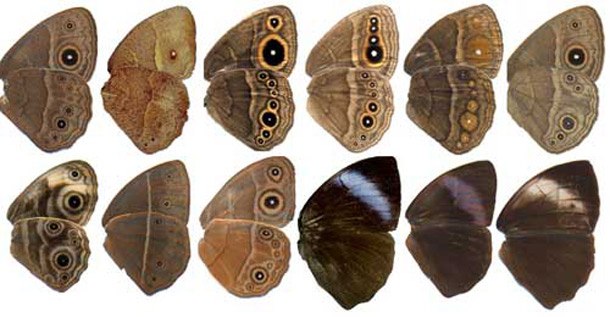
These moths are all the same species. The differences between their wings is an example of ............
Evolution
3
Multiple Choice
Variation refers to the differences in characteristics found within the same population or species.
The characteristics in the above statement refers to...
genotype
phenotype
4
Multiple Choice
Biston betularia (moth) with wings similar to the color of tree bark are better able to camouflage themselves than moths of a different color. As a result, the tree-colored moths are more likely to survive from predator, reproduce, and pass on their genes.
The above statement is can be describe as....
Mutation
Discontinuous variation
Natural selection
5
Multiple Choice
• A variation in which the differences in the characteristic is not distinct.
• Individuals show gradual differences in characteristic from one extreme to the other extreme.
The above statement describes....
Continuous variation
Discontinuous variation
6
Multiple Choice
• Distinct differences in characteristic.
• The characteristic is not influenced by environmental factors.
Discontinuous variation
Continuous variation
7
Multiple Select
Which type of variation is represented by the graph?
ABO blood group
Intelligence quotient (IQ)
Heart rate
Type of ear lobe
8
9
10
Multiple Select
Choose the correct genetic factors which causes discontinuous variation.
Mutation
Random fertilisation of gametes
Independent assortment of chromosomes during metaphase I
crossing over during prophase I
11
Fill in the Blanks
Name the occurrence in the picture.
Type answer...
12
13
Fill in the Blanks
During metaphase I of meiosis, a homologous chromosome pair (one maternal chromosome and one paternal chromosome) is arranged
Type answer...
14
15
Fill in the Blanks
Fertilisation between sperm and secondary oocyte is random.
The above statement can be rephrase as
Type answer...
16
17
Multiple Choice
.................... is a permanent change which occurs spontaneously on genes or chromosomes.
random fertilisation
independent assortment
crossing over
18
19
Multiple Choice
Acidic soil, with a pH lower than 6.0, yields blue or lavender-blue hydrangea blooms. Alkaline soil, with a pH above 7.0, promotes pinks and reds. With a pH between 6 and 7, the blooms turn purple or bluish-pink.
The above statement is an example of......
Genetic factor
Environmental factor
20
21
22
Fill in the Blanks
In conclusion, differences in eating habits and environment while growing up produce
different
Type answer...
23
Multiple Select
Choose the dominant traits in humans.
Presence of dimple
Free earlobe
Can roll the tongue
Curly hair
24
Multiple Choice
........... is a spontaneous and random change of genetic material, namely DNA of the cell in an organism.
Mutagen
Mutation
Nondisjunction
25
Multiple Choice
A substance which causes mutation or increases the mutation rate to a dangerous level is called a .......................
Mutagen
Mutation
Nondisjunction
26
27
28
Multiple Select
The types of gene mutations are...
base substitution
base deletion
base insertion
29
30
Multiple Choice
When there is a portion of nucleotide is removed from the sequence, it is a _________ mutation
substitution
deletion
insertion
31
Multiple Choice
DNA molecule segment is : TTACGCAAG The mutated DNA segment is TTCCGCAAG. This is an example of ___ mutation.
Substitution
Deletion
Insertion
Inversion
32
Multiple Choice
DNA molecule segment is : TTCAAG The mutated DNA segment is TTCCGCAAG. This is an example of ___ mutation.
Substitution
Deletion
Insertion
Inversion
33
Fill in the Blanks
Point mutation is also known as
Type answer...
34
Multiple Select
Choose the example disease caused by gene mutation.
35
Multiple Choice
Chromosomal mutation involves changes to chromosomal structure or changes to the chromosomal number.
TRUE
FALSE
36
Multiple Choice
Changes in chromosomal structure involve changes
to the gene sequence in a chromosome. The structural
change causes abnormality to the chromosome, which is
known as chromosomal .......
aberration
mutation
deletion
37
38
39
40
41
Multiple Choice
What situation causes a deletion?
Part of the chromosome is missing
Part of the chromosome breaks off and attaches to a different chromosome
42
Multiple Choice
What situation causes a duplication?
Part of the chromosome breaks off and attaches to a different chromosome
Part of a chromosome is duplicated
43
Multiple Choice
What situation causes a translocation?
Part of the chromosome breaks off, rotates 180O and join again.
Part of the chromosome breaks off and attaches to a different chromosome
44
Multiple Choice
What situation causes an inversion ?
Part of the chromosome breaks off, rotates 180O and join again.
Part of the chromosome breaks off and attaches to a different chromosome
45
Fill in the Blanks
A change in chromosomal number causes a diploid organism to lose one or more chromosomes, or gain one or more chromosomes.
The change occurs when homologous chromosomes fail to separate during anaphase I in meiosis or sister-chromatids fail to
separate during anaphase II in meiosis.
This is probably because the normal ......... ......... fail to form during meiosis.
Type answer...
46
Multiple Choice
Non disjunction of chromosomes occurs during?
Meiosis
Mitosis
Replication
47
Multiple Select
Examples of nondisjunction occur at sex chromosomes during oogenesis or spermatogenesis.
Jacob syndrome
Klinefelter syndrome
Turner syndrome
48
Multiple Choice
The structure of chromosome changes due to a partial deletion on the short arm of chromosome number 5.
Down
Syndrome
Cri du chat
syndrome
49
Multiple Choice
Mutation in somatic cells will cause the variation cannot be inherited by the next generation whereas mutation in gametes can be inherited by the next generation.
TRUE
FALSE
50
by ROSLINDA Moe
Show answer
Auto Play
Slide 1 / 50
SLIDE

Similar Resources on Wayground
43 questions
Connective Tissue Slides
Presentation
•
11th - 12th Grade
45 questions
Adaptations, GE, Evolution
Presentation
•
11th Grade
45 questions
SFP HE WK 18 Food Labelling
Presentation
•
12th Grade
44 questions
7.05 & 7.06
Presentation
•
12th Grade
48 questions
Enzyme
Presentation
•
12th Grade
48 questions
Genes to proteins
Presentation
•
12th Grade
43 questions
GS START - Medicines commonly Prescribed in General Surgery
Presentation
•
KG - University
41 questions
Application of Colligative Properties
Presentation
•
12th Grade
Popular Resources on Wayground
21 questions
Continents and Oceans
Quiz
•
6th Grade
20 questions
Parts of Speech
Quiz
•
5th Grade
16 questions
Subject & Predicate
Quiz
•
5th Grade
25 questions
Multiplication Facts
Quiz
•
5th Grade
12 questions
Map Skills
Quiz
•
3rd Grade
22 questions
Continents and Oceans
Quiz
•
5th Grade
15 questions
Rounding Decimals
Quiz
•
5th Grade
20 questions
Brand Labels
Quiz
•
5th - 12th Grade
Discover more resources for Biology
10 questions
Exploring the 4 Major Macromolecules and Their Functions
Interactive video
•
9th - 12th Grade
20 questions
Cell Transport
Quiz
•
9th - 12th Grade
16 questions
AP Biology: Unit 2 Review (CED)
Quiz
•
9th - 12th Grade
16 questions
AP Biology: Unit 1 Review (CED)
Quiz
•
9th - 12th Grade
20 questions
Ecological Succession Review
Quiz
•
9th - 12th Grade
30 questions
Quiz Week 6 Review (10/2/26)
Quiz
•
9th - 12th Grade
40 questions
Unit 3 Cell Growth and Differentiation
Quiz
•
10th - 12th Grade
25 questions
3.2 Protein Synthesis Practice
Quiz
•
9th - 12th Grade