

Balanced and Unbalanced Forces

Presentation
•
Science
•
5th Grade
•
Practice Problem
•
Medium
Standards-aligned

Kaley Brown
Used 1K+ times
FREE Resource
6 Slides • 4 Questions
1
What effects do balanced and unbalanced forces have on the motion of objects?
2
A Force causes an object’s motion to change through pushes or pulls.
Friction is a type of force that stops or slows down an object's motion and is produced between two surfaces or two objects that are touching one another.
Magnetism, static electricity, and gravity are all types of forces that move objects without touching them.
3
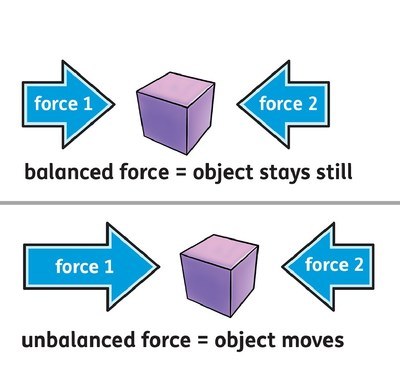
More than one force can act on an object at once.
If one of those forces is stronger than the other, it is callen an unbalanced force, and the object will move.
If both forces have the same strength, it is called a balanced force. Balanced forces make objects stand still.
4
Imagine you are playing tug-of-war with your friends. Your team starts by pulling really hard, with all its strength. But the other team is also pulling with an equal amount of force and in the opposite direction. The flag in the middle of the rope does not move. The flag does not move because the force your team is pulling with is equal to the force applied by the other team but in the opposite direction. The forces are in opposite directions. The forces on the rope are balanced. When the forces are balanced, the flag in the center of the rope will not move. To win the game, one team must apply more force than the other.

5
By applying an unbalanced force, you can change the motion of an object. Unbalanced forces can make an object at rest start moving, make a moving object stop, or change the direction and speed of the object. Think back to the game of tug-of-war. At the start of the game, both teams pulled equally hard on opposite ends of the rope. The two teams pulled with balanced forces. The flag in the middle of the rope did not move.

6
Examples of balanced forces
include:
doing a handstand without falling
an object floating in water
a person standing or sitting still
framed pictures hanging on a wall
a jacket hanging on a coat hook
a running car staying in place because the brakes are applied
Examples of unbalanced forces include:
an object sinking in water
doing a cartwheel
riding a skateboard
a fruit dropping from a tree
an object getting knocked over.
a football sailing toward the goalpost after it is kicked
7
Multiple Choice
What is a balanced force?
when two forces with unequal strengths are acting on an object.
when two forces with equal strengths are acting on an object.
when two forces with little strength are acting on an object.
when two forces with a lot of strength are acting on an object.
8
Multiple Choice
What is an unbalanced force?
when two forces with equal strengths are acting on an object.
when two forces are acting on an object.
when two forces with unequal strengths are acting on an object.
when only one force is acting on an object.
9
Multiple Choice
What example below is an example of a balanced force?
A ball being caught in mid-air.
A bicycle that is parked and not moving.
A ball being thrown to another person.
A bicycle that is moving down a hill.
10
Multiple Choice
What example below is an example of an unbalanced force?
A basketball that is not moving.
A rope being pulled with the same strength in both directions.
A football that is resting on a kickoff tee.
A soccer player kicking a soccer ball across the field.
What effects do balanced and unbalanced forces have on the motion of objects?
Show answer
Auto Play
Slide 1 / 10
SLIDE
Similar Resources on Wayground

9 questions
Mixtures and Solutions
Presentation
•
5th Grade
10 questions
states of matter
Presentation
•
4th - 5th Grade
9 questions
Science Unit 2 Lesson 1
Presentation
•
5th Grade
7 questions
Volume 5th Grade
Presentation
•
5th Grade
9 questions
Parts of an Atom
Presentation
•
6th Grade
8 questions
Fractions and Line Plots
Presentation
•
5th Grade
7 questions
Variables Lesson
Presentation
•
5th Grade
9 questions
LIVING THINGS
Presentation
•
5th Grade
Popular Resources on Wayground
10 questions
How much do you know about our Portrait of an Eagle?

Quiz
•
10th Grade
10 questions
Fast Food Slogans
Quiz
•
6th - 8th Grade
21 questions
Continents and Oceans
Quiz
•
6th Grade
20 questions
Parts of Speech
Quiz
•
5th Grade
16 questions
Subject & Predicate
Quiz
•
5th Grade
25 questions
Multiplication Facts
Quiz
•
5th Grade
12 questions
Map Skills
Quiz
•
3rd Grade
22 questions
Continents and Oceans
Quiz
•
5th Grade
Discover more resources for Science
9 questions
Properties of matter and Mixtures
Quiz
•
5th Grade
20 questions
Mixtures and Solutions Practice
Quiz
•
5th Grade
20 questions
Food Chains and Food Webs Review
Quiz
•
5th Grade
11 questions
Understanding Light Review 4
Quiz
•
5th Grade
15 questions
Force and Motion
Presentation
•
5th Grade
20 questions
Food Chains & Food Webs
Quiz
•
5th - 7th Grade
20 questions
Weathering, Erosion, & Deposition
Quiz
•
5th Grade
16 questions
Mixture or Solution?
Quiz
•
5th Grade