Search Header Logo
LSS107 Diversity & Ecology - Carbon Cycle

LSS107 Diversity & Ecology - Carbon Cycle

Assessment

Presentation

•

Biology, Science

•

8th Grade

•

Medium

Created by

Angela Toh

Used 8+ times

FREE Resource

10 Slides • 27 Questions

1

LSS107 Diversity & Ecology

​Carbon Cycle

by Angela Toh

2

media

3

Multiple Choice

All of the carbon in existence is continually recycled in the carbon cycle
1
True
2
False

4

Multiple Choice

Carbon atoms cannot be created or destroyed

1

True

2

False

3

Not enough information to answer

5

Multiple Choice

All of the carbon in existence is continually recycled in the carbon cycle
1
True
2
False

6

media

7

Multiple Choice

Question image
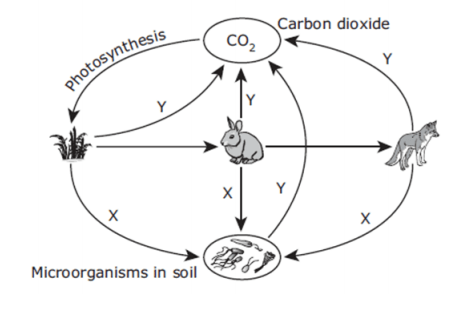
The diagram shows the flow of organic molecules through an ecosystem. What two processes are identified by the labels X and Y?
1
X : Respiration
Y : Predation
2
X : Adaptation
Y : Decomposition
3
X : Fermentation
Y : Nitrogen Fixation
4
X : Decomposition
Y : Respiration

8

Multiple Choice

Question image

What do 'plants' do with the carbon they receive?

1

They turn it into water

2

They don't need carbon

3

They turn it into food by photosynthesis

4

They keep it forever

9

Multiple Select

Question image

How does carbon get from animals and back into the atmosphere? (CHOOSE ALL THAT APPLY)

1

Respiration (breathing)

2

After they die, they are broken down by decomposers

3

Photosynthesis

4

None of these

10

Multiple Choice

Question image

How do animals get carbon?

1

Photosynthesis

2

They absorb it from the atmosphere

3

The sun

4

They eat other plants and animals

11

Multiple Choice

Question image

How is carbon recycled?

1

The carbon cycle

2

At the recycle plant

3

It can't be recycled

4

Through water

12

Multiple Select

Choose the things that take carbon dioxide (CO2) out of the air.

1

Plants

2

Water

3

Trees

4

Humans

13

media

14

Multiple Choice

Which reason best explains why living things need carbon?

1

Carbon bonds are a source of energy.

2

Carbon bonds are NOT a source of energy.

15

Multiple Choice

What is the primary function of the carbon cycle?

1

recycling the supply of carbon on Earth

2

recycling the supply of water on Earth

16

Multiple Choice

What would most likely happen to life on Earth if the carbon cycle stopped?

1

Life would cease to exist.

2

Only plants would be affected.

17

media

18

Multiple Choice

In what form is carbon found in the atmosphere?

1

CO2

2

C6H12O6

3

H2O

4

ATP

19

Multiple Choice

The carbon cycle ensures that carbon is not lost. Which is another important benefit of the carbon cycle?

1

The carbon cycle ensures that living things have a continual source of hydrogen.

2

The carbon cycle helps transport nutrients in bodies of water.

3

The carbon cycle helps regulate Earth's temperature.

4

The carbon cycle ensures that there is a continual supply of water.

20

Multiple Choice

What is the primary function of the carbon cycle?

1

recycling the supply of carbon on Earth

2

creating macromolecules

3

recycling the supply of water on Earth

4

creating fossil fuels

21

Multiple Choice

Which action would most likely increase the amount of carbon in the environment?

1

choosing to burn coal to generate electricity

2

using energy-efficient appliances in place of older, traditional appliances

3

reusing shopping bags instead of using disposable plastic bags

4

recycling paper and plastic instead of throwing it in the trash

22

Multiple Choice

How will the level of carbon in the atmosphere change if humans do nothing to reduce their impact on the carbon cycle?

1

Carbon will be removed from the atmosphere altogether.

2

The level of carbon in the atmosphere will decrease.

3

Carbon in the atmosphere will remain the same.

4

The level of carbon in the atmosphere will increase.

23

media

24

media

25

Multiple Choice

water pollution includes

1

organisms in water that cause disease

2

water that is too cold

3

high amounts of dissolved oxygen

4

all of these options

26

Multiple Select

Question image

Water pollution occurs when:

1

Harmful substances enter a water supply

2

Industries dispose of waste safely and correctly.

3

Industries cut costs with waste disposal.

4

None of the above.

27

Multiple Choice

What are the main sources of water pollution?

1

Plastic, Paper, and Metal

2

Snails in water

3

Help, there is a boot with a snake inside of it that somehow in the nearby lake.

4

Agriculture, Industry, and Community

28

Multiple Choice

Which of the following is not a natural cause of water pollution?

1

Volcanoes

2

Animal waste

3

Oil spills

4

Silt from storms and floods

29

Multiple Choice

Question image

We can prevent water pollution by:

1

Reduce the use of plastic.

2

Properly dispose of chemicals.

3

Clean up after your animals.

4

All of the above

30

Multiple Choice

What can happen to fish when there is not enough oxygen in the water?

1

They can suffocate

2

They can't float

3

They can't see.

4

Nothing. Fish don't need oxygen.

31

media

32

Multiple Select

Question image

Water pollution occurs when:

1

Harmful substances enter a water supply

2

Industries dispose of waste safely and correctly.

3

Industries cut costs with waste disposal.

4

None of the above.

33

Multiple Choice

Which of the following does NOT cause water pollution?
1
oil spills
2
garbage
3
fertilizers from farms
4
smoke

34

Multiple Choice

Question image

There is nothing we can do to stop water pollution.

1

True

2

False

35

Multiple Select

How can governments prevent disposal of chemical waste into water?

1

Ensure that businesses know what constitutes chemical waste and how to dispose of it safely

2

Check water quality in areas close to industrial plants

3

Research and implement alternatives to chemical processes that produce dangerous waste

4

Make it illegal for factories to produce chemical waste

36

media

37

media

LSS107 Diversity & Ecology

​Carbon Cycle

by Angela Toh

Show answer

Auto Play

Slide 1 / 37

SLIDE