Search Header Logo
Cell Types quiz study guide quizizz lesson

Cell Types quiz study guide quizizz lesson

Assessment

Presentation

Biology

10th Grade

Hard

FREE Resource

8 Slides • 63 Questions

1

Cell Types quiz study guide quizizz lesson

Coach Wilson

2

Multiple Choice

Question image

This is a eukaryotic cell.

1

true

2

false

3

Multiple Choice

Question image

This would be found in a prokaryotic cell.

1

true

2

false

4

Multiple Choice

Question image

This organelle has its own DNA and is a

1

lysosome

2

nucleus

3

smooth ER 

4

mitochondria

5

Multiple Choice

Question image

In what organelle is the genetic material found inside?

1

Endoplasmic Reticulum

2

Golgi Complex

3

Nucleolus

4

Nucleus

6

Multiple Choice

Question image
Using this image, what organelle is C?
1
Cell Wall
2
Mitochondria
3
Large Cell Vacuole
4
Chloroplast

7

Multiple Choice

Question image

Where does photosynthesis occur?

1

mitochondria

2

stomata

3

xylem

4

chloroplast

8

Multiple Choice

What can only be found in plant cells?
1
Cell membrane
2
Vacuole
3
Chloroplast
4
Mitochondrion

9

Multiple Choice

Question image
The two kinds of cells are Prokaryotes and Eukaryotes. How are they different?
1
Prokaryotes have a nucleus.
2
Eukaryotes have a nucleus.
3
Prokaryotes are plant cells.
4
There is no difference.

10

​Terms to know

​Virus

​Prokaryotic cell

​Eukaryotic cell

​Unicellular

​Multicellular

​Protists

​Fungi

​Plants

​Animals

11

​cell theory

  • All organisms are made of cells. Cells are the smallest unit of life. ...

  • Cells are the most fundamental unit of life. Organisms can be single cells, which hold all of the components necessary for a metabolism, or they can be more complex. ...

  • Cells come from other cells.

12

13

Multiple Choice

The _______ is the smallest structural and functional unit of a living thing. (this will be matching on the test)

1

cell

2

metabolism

3

nutrition

4

defense

14

Multiple Choice

_______ are chemical reactions within a cell. (This will be a matching question on the test)

1

Metabolism

2

Nutrition

3

Cell

4

Defense

15

Multiple Choice

__________ is responding to changes in the environment. (This will be a matching question on the test)

1

Response

2

Reproduction

3

Metabolism

4

Growth

16

Multiple Choice

______ is keeping conditions in the cell balanced. (This will be a matching question on the test)

1

Homeostasis

2

Response

3

Metabolism

4

Nutrition

17

Multiple Choice

______ means to increase in size. (This will be a matching question on the test)

1

Growth

2

Nutrition

3

Reproduction

4

Defense

18

Multiple Choice

______ means producing offspring. (This will be a matching question on the test)

1

Reproduction

2

Defense

3

Nutrition

4

Growth

19

Multiple Choice

Which choice is NOT part of the cell theory.

1

All organisms are composed of cells.

2

Cells are the basic unit of life.

3

All cells come from previous cells.

4

Cells are always the same size and shape.

20

Multiple Choice

Microscopes help us see very small objects like cells in detail.

1

True

2

False

21

Multiple Choice

What happened that allowed cells to be studied?

1

Cells increased in size.

2

Scientists began to work together.

3

Scientists became smarter.

4

The microscope was invented and improved.

22

Multiple Choice

This scientist concluded that animals and, in fact, all living things are made of cells:
1
Hooke
2
Leeunwenhoek
3
Schleiden
4
Schwann

23

Multiple Choice

This scientist was the first to identify cells and name them:
1
Hooke
2
Leeunwenhoek
3
Schleiden
4
Virchow

24

Multiple Choice

This scientist proposed that all cells come from other cells:
1
Leeunwenhoek
2
Schleiden
3
Schwann
4
Virchow

25

Multiple Choice

This scientist concluded that plants are made of cells:
1
Virchow
2
Schwann
3
Schleiden
4
Leeunwenhoek

26

Multiple Choice

This scientist observed live cells and observed greater detail:
1
Hooke
2
Leeunwenhoek
3
Virchow
4
Schwann

27

Multiple Choice

This is the most basic unit of life
1
atom
2
cell
3
nucleus
4
DNA

28

Multiple Choice

Who looked at cork and named the cell?
1
Robert Hooke
2
Van Leeuwenhoek
3
Robert Brown
4
Francesco Redi

29

​More terms

​Characteristics of life- All living organisms share several key characteristics or functions: order, sensitivity or response to the environment, reproduction, growth and development, regulation, homeostasis, and energy processing. When viewed together, these characteristics serve to define life.

30

Multiple Choice

What is a living thing?
1
Reproduction
2
Organism
3
Development
4
Homeostasis

31

Multiple Choice

What is a all of the changes that take place during the life of an organism?
1
Reproduction
2
Organism
3
Development
4
Homeostasis

32

Multiple Choice

What is an organism whose body is made of more than 1 cell known as?
1
unicellular
2
multicellular
3
cell
4
Homeostasis

33

Multiple Choice

Question image
This picture is a good example of
1
Growth
2
Development

34

Multiple Choice

Question image
This picture is a good example of
1
Growth
2
Development

35

Multiple Choice

A plant grows toward the light. The plant's action is an example of 
1
reproduction.
2
a response.
3
a stimulus.
4
development. 

36

Multiple Choice

Question image
Living things require energy to survive.
1
True
2
False

37

Multiple Choice

The ability of an organism to create offspring is ___________________________________.  
1
reproduction
2
evolution
3
development
4
growth

38

Multiple Choice

To maintain stable internal conditions is  __________________________________.
1
growth
2
adaptation
3
homeostasis
4
development

39

Multiple Choice

Type of reproduction that produces two genetically identical offspring from one parent is _________________.
1
Sexual
2
Asexual
3
reproduction
4
homeostasis

40

Multiple Choice

A reaction to a stimulus is a ______________.
1
hiccup
2
response
3
metabolism
4
homeostasis

41

Multiple Choice

Every organism must pass on its ________________, stored in DNA.
1
metabolism
2
response
3
growth
4
genetic code

42

​More terms

​Autotroph

​Heterotroph

​asexual reproduction

​Sexual reproduction

​Metabolism

​Homeostasis

​Organelles

​Organism

43

44

Multiple Choice

Question image
In mitosis, the two resulting cells are
1
different from the starting cell and identical to each other.
2
different from the starting cell and different from each other.
3
identical to the starting cell and different from each other.
4
identical to the starting cell and identical to each other.

45

Multiple Choice

The joining of a sperm cell and an egg cell is called __________.

1

fertilization

2

labor

3

asexual reproduction

4

magic

46

Multiple Choice

Sexual reproduction requires _____ parents and asexual reproduction requires _____ parents.

1

1,1

2

2,2

3

2,1

4

1,2

47

Multiple Choice

Question image

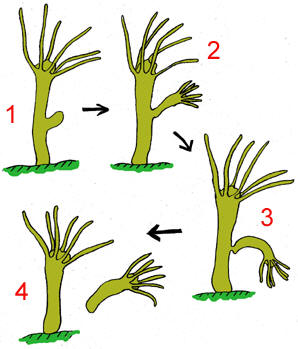
When an offspring grows off from the body of a parent organism it is called __________________.

1

budding

2

binary fission

3

regeneration

4

runners

48

Multiple Choice

What is an advantage of sexual reproduction?
1
Allows genetic variation
2
Only needs one parent
3
Happens very quickly
4
Offspring are exact copies of parent

49

Multiple Choice

Question image

Strawberry plants produce offspring by sending out specialized stems. This is an example of...

1

runners.

2

tubers.

3

fragmentation.

4

budding.

50

Multiple Choice

In asexual reproduction, all of the offspring are:

1

a 50/50 blend of each parent

2

genetically identical

3

unique

4

take longer to create

51

Multiple Choice

How many parents are required for asexual reproduction?

1

none

2

1

3

2

4

4

52

Multiple Choice

What is one advantage of asexual reproduction?

1

offspring are different from parents

2

diseases are not passed from parent to offspring

3

it takes a longer time

4

it takes less time

53

Multiple Select

Why do cells divide? Mark all the apply.

1

to repair damaged cells

2

to stop cancer cells

3

to replace old or dead cells

4

growth of organism

54

Multiple Choice

Question image
I store water in both plant and animal cells. What am I?
1
cytoplasm
2
ribosomes
3
vacuole
4
lysosomes

55

Multiple Choice

Question image
What cell part is NOT found in all cells?
1
Cell Wall
2
Cell Membrane
3
Cytoplasm
4
Genetic Material

56

Multiple Choice

Question image
What does this organism use for movement?
1
Pseudopod
2
Cilia
3
Flagella
4
legs

57

Multiple Choice

Where are ribosomes produced?
1
Nucleolus
2
Endoplasmic reticulum
3
Golgi body
4
Vessicle

58

Multiple Choice

Question image

Structures that transport and ship proteins like UPS,

1

Ribosomes

2

Lysosomes

3

Organelles

4

Golgi Bodies

59

​Parts of the microscope

media

60

Multiple Choice

Question image
What is the total magnification of a microscope with two lenses when one lens has a magnification of 10x, and the other lens has a magnification of 30x?
1
15x
2
30x
3
40x
4
300x

61

Multiple Choice

Question image
When you focus on a new specimen, always begin with
1
low power and coarse adjustment.
2
low power and fine adjustment
3
high power and coarse adjustment
4
high power and fine adjustment

62

Multiple Choice

Question image
If your teacher asks you to move a microscope to table, how do you carry it?
1
by the body tube and the eyepiece
2
with one hand
3
one hand on the arm and the other under the base
4
with one hand on the base and the other on the eyepiece.

63

Multiple Choice

Question image
Which part of the microscope controls the amount of light available?
1
coarse adjustment knob
2
diaphragm
3
objective lens
4
revolving nosepiece

64

Multiple Choice

Question image
Which part lets you turn up the power of magnification, such increasing from 40x to 100x?
1
coarse adjustment knob
2
diaphragm
3
field-of-view
4
revolving nosepiece

65

Multiple Choice

Question image
What is part 1?
1
eye piece
2
body tube
3
arm
4
coarse adjust

66

Multiple Choice

Question image
What part is 3?
1
eye piece
2
base
3
arm 
4
coarse adjust

67

Multiple Choice

Question image
What part is 5?
1
coarse adjustment
2
fine adjustment
3
diaphragm
4
stage

68

Multiple Choice

Moves stage up and down for focusing; locates the specimen

1

Fine Focus Knob

2

Large Focus Knob

3

Course Focus Knob

4

Small Focus Knob

69

Multiple Choice

What will be the total magnification if ocular lens is 10X and objective lens is 4X?
1
4X
2
40X
3
10X
4
100X

70

Multiple Choice

True of False: If the coarse and fine focus knobs are not turning, you should force them to turn.

1

True

2

False

71

Multiple Choice

Question image

The specimen slide is placed on the ___

1

platform

2

table

3

stage

4

base

Cell Types quiz study guide quizizz lesson

Coach Wilson

Show answer

Auto Play

Slide 1 / 71

SLIDE