Search Header Logo
Biology Semester Review 2

Biology Semester Review 2

Assessment

Presentation

•

Biology

•

9th Grade

•

Medium

•
NGSS
HS-LS1-4, MS-PS1-1, HS-LS3-1

+6

Standards-aligned

Created by

Stacy King

Used 6+ times

FREE Resource

42 Slides • 26 Questions

1

Biology Semester Review 2

Slide image

2

Slide image

3

Phylogenetic tree

identifies the most common (known) ancestor

Slide image

4

Multiple Choice

Question image

Which is more closely related?

1

Lamprey and tiger

2

Gorilla and Human

3

Salamander and Tiger

4

Shark and Lizard

5

Multiple Choice

Question image

The cladogram shows the evolution of land plants as indicated by fossil records.

Which discovery would challenge the validity of this cladogram?

1

A large aquatic vascular plant about 200 million years old

2

A species of algae that has existed for less than one million years

3

A moss species that has existed for less than 380 million years

4

A fossil of a fern more than 425 million years old

6

Atoms are the basic unit of matter

  • neutrons= neutral charge

  • Protons= positive charge

  • electrons= negative charge

Slide image

7

center of atom (nucleus)

  • neutrons

  • protons

Slide image

8

protons

  • positive charged

  • identity of the element

  • changing protons change the element

  • H bomb is caused by ejecting a proton

Slide image

9

Neutrons

  • neutral charge

  • isotope- the change in the number of neutrons

  • elements can have many isotopes

  • mass changes not the element

Slide image

10

Electrons

  • orbit the nucleus of atoms electron cloud

  • negatively charged

  • reason for chemical reactions

  • so small they defy laws of physics particles and waves

Slide image

11

Multiple Choice

all matter is made of what 
1
energy 
2
atoms 
3
electrons 
4
compounds 

12

Multiple Choice

The positive particles of an atom are 
1
electrons 
2
positrons 
3
neutrons 
4
protons 

13

Multiple Choice

Particles in an atom that are neutral and have no charge are 
1
negatrons 
2
electrons 
3
neutrons 
4
protons 

14

Multiple Choice

The positive particles of an atom are 
1
electrons 
2
positrons 
3
neutrons 
4
protons 

15

Chemical Compound

2 or more elements bonded together

ionically- metal with nonmetal

covalently- nonmetal with nonmetal

Slide image

16

Hydrogen bonds

intramolecular bond

binds molecules together

Slide image

17

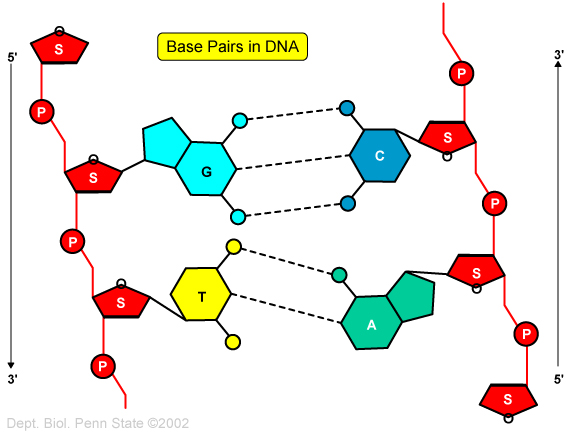
Multiple Choice

Question image
Nitrogenous bases are joined by which type of bond?
1
polar bonds
2
ionic bonds
3
covalent bonds
4
hydrogen bonds

18

Acid and Bases

  • acids- release H+ ions in solution

  • bases- release OH- ions in solution

Slide image

19

pH scale

indicates the concentration of H+ in a solution

Slide image

20

Slide image

21

Carbohydrates

main source of energy for organisms

can be used for structural support (cellulose)

Slide image

22

Saccharides (carbohydrates)

  • mono-1 unit

  • di-2 units

  • poly- chains

Slide image

23

Lipids

form biological structures

phospholipids

steriods

Slide image

24

Proteins biological functions

rate of reactions

cellular transportation

enzymes

Slide image

25

Protein complexity

  • amino acid- single unit

  • polypeptide strand- chain of aa's

  • pleating or spirals- hydrogen bonds

  • folding- molecular interactions proteins

Slide image

26

Multiple Choice

Question image
Which of the following is a carbohydrate (monosaccharide)?
1
A
2
B
3
C
4
D

27

Multiple Choice

Question image

The complex carbohydrates pictured below are made by linking molecules of glucose.


In all three complex carbohydrates, the subunits of glucose are bonded together differently. Because they have different structures, they most likely —

1

contain different chemical elements

2

form different proteins

3

carry different nucleotides

4

perform different functions

28

Multiple Choice

Which biomolecule is also known as enzymes?
1
Carbohydrate
2
Lipid
3
Nucleic Acid
4
Protein

29

Multiple Choice

Question image

Students were given a list of seven elements and asked to identify the four elements that are most abundant in biomolecules. Which table correctly identifies the four most-abundant elements in biomolecules?

1

A (Carbon, Hydrogen, Nitrogen, Oxygen)

2

B (Hydrogen, Nitrogen, Oxygen, Phosphorus)

3

C (Carbon, Fluorine, Oxygen, Phosphorous)

4

D (Carbon, Hydrogen, Iodine, Oxygen)

30

Multiple Choice

Proteins and polysaccharides are polymers. These polymers are formed by dehydration synthesis. Which statement correctly identifies a difference in the structure of proteins and polysaccharides?

1

Only polysaccharides are comprised of repeating units of cytosine, adenine, guanine, and thymine.

2

Only proteins are formed from amino acids joined by peptide bonds.

3

Only polysaccharides can be folded and twisted to very specific shapes.

4

Only proteins can be large molecules with thousands of subunits.

31

Multiple Choice

Question image

Proteins and carbohydrates have many functions in the body of an organism. Specific Proteins and carbohydrates perform specific tasks. Information about a protein and a carbohydrate is given.


How are ferritin and glycogen similar in their primary functions for an organism?

1

Both store materials needed by the organism.

2

Both store energy used by the organism.

3

Both support the structure of the organism.

4

Both store information for the organism.

32

Nucleic acids

  • phosphate

  • sugar

  • nitrogenous base

Slide image

33

Slide image

34

DNA

  • double helix

  • Deoxyribose sugar

  • Base pairs

  • A-T

  • C-G

Slide image

35

DNA Genetic code

Nitrogenous base sequencing codes for genetic traits

Slide image

36

RNA

  • single stranded

  • ribose sugar

  • transcription and translation of genes to protein

  • base pairs

  • A-U

  • C-G

Slide image

37

Multiple Choice

In DNA, adenine pairs with _______, while guanine pairs with _______.

1

uracil / cytosine

2

thymine / uracil

3

thymine / cytosine

4

adenine / guanine

38

Multiple Choice

What are the three main parts of a nucleotide?

1

carbon, hydrogen, and oxygen

2

phosphate, sugar, and nitrogen base

3

phosphate, sulfate, and nitrate

4

adenine, thymine, and uracil

39

Multiple Choice

Which of these substances stores and transmits the information that specifies the traits of an organism?
1
DNA
2
RNA
3
enzymes
4
carbohydrates

40

Transcription

  • mRNA transcribes the DNA blueprint

  • inside the nucleus

Slide image

41

Translation

mRNA attaches to ribosome and tRNA brings matching amino acids to build a protein

Slide image

42

Multiple Choice

Proteins are formed in the cytoplasm of cell using genetic instructions from DNA, which is located in the cells nucleus.  Which of the following best explains how the genetic information gets to the site of protein synthesis?
1
DNA is divided during mitosis, and one strand travels outside the nucleus to bind with RNA and form a protein
2
DNA is copied to make mRNA. The mRNA leaves the nucleus and goes to the ribosomes, where the information is used to guide protein synthesis.
3
Genetic information travels from DNA in the nucleus along a strand of mRNA that is connected to ribosomes in the cytoplasm where proteins are made.
4
The genetic code is transferred to ribosomes on tRNA molecules, which can pass through the nuclear membrane.

43

Multiple Choice

What is the funtion of tRNA?

1

contains codons and carries an amino acid to the ribosome

2

carries a sugar to the ribosome

3

contains anticodons and carries an amino acid to the ribosome

4

carries an amino acid to the nucleus

44

Multiple Choice

The process in which a section of DNA is used to produce a copy of mRNA is called:

1

transcription

2

translation

3

mutation

4

inheritance

45

Slide image

46

Cell cycle

  • Interphase- non-dividing

  • mitosis- dividing

Slide image

47

interphase (non-dividing)

  • G1- growth (longest phase)

  • S- synthesis DNA replication

  • G2- replication of cell structures (organelles)

  • Chromatin in nucleus

Slide image

48

Slide image

49

Prophase of Mitosis

  • chromosomes are visible in the nucleus

  • nuclear envelope begins to break apart

  • centrioles move to opposing ends

Slide image

50

Metaphase

  • Chromosome align in the middle

  • spindle fibers attach to centromer

Slide image

51

Anaphase

  • centomers spit pulling sister chromatids apart

  • chromosomes move to opposite sides of the dividing cell

Slide image

52

Telophase

  • nuclear envelope reforms

  • chromosomes unravel into chromatin

  • cell membrane begins cytokinesis

Slide image

53

Slide image

54

Multiple Choice

Question image

Part of the cell cycle is shown in this simplified model.

This part of the cell cycle is best described as the process that

1

duplicates the DNA

2

completes cell division

3

maintains genetic homeostasis

4

synthesizes new molecules

55

Multiple Choice

Question image

The diagram shows cells in different phases of mitosis. A student is trying to find a cell in a particular phase of mitosis. The student is looking for evidence that spindle fibers are separating the chromosomes to ensure that each new nucleus has one copy of each chromosome.

Which cell is in the phase of mitosis that the student is searching for?

1

1

2

2

3

3

4

4

56

Multiple Choice

Question image
This diagram shows the cell cycle.

Which of the following activities occur in the S phase?
1
Replication of the DNA
2
Growth of the cell
3
Formation of the mitotic spindle
4
Breakdown of the nuclear membrane

57

Cytokinesis

final separation into 2 daughter cells

cell plate forms in plant cells

Slide image

58

Uncontrolled cell growth

  • unregulated cell mitosis

  • onco- cancerous

  • tumors are formed

Slide image

59

Multiple Choice

Oncogenes are mutated forms of genes. Oncogenes can transform a cell into a tumor cell. Some tumor cells are benign, while others are malignant. How does the presence of an oncogene lead to the formation of a tumor?

1

ATP production is inhibited.

2

Cell division is unregulated.

3

Somatic cell growth is inhibited.

4

Antibody activity is unregulated.

60

Slide image

61

Diffusion

  • movement from an area of higher concentration to an area of lower concentration

  • osmosis-water diffusion through a semipermeable membrane

Slide image

62

Cell membrane

semipermeable

only small molecules and water can diffuse through the membrane

Slide image

63

Passive transport

  • along the concentration gradient

  • no ATP expended

  • simple- diffusion

  • facilitated- transport protein

Slide image

64

Active transport

  • against the concentration gradient

  • requires ATP

Slide image

65

Multiple Choice

Question image

A student used a microscope to observe Elodea submerged in a solution. The student observed the cell cytoplasm pull away from the cell wall and clump together in the center of the cell.

What statement best explains why this occurred?

1

The cell was submerged in a pure water solution

2

The cell was submerged in a solution with a higher water concentration than the inside of the cell.

3

The cell was submerged in a solution with an equal water concentration to the inside of the cell.

4

The cell was submerged in a solution with a lower water concentration than the inside of the cell.

66

Multiple Choice

Which cellular structure in an animal cell helps maintain homeostasis by controlling the transportation of substances into and out of the cell?

1

vacuole

2

cell membrane

3

mitochondrion

4

cell wall

67

Multiple Choice

Question image

The diagram illustrates the movement of molecules through a cell membrane.

What process is being used by the cell to move the molecules?

1

osmosis

2

endocytosis

3

active transport

4

facilitated diffusion

68

Slide image

Biology Semester Review 2

Slide image

Show answer

Auto Play

Slide 1 / 68

SLIDE