Search Header Logo
Genetics terms part 3

Genetics terms part 3

Assessment

Presentation

Biology

9th - 10th Grade

Medium

Created by

Stacey Ramay

Used 63+ times

FREE Resource

14 Slides • 15 Questions

1

media

2

Multiple Choice

In what phase is the DNA of the cell replicated or copied?

1

Interphase

2

Prophase I

3

Telophase I

4

Metaphase I

3

Multiple Choice

What part of the cell disappears during Prophase and reappears in Telophase?

1

nuclear membrane

2

cell membrane

3

chromosomes

4

media

19. Meiosis

Meiosis is the process by which

organisms produce gametes. It
goes through the same steps as
mitosis, but it goes through them
twice. Important because it
increases genetic variation in a
population.

2

5

media

8. Gametes

Sex cells: sperm and egg

3

6

Multiple Choice

Question image

An organism's reproductive cells, or sex cells, are called _____.

1

bacteria

2

prokaryotes

3

gametes

4

pathogens

7

Multiple Choice

Body cells are also called _________ cells.

1

normal

2

prokaryotic

3

pathogens

4

somatic

8

media

5. Diploid

A cell that has 2 of each type of allele.

This is a cell that has a copy of the
maternal (mom) DNA and a copy of the
paternal (dad) DNA. This is a normal
somatic (body) cell. In humans this is
46 chromosomes.

4

9

Multiple Choice

Question image

How many chromosomes does a human body cell have, total?

1

48

2

46

3

23

4

47

10

Multiple Choice

Question image

Cells that contain 2 sets of chromosomes are called _________ (2n).

1

diploid

2

haploid

3

triploid

4

polyploid

11

media

11. Haploid

A cell that has Half the normal number

of chromosomes. This is a gamete (sex
cell). In humans this would be 23
chromosomes

5

12

Multiple Choice

Question image

Cells that contain only ONE set of chromosomes are called ________ (n).

1

diploid

2

polyploid

3

triploid

4

haploid

13

Multiple Choice

The gametes only contain half as many chromosomes as your body cells.

1

True

2

False

14

media

15

media

32. Zygote

The fertilized egg that has one set

of alleles from mom and one set
from dad. It is a diploid cell.

7

16

Multiple Choice

Question image

A _______ is an egg that has been fertilized by a sperm cell.

1

gene

2

chromosome

3

zygote

4

embryo

17

media

14. Homologous chromosomes

Contain DNA that codes for the same

genes, but possibly different versions
of those genes (alleles) . One
Chromosome originally came from
dad and one came from mom.

8

18

media

19

Multiple Choice

Homologous pairs line up in the middle of the cell in what phase of Meiosis?

1

Metaphase I

2

Metaphase II

3

Mitosis

4

Prophase II

20

Multiple Choice

Question image

Chromosomes that are paired by size and content are called _______ chromosomes.

1

homeostasis

2

homologous

3

matching

4

sister

21

media

29. Synapsis

The pairing up of two homologous

chromosomes (matching chromosomes
from each parent). Occurs during
Prophase 1.

10

22

media

30. Tetrad

The pair of homologous chromosomes that forms in prophase 1 and separates

in anaphase 1.

11

Homologous chromosomes

Tetrad

23

media

4

.

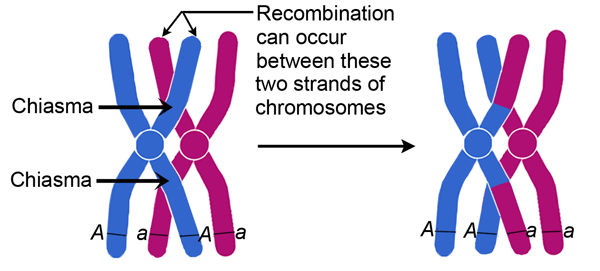
Crossing Over

Segments of homologous chromosomes break and reattach to
the other

chromosome. Occurs during Prophase 1. Increases

genetic variation in a population.

24

Multiple Choice

The process of crossing over occurs in what phase of meiosis?
1
anaphase 1
2
prophase 1
3
prophase 2
4
telophase 1

25

Multiple Choice

Genetic information is transferred to homologous pairs during what?

1

Cytokinesis

2

Crossing over

3

Interphase

26

media
media

18. Independent assortment

Chromosomes line up and separate randomly

during metaphase 1 and anaphase 1. Increases
genetic variation in a population.

13

27

media

26. Segregation

The separation of allele pairs (different

traits of the same gene) during meiosis into
different gametes. Each gamete contains
only one member of every pair of genes.
This allows each gamete to be different,
increasing genetic variation.

14

28

Multiple Choice

Question image
This image shows chromosomes during Prophase 1. Which of the following correctly describes the process shown?
1
segregation of sister chromatids
2
condensation and segregation of alleles
3
mutationin which the DNA content of the gene is altered
4
crossing - over in which alleles are exchanged

29

Multiple Choice

How many copies of each gene do you have?

1

1

2

2

3

3

4

4

media

Show answer

Auto Play

Slide 1 / 29

SLIDE