

Electricity Lesson

Presentation
•
Science
•
6th - 8th Grade
•
Medium
+1
Standards-aligned

Crystal Winner
Used 67+ times
FREE Resource
20 Slides • 18 Questions
1
By Crystal Winner
2
By the end of the lesson, students should be able to
Describe and explain static electricity
Explain electric force
Describe conductors and insulators
Understand electric current in a circuit
Discuss and construct components in parallel circuit
3
4
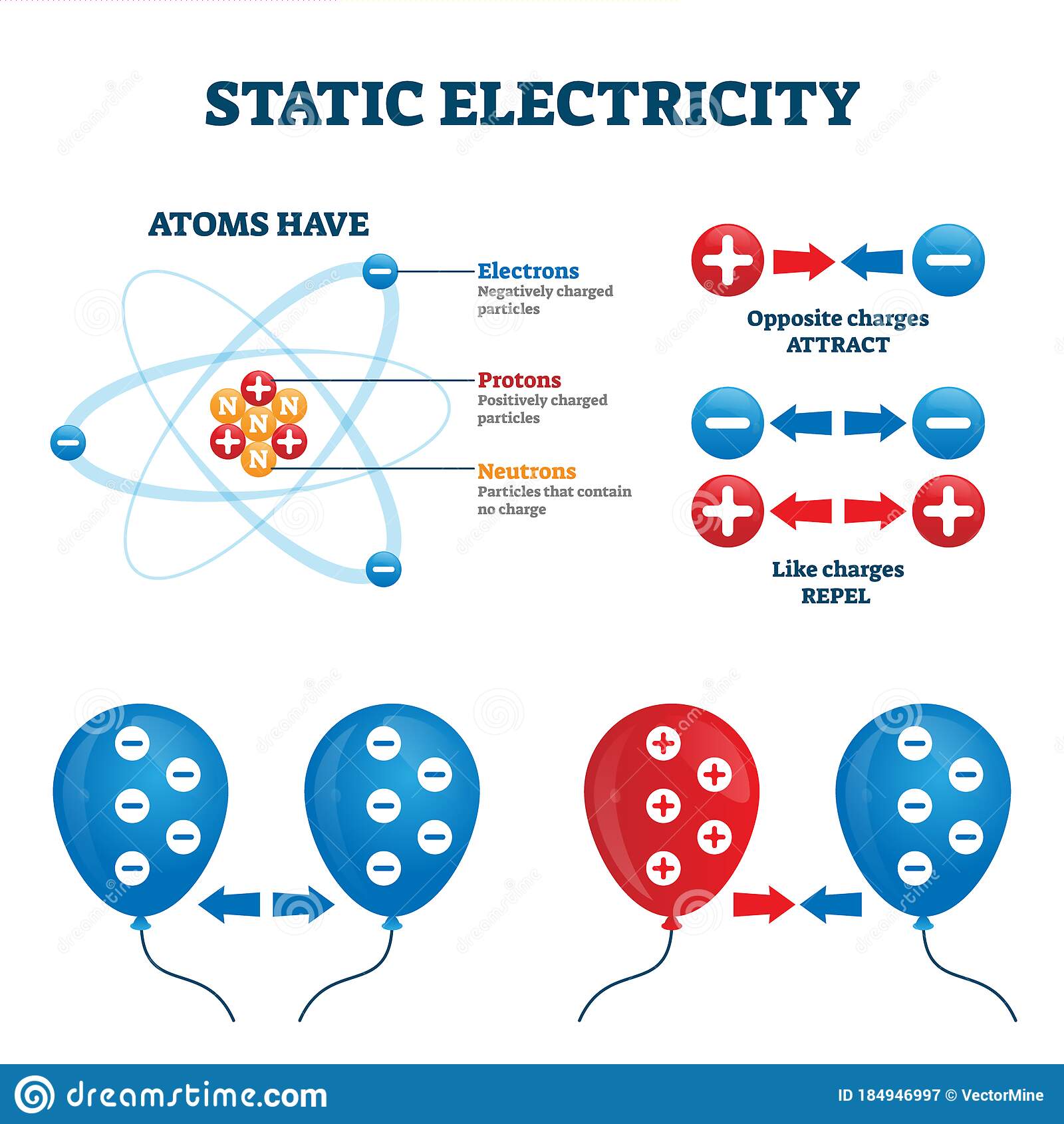
Protons are POSITIVELY CHARGED Neutrons are NEUTRAL Electrons are NEGATIVELY CHARGED
Overall an atom is typically neutral because the protons and electron numbers are the same and the positive and negative charges balance.

5
Static Electricity is the build up of negative charge (electrons) when two objects that are really good insulators rub together.
- A material that gains electrons have a negative charge
- A material that loses electrons have a positive charge
Static electricity only occurs in insulating material because the charges in a conductor can move around freely, so a charge cannot build up in one place and spreads out across the surface
6
When a charged object comes near to another object the two objects will either attract or repel each other:
•if the charges are the same - they repel
•if the charges are opposite - they attract
•if one is charged and the other is not - they may attract depending on the nature of the substances
Like charges repel, and unlike charges attract.

7
8
Multiple Choice
9
Multiple Choice
10
Multiple Choice
If an object gains electrons, it will be...
positively charged
negatively charged
neutral
11
Multiple Choice
Two objects that are both positively charged will
attract each other
repel each other
do nothing
12
13

14
Multiple Choice

Is wool a conductor or insulator?
Conductor
Insulator
15
Multiple Choice
Thermal energy is NOT able to travel quickly through this type of material.
Insulator
Conductor
16
Multiple Choice
Conductors are materials that...
Allow heat to pass through them freely.
Allow cold to pass through them freely.
Stop heat from passing through.
Stop cold from passing through.
17
Poll
What objects do you think will make the best conductor (Allow the heat from his hand to pass freely through them to the paper)?
Cardboard Circle
Shark Tooth
Penny
Metal Key Chain
Plastic Toy
18
Multiple Choice
Which one of these objects is a good insulator
Copper wire
Glass
Aluminum
Gold
19
The current in a circuit depends on the potential difference and the resistance.
It is easy to think of each of these in the following way:
•the current is the flow of electric charges
•the potential difference provides the 'push‘
•the resistance restricts the flow of charges

20
1. You require a complete circuit.
2. A power supply which “pushes” the charged particles around the circuit.
21
The wires and the other components in a circuit reduces the flow of charge through them. This is called resistance.
The unit of resistance is the ohm, and it has the symbol Ω (an uppercase Greek letter omega
22
When electrons move through the wire, some electrons collide with the ions of the material in the wire. It is these collisions that cause electrical resistance. With each collision, some energy is lost to the wire as heat. This explains the heating effect of current.

23
•Increasing the resistance decreases the current. You can increase the resistance by adding more components with higher resistance.
24
. The greater the battery voltage (i.e., electric potential difference), the greater the current.
25

26

27
if a lamp breaks or a component is disconnected, the circuit is broken and all the components stop working.
The current is the same everywhere in a series circuit. It does not matter where you put the ammeter
If you put more lamps into a series circuit, the lamps will be dimmer than before because less current will flow through them.

28
In a parallel circuit, different components are connected on different branches of the wire
If a lamp breaks or a component is disconnected from one parallel wire, the components on different branches keep working.
When two components are connected in parallel, the current is shared between the components. The current is shared when it reaches the branches, then adds again where the branches meet

29

30
Multiple Choice
What is an electric circuit?
The path which the electric current takes.
Movement or flow of negatively charged electrons
A device to control the flow of electricity
The current flow of electricity that always goes in one direction
31
Multiple Choice
32
Multiple Choice
33
Multiple Choice

A _____________ is a path that is made of parts that work together to allow current to flow.
Static electricity
Circuit
Insulator
34
Multiple Choice
What type of electricity do we use everyday?
Static electricity
Electric current
35
Multiple Choice

36
Multiple Choice

37
Multiple Choice

38
Multiple Choice

By Crystal Winner
Show answer
Auto Play
Slide 1 / 38
SLIDE
Similar Resources on Wayground

33 questions
Specific Heat & Local Winds
Presentation
•
6th - 8th Grade
32 questions
TCi Adaptation Lesson 3
Presentation
•
6th - 8th Grade
32 questions
Circulatory System
Presentation
•
6th - 8th Grade
35 questions
Balanced and Unbalanced Forces
Presentation
•
6th - 8th Grade
35 questions
Magnetic Force
Presentation
•
6th - 8th Grade
35 questions
Sexual and Asexual Reproduction
Presentation
•
6th - 8th Grade
30 questions
The Waves Halftime Show
Presentation
•
6th - 8th Grade
31 questions
States of Matter and Phase Changes
Presentation
•
6th - 8th Grade
Popular Resources on Wayground
10 questions
How much do you know about our Portrait of an Eagle?

Quiz
•
10th Grade
10 questions
Fast Food Slogans
Quiz
•
6th - 8th Grade
21 questions
Continents and Oceans
Quiz
•
6th Grade
20 questions
Parts of Speech
Quiz
•
5th Grade
16 questions
Subject & Predicate
Quiz
•
5th Grade
25 questions
Multiplication Facts
Quiz
•
5th Grade
12 questions
Map Skills
Quiz
•
3rd Grade
22 questions
Continents and Oceans
Quiz
•
5th Grade
Discover more resources for Science
17 questions
7.6D Aqueous Solutions
Quiz
•
7th Grade
20 questions
Scientific Method and Variables
Quiz
•
8th Grade
20 questions
Scientific method and variables
Quiz
•
8th Grade
27 questions
Counting Atoms - Subscripts
Quiz
•
8th Grade
10 questions
6.6D - Relative Density Review
Quiz
•
6th Grade
20 questions
Claim, Evidence and Reasoning (CER)
Quiz
•
6th - 8th Grade
18 questions
Counting Atoms
Quiz
•
7th - 8th Grade
20 questions
Density
Quiz
•
6th Grade