Search Header Logo
  1. Resource Library
  2. Science
  3. Physics
  4. Light
  5. Light And Sound Waves
Light and Sound Waves

Light and Sound Waves

Assessment

Presentation

Science

6th - 8th Grade

Medium

NGSS
MS-PS4-2, MS-PS1-4

Standards-aligned

Created by

Samantha Heaberg

Used 177+ times

FREE Resource

14 Slides • 16 Questions

1

Waves and Their Properties

Slide image

2

Matter can Transmit Light

  • Light is a type of electromagnetic wave, so it can travel through empty space

  • When light meets with a material, it can be passed through the material – we call this transmission

  • Transparent – Matter that transmits light; you can see through them

  • Translucent – light is scattered in different directions; you can't see all the way through

3

Matter can Absorb Light

  • Opaque materials do not let any light pass through; they can reflect, absorb, or both

  • Absorption transfer of light energy to matter (think like how a sponge soaks up water)

4

Matter Can Reflect Light

  • Reflectionthe bouncing of light off a surface; The Law of Reflection states that a light way striking a mirror will bounce off the mirror at the same angle

  • When light bounces off a smooth surface it reflects in a uniform way

  • When light bounces off a rough surface it scatters in many different directions

5

Multiple Choice

What type of wave interaction is being described - The road becomes hot on a summer day due to matter taking in light waves.

1

absorption

2

reflection

3

refraction

4

scattering

6

Multiple Choice

What type of wave interaction has to take place for an object to appear opaque?

1

Light waves are reflected

2

Light waves are refracted

3

Light waves are diffracted

4

Light waves are transmitted

7

Multiple Choice

For an object to appear transparent, what type of wave interaction must take place?

1

Light waves are transmitted

2

Light waves are absorbed

3

Light waves are diffracted

4

Light waves are reflected

8

What determines what colors we see?

  • Remember the colors we can see are called visible light – Roy G. Biv

  • Light can be reflected or absorbed. Objects that appear a specific color are because those are the light waves that are reflected

  • Objects that are translucent or transparent can absorb, reflect, and transmit light waves.

Slide image

9

Black and White Objects

  • When an object absorbs all light waves, it appears black

  • When an object reflects all light waves, it appears white

  • Any other color that you see is due to reflection of light waves

Slide image

10

Multiple Choice

How are we able to perceive an object as being the color white?

1

All colors of visible light are absorbed by an object and then reflected into our eye.

2

All colors of visible light are reflected off an object and then to our eye.

3

All colors of visible light are absorbed by an object and no light is being reflected into our eye.

11

Multiple Choice

How are we able to perceive an object as being the color black?

1

All colors of visible light are absorbed by an object and then reflected into our eye.

2

All colors of visible light are reflected off an object and then to our eye.

3

All colors of visible light are absorbed by an object and no light is being reflected into our eye.

12

Multiple Choice

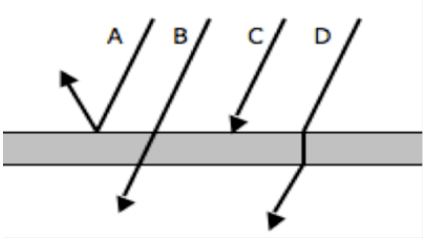
Question image

Ray C represents __.

1

reflection

2

refraction

3

transmission

4

absorption

13

Multiple Choice

Question image

Ray B represents __.

1

reflection

2

refraction

3

transmission

4

absorption

14

Multiple Choice

If you see an object as orange,

1

it is absorbing orange light and reflecting all other colors.

2

it is reflecting all colors.

3

it is absorbing all colors.

4

it is reflecting orange light and absorbing all other colors.

15

Light waves change when interacting with matter

Refraction - is the change in direction of a wave as it passes from one medium into another at an angle.

-Examples: shining white light through a prism creates a rainbow

Slide image

16

Light waves change when interacting with matter

Diffraction - occurs when a wave bends as it passes through an opening or around an object

Example - sunlight shining around a cloud

Slide image

17

Multiple Choice

Question image

A student placed a pencil in a cup of water. The pencil appears broken because light

1

always travels in a straight line.

2

bends when it passes through water.

3

makes the water in the glass evaporate.

4

reflects the pencil on the water's surface.

18

Mirrors and Lenses

Concave vs. Convex

Concave is curved inward like a bowl or a spoon

Convex is curved outward like the back of a spoon

Slide image

19

Multiple Select

A mirror that gives a wider view field making bigger objects appear to be smaller than their original form.

1

concave

2

convex

20

Multiple Choice

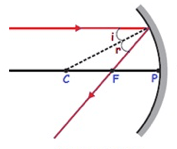
Question image

This ray diagram is for which mirror?

1

concave

2

convex

3

plane

4

window

21

Sound Wave Interactions

22

What affects the speed of sound?

  • Two main factors affect the speed

    of sound: the type of medium that the sound travels through, and

    the temperature of the medium.

  • Sound travels fastest through solids because solids are denser than liquids or gases

  • Sound travels faster through hot air than through cold air.

23

Multiple Choice

The speed of a sound wave depends on
1
the frequency
2
the medium
3
both air temperature and medium
4
the air temperature

24

Matter Can Reflect Sound Waves

  • Reflection is the bouncing back of a wave when the wave hits a barrier

  • Example - an echo

Slide image

25

​Matter Can Absorb Sound Waves​

  • A rough wall will absorb sound better than a smooth wall will.

    And soft materials absorb sound better than hard materials do

Slide image

26

Diffraction

Diffraction is how a wave changes when it interacts with an obstacle or an opening.​


​If a wave hits an object it cannot pass through, it bends to move around the object.


Slide image

27

Multiple Select

Question image

People often put noise-cancelling earmuffs on babies when they bring them to loud places. This is to help protect their ears. How do you think this works? Select TWO answers.

1

Sound waves are striking the earmuffs and bouncing off of them.

2

Sound waves are striking the earmuffs, going into them, but not passing through them.

3

Sound waves are striking earmuffs and going through them.

4

Sound waves are striking the earmuffs and being bent as they pass through.

28

Multiple Choice

Listen to the recording of someone yelling in a tunnel. Why do we hear something after each yell?

1

Sound waves are striking the walls of the tunnel and bouncing off of the walls.

2

Sound waves are striking the walls of the tunnel and going into the walls (they are not passing all the way through).

3

Sound waves are striking the walls of the tunnel and going all the way through the walls.

4

Sound waves are striking the walls of the tunnel and being bent as they go through the walls.

29

Multiple Choice

Question image
What type of wave behavior is pictured above?
1
Refraction
2
Reflection
3
Absorption
4
Diffraction

30

Multiple Choice

When a sound wave experiences reflection, we hear
1
a louder sound
2
an echo
3
a quieter sound
4
nothing

Waves and Their Properties

Slide image

Show answer

Auto Play

Slide 1 / 30

SLIDE