

Lesson: Newton, Force, and Acceleration

Presentation
•
Physics
•
9th Grade
•
Medium
+2
Standards-aligned

William Jared Lovering
Used 34+ times
FREE Resource
29 Slides • 32 Questions
1
By William Lovering
2

3

4

5

6

7
Multiple Choice
8

9
Forces could be balanced or unbalanced
There can be multiple forces acting on an object
Forces in opposite directions cancel each other. Forces in the same direction help each other.
Net force is the force an object experiences or "feels" after you sum (add or subtract) all of the forces.
Add if in the same direction.
Subtract if in opposite directions
10

11

12

13

14
Multiple Choice

Forces that have a net force of zero
Balanced force
Unbalanced force
15
Multiple Choice
A(n) _______ is present if velocity changes.
unbalanced force
balanced force
machine
gravitational force
16
Multiple Select
Which of the following would NOT require an unbalanced force? (Choose all that apply)
an object remains at rest
an object moving in a straight line at a constant speed
an object moving in a circle at a constant speed
an object slowing down in a straight line
17
Multiple Choice
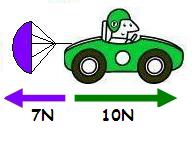
What is the net force?
17N Left
3 N, right
10N Right
3N Left
18
Multiple Choice

19
An object in motion tends to stay in motion unless acted upon by an unbalanced force.
An object at rest tends to stay at rest unless acted upon my an unbalanced force.
The first law is often called the law of inertia.
Inertia means that an object usually resist a change in motion. The more mass an object has, the more inertia it has. For example, a train has more inertia than feather.
20

21
When a force is balanced, it will move with a constant velocity (staying still or moving at the same speed)
When a force is unbalanced, it will accelerate in the direction of the larger force.
Net force is the combination of all the forces acting on an object. If the forces are going in the same direction they can be added on top of each other.
22

23

24

25

26

27
Multiple Choice
28
Multiple Choice
29
Multiple Choice
A force which is present in all objects with mass.
gravity
friction
normal
inertia
30
Multiple Choice
The force that opposes gravity when an object doesn't fall.
gravity
magnetism
normal
friction
31
Multiple Choice
A force that opposes motion when matter touches
gravity
magnetism
normal
friction
32

33
F= m * a
m=F/a
a = F/m
The more mass an object has, the more force is needed to accelerate it. The more force you apply, the more it will accelerate. There are a lot of applications of Newton's Second Law.
34
Multiple Choice
What is the acceleration of an object that has a mass of 5 g and is hit with a force of 10 N?
50 m/s2
2 m/s2
15 m/s2
5 m/s2
35
Multiple Choice
36
Multiple Choice

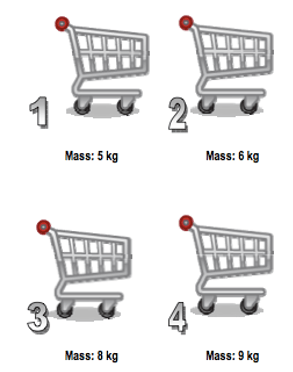
If the man pushes with an equal amount of force, which object will accelerate more?
Car because it has more mass
Lawnmower because it has less mass
Car because it has less mass
Lawnmower because it has more mass
37
Multiple Choice
An object with a mass of 100 kg is observed to accelerate at the rate of 5 m/s2. Calculate the force required to produce this acceleration.
20N
500 M/S
20 Kg
500N
38
Multiple Select
Which statement, or statements about the relationship between mass, force, and acceleration is true? (you may select more than one answer)
An object will accelerate (change velocity) if a force is applied.
If the same force is applied to 2 objects with different mass, the one with more mass will accelerate less.
If forces of different strength are used on 2 objects with the same mass, they will still accelerate (change velocity) at the same rate.
If you reduce the mass of an object, you can have the same acceleration with less force.
39

40

41

42

43

44
Multiple Choice
While driving down the road, a firefly strikes the windshield of a bus and makes a quite obvious mess in front of the face of the driver. The firefly hit the bus and the bus hits the firefly. Which of the two forces is greater: the force on the firefly or the force on the bus?
Firefly
Bus
Equal Forces
45
Multiple Choice
What is Newton's Third Law of Motion?
an object at rest stays at rest, and an object in motion will stay in motion until an outside force acts upon it
the acceleration of an object will be equal to the net force of an object divided by its mass
for every action, there will be an equal and opposite reaction
an object that is not moving will stay not moving moving until an unbalanced force acts on it
46
Multiple Choice
If you throw a ball into the air, Earth exerts a force on the ball. The ball in the air exerts no force on Earth.
True; all forces act alone
False; there will always be a force pair
47
Multiple Choice
When you jump up, you push the earth downwards. Why can't you tell that the earth has moved?
The force of you jumping up doesn't actually push the earth down.
The earth has much more mass so it doesn't move at all
The earth is firmly rooted
The earth has much more mass so you can't tell that it moved
48
Multiple Choice
When you hit a tennis ball with a racket...
The ball exerts more force on the racket
The ball and racket exert the same force on each other
The racket exerts more force on the ball
It depends on how hard you hit it
49
Multiple Choice
When you jump upwards, what force is moving you upwards once you leave the ground?
Gravity on to you
The air on to you
You on to the earth
There is no upward force once you leave the ground
50
Multiple Choice
51
Newton's 1st Law: The Law of Inertia
Objects resist changing their velocity. This resistance is called inertia. Whatever velocity an object has, it will keep that velocity until an unbalanced force causes it to change.
I can explain the relationship between forces and motion and use that to predict changes in motion using Newton's Laws.
Newton's 2nd Law: F, M, and A
There is a mathematical relationship between force, mass, and acceleration. The amount of force on an object equals the amount of mass times the amount of acceleration (F = ma). More mass = more inertia. Inertia works against force. (Force wants to change velocity, inertia wants it to stay the same). How fast an object accelerates depends on the amount of force used and the mass of the object.
52
Newton's 3rd Law: Action and Reaction Forces.
When a force is applied to an object, the object always applies a force back that is equal in strength and in the opposite direction. The first force is called the "action force" and the second is called the "reaction force". Together they make a "force pair".
Some text here about the topic of discussion
53
Multiple Choice
Which of the following is the cause of an acceleration?
speed
inertia
force
velocity
54
Multiple Choice
A player throws a ball. The action force is the player pushing on the ball. The reaction force is...
The force of the ball pushing on the player
55
Multiple Choice
56
Multiple Choice

57
Multiple Choice
58
Multiple Choice
Without a force to stop or slow a coasting object, what will happen?
it will coast in a straight line forever
It will keep the same speed but eventually change direction
It will slow down with time
It will explode
59
Multiple Choice
60
Multiple Choice
61
Multiple Choice

Which law explains why the driver "keeps moving forwards, even though the car has stopped"?
1st
2nd
3rd
By William Lovering
Show answer
Auto Play
Slide 1 / 61
SLIDE
Similar Resources on Wayground

52 questions
MOMENTUM
Presentation
•
9th Grade
56 questions
GRAMMAR FOR RECEPTION
Presentation
•
KG
53 questions
EM Spectrum
Presentation
•
8th Grade
54 questions
1.1 Describing Motion
Presentation
•
9th Grade
55 questions
Linear Characteristics Review
Presentation
•
9th Grade
57 questions
10.4 Lesson - Two-Way Tables
Presentation
•
8th Grade
55 questions
Chapter One -Forces
Presentation
•
8th Grade
Popular Resources on Wayground
10 questions
Safety Day 2026 – Student Review

Quiz
•
9th Grade
21 questions
Continents and Oceans
Quiz
•
6th Grade
20 questions
Parts of Speech
Quiz
•
5th Grade
16 questions
Subject & Predicate
Quiz
•
5th Grade
25 questions
Multiplication Facts
Quiz
•
5th Grade
12 questions
Map Skills
Quiz
•
3rd Grade
22 questions
Continents and Oceans
Quiz
•
5th Grade
15 questions
Rounding Decimals
Quiz
•
5th Grade
Discover more resources for Physics
20 questions
Position vs. Time Graphs
Quiz
•
9th Grade
10 questions
Exit Check 5.1 - Forms of Energy
Quiz
•
9th Grade
11 questions
Electricity Explained

Interactive video
•
9th - 12th Grade
87 questions
25-26 Unit 1.2 Review - Radioactivity & Earth's Age
Quiz
•
8th - 10th Grade
18 questions
Quiz #8 Practice: Forces on an Incline
Quiz
•
9th Grade
25 questions
Newton's Laws of Motion
Quiz
•
9th Grade