

Proteins

Presentation
•
Biology
•
11th - 12th Grade
•
Medium
Standards-aligned

Cheryl Graves
Used 7+ times
FREE Resource
18 Slides • 18 Questions
1
Protein
Also called polypeptides
A protein consists of 1 or more polypeptides in specific conformations.
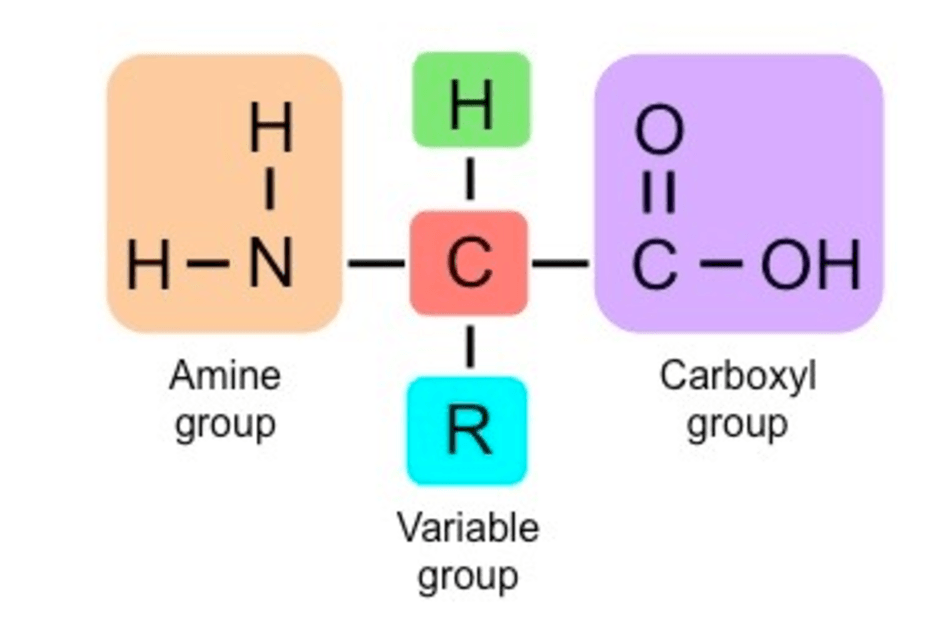
Monomer: amino acids
There 20 amino acids: all have the same basic structure but differ in the side chain (R group).
2

3

4
Multiple Choice

Every amino acid is built around a central
carbon
carboxyl
nitrogen
hydrogen
5
How many amino acids are grouped
All have the same basic structure but differ in their side chain (R group).
4 groups amino acids are:
Non polar
Polar
Acidic
Basic
6
Multiple Choice
7
Function of proteins
Growth and maintenance
biochemical reactions: enzymes, blood clotting, muscle contraction
Messengers: hormones
Structure: e.g. collagen
Maintain pH
Balance water
Immunity
8
Multiple Choice
Which of the following is NOT a function of proteins?
stored energy
create muscle
speed up reactions as enzymes
fights infection in the form of antibodies
9
Multiple Choice
This is one job proteins do NOT have in the body
insulation
structure for tissues and organs
speeds up chemical reactions
transport things through cell membrane
10
Multiple Choice
Which of the following are examples of protein?
cutin, waxes, fats, oils
Collagen, enzymes, hemoglobin, insulin, and antibodies
DNA& RNA
Glucose, sucrose, glycogen, and cellulose
11
Multiple Choice

The diagram shows a bond forming between two amino acids. What is the name of this reaction?
Dehydration Synthesis
Hydrolysis
Pepysis
Oxidation
12

13

14
Multiple Choice
15
16
Levels of protein structure
Each protein has a specific 3-D conformation.
4 levels of protein structure are:
Primary (1o)
Secondary (2o)
Tertiary (3o)
Quaternary (4o)

17
Primary structure
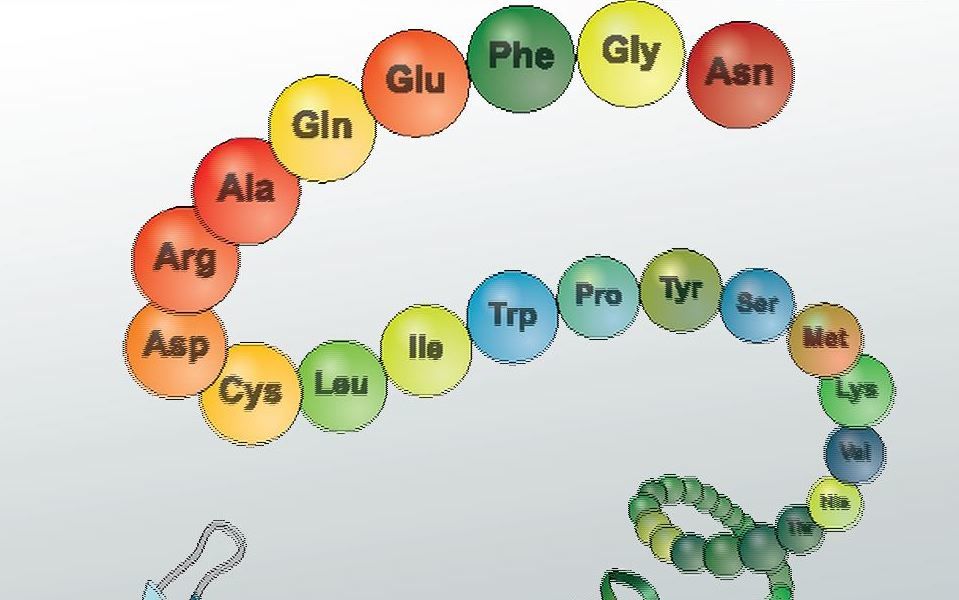
Unique sequence of amino acids joined by peptide bonds in a linear polypeptide chain
The 20 common amino acids can be arranged in different ways (determined by genetic information)
Eg: Glucagon consist of a sequence of 29 amino acids

18
Multiple Choice
A bond between amino acids is called a(n) _____ bond.
acid
hydrogen
ionic
peptide
19
Multiple Choice
20
Secondary structure
Once a linear chain of amino acids is formed, it spontaneously coils to form the alpha helix or folds to form the beta pleated sheet.
Because of hydrogen bonds between the repeating constituents of the polypeptide backbone (not the amino acid side chains).

21
Multiple Choice

Figure 1 Represents a common process that occurs in organisms.
Which of the following is an accurate description of this process shown in figure 1?
The linking of amino acids with an ionic bond as an initial step in the protein synthesis process
The formation of a more complex carbohydrate with the covalent bonding of 2 simple sugars
the hydrolysis of amino acids with the breaking of covalent bonds with the release of water
The formation of a covalent peptide bond in a dehydration synthesis reaction
22
Multiple Choice
which of the following best describes how amino acids affect the tertiary structure of a protein?
the number of amino acids determines the tertiary structure of the protein
the interactions of the different R-groups with other R-groups and with their environment determine the tertiary structure of the protein
the R-group of the last amino acid that is added to a growing polypeptide chain determines the next amino acid that is added to the chain
the sequence of the amino acids in the polypeptide chain determines the protein's primary structure but has no effect on it's tertiary structure
23
Secondary structure
Two forms:
- alpha helix (coiled)
- beta pleated sheet (folded)
alpha helix - Keratin found in hair, nails, horn
beta pleated sheet - Silk protein produced by many insects & spiders
24
Multiple Choice

Which of the following best describes the formation of the amino acids shown in figure 1?
An ionic bond is formed between a carbon atom of one amino acid and the nitrogen atom of the other amino acid
an ionic bond is formed when the negative charge of an OH group is balanced by the positive charge of a hydrogen ion
a covalent bond is formed between a carbon atom and a nitrogen atom along with the formation of water
a covalent bond is formed that replaces the hydrogen bond between the oH group and H atom
25
Tertiary structure
A polypeptide may be further coiled into a globular shape which is maintained by bonds & interactions among side chains.
The bonds and interactions that maintained the structure are:
i. Disulfide bridges
ii. Ionic bonds
iii. Hydrogen bonds
iv. Hydrophobic interactions
v. Van der Waals interactions

26
Multiple Choice
27
Quaternary structure
Consists of 2 or more polypeptide chains joined to form a single functional molecule.
The bonds that formed between the polypeptide chains are :
i) Disulfide bonds
ii) Ionic bonds
iii) Hydrogen bonds
iv) Hydrophobic
v) Van der Waals interactions

28
Quaternary structure
Eg : haemoglobin and collagen
a) Haemoglobin
• Consists of 4 polypeptide chains
• 2 α-chains
• 2 β-chains
b) Collagen
• Consists of 3 polypeptide chains that forms triple- stranded helical coils.
• Fibrous protein
29

30

31
Multiple Choice
which of the following terms refers to the order in which amino acids are linked together in a protein.
Primary
Secondary
Tertiary
Quaternary
32
Multiple Choice
The chain of amino acids folds and coils on itself
Primary
Secondary
Tertiary
Quaternary
33
Multiple Choice
The entire polypeptide forms a three-dimensional structure
Primary
Secondary
Tertiary
Quaternary
34
Multiple Choice
35


Denaturing a
Protein
Proteins have their shape changed under harsh conditions
Conditions that can
denature enzymes:
▪ High temperature
▪ concentration
▪ extreme pH
36
Multiple Choice
If a protein is "denatured", what does that mean?
The protein has broken down
The protein has been created
The protein has folded
The protein has been domesticated
Protein
Also called polypeptides
A protein consists of 1 or more polypeptides in specific conformations.
Monomer: amino acids
There 20 amino acids: all have the same basic structure but differ in the side chain (R group).
Show answer
Auto Play
Slide 1 / 36
SLIDE
Similar Resources on Wayground

31 questions
Basic Trig Identities
Presentation
•
10th - 12th Grade
32 questions
Anatomy and Physiology Medical Terms
Presentation
•
11th - 12th Grade
28 questions
Ureters, bladder, & urethra
Presentation
•
11th - 12th Grade
32 questions
Body Systems
Presentation
•
10th - 12th Grade
28 questions
Earths Geologic History
Presentation
•
11th - 12th Grade
30 questions
Les Objets Directs
Presentation
•
11th - 12th Grade
31 questions
Applied Bio 19.2
Presentation
•
11th - 12th Grade
29 questions
Unit 5A: Lesson 1: Heart Structure
Presentation
•
10th - 12th Grade
Popular Resources on Wayground
6 questions
PRIDE Always and Everywhere
Presentation
•
12th Grade
20 questions
Lab Safety Quiz

Quiz
•
6th Grade
26 questions
KOR Review Kahoot Questions
Quiz
•
8th Grade
21 questions
Continents and Oceans
Quiz
•
6th Grade
12 questions
Unit Zero lesson 2 cafeteria
Presentation
•
9th - 12th Grade
20 questions
Parts of Speech
Quiz
•
5th Grade
10 questions
Riddles Riddles fun Riddles
Quiz
•
6th - 12th Grade
16 questions
Subject & Predicate
Quiz
•
5th Grade
Discover more resources for Biology
20 questions
Scientific Method & Variables
Quiz
•
9th - 12th Grade
10 questions
Exploring the 4 Major Macromolecules and Their Functions

Interactive video
•
9th - 12th Grade
20 questions
Cell Transport
Quiz
•
9th - 12th Grade
26 questions
Quiz Week 2 REVIEW (9/4/26)
Quiz
•
9th - 12th Grade
15 questions
Biomolecules and Enzyme Test Review
Quiz
•
11th Grade
12 questions
EOC WARM UP: BIOMOLECULES AND ENZYMES
Quiz
•
10th - 11th Grade
20 questions
Properties of Water
Quiz
•
9th - 12th Grade
20 questions
Food Chains and Food Webs
Quiz
•
7th - 12th Grade