

SCIENCE 4 Q3 Lesson 8 ELECTRICITY AND MAGNETISM

Presentation
•
Science
•
4th Grade
•
Medium
+7
Standards-aligned

Maritess Jacinto
Used 4+ times
FREE Resource
36 Slides • 19 Questions
1
By Maritess Jacinto
2
Following God
"For the kingdom of God is not a matter of talk but of power.
1 Corinthians 4:20
3
At the end of this lesson, using your knowledge about electricity, I you will be able to:
· define concepts related to electricity and magnetism, cite examples of how they are used,
· electricity and magnetism safely and economically.
4
5
6

Energy in the form of moving electrons is called electricity.
Perhaps you have experienced going down a slide, then touching someone on the ground with a fingertip, and getting a jolt.
You may even have seen and heard an actual spark fly!
What you experienced is a transfer of static electricity or stored electricity.
What is electricity?
7
You have learned that atoms have tiny parts called electrons. Electrons have a negative charge.
They also have protons in the nucleus. Protons have a positive charge. These charges are equal in strength. Usually, atoms have as many electrons as protons. Therefore, they are balanced or neutral.
Unlike charges are to each other, while like charges repel.
8

After several trips down the slide, your body gains electrons and stores them. You become negatively charged. When you touch someone who has not been sliding and is positively charged, whaml -- electrons from your fingers jump across to the other person, giving both of you a jolt.
Some text here about the topic of discussion.
9

Static electricity is also involved when after you have been squirming in a plastic chair, your hair begins to stand on end and stick to the chair. If you break a sugar cube in complete darkness, you may see a small green flash that shows static electricity was transferred.
Some text here about the topic of discussion.
10

If your car is struck by lighting and we have to leave your car,
JUMP OUT! DO NOT ALLOW ANY PART OF YOUR BODY TO TOUCH THE CAR AND THE GROUND AT THE SAME TIME
Some text here about the topic of discussion.
11

Static electricity is usually made up of small charges. No one has yet found a way to use lightning because it is so unpredictable.
The electricity we use has to be in a form that can be controlled, to be turned on or off, and in safe and useful amounts.
Some text here about the topic of discussion.
12
Multiple Choice
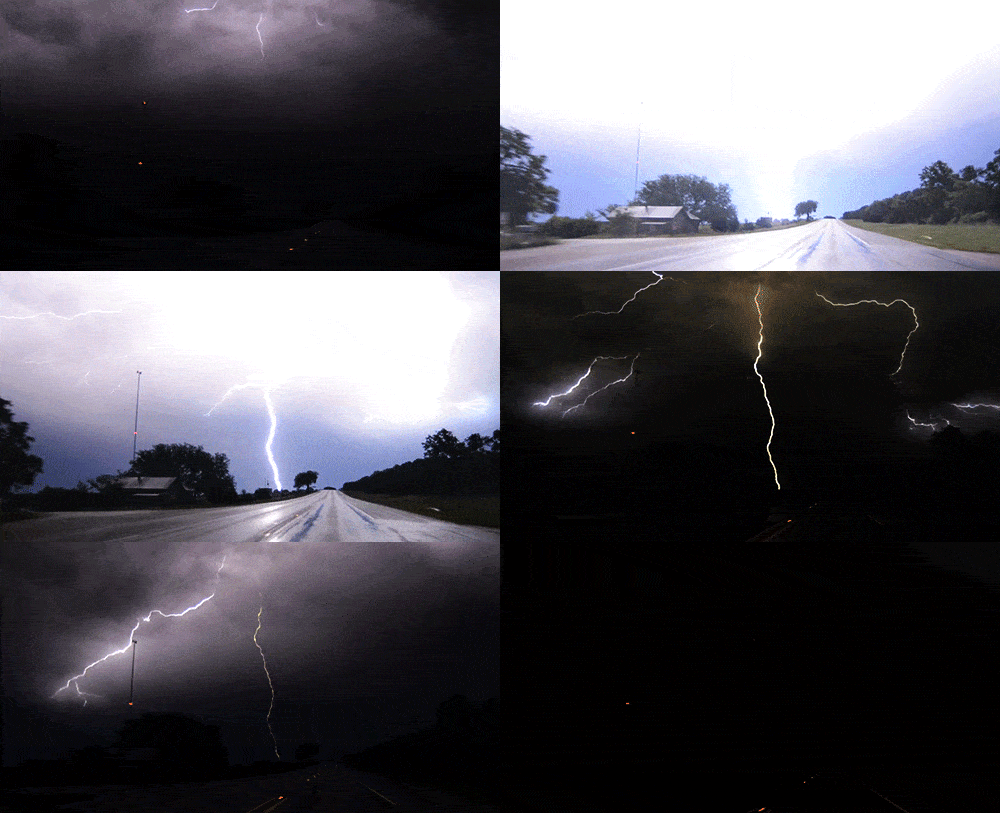
Lightning occurs because ___.
the negative charges at the bottom of clouds are attracted to the positive charges on the ground.
the positive charges at the bottom of clouds are attracted to the negative charges on the ground.
the positive and negative charges inside clouds are attracted to each other
All of these reasons are correct.
13
Electrical wiring has to be covered with insulating materials, otherwise we would not be safe using electricity.
14
Multiple Choice
15
Electricity, to be useful, however, has to be able to flow continuously. The continuous flow of electrical energy is called a current.
To keep electrons moving, they have to travel through a material that is a conductor, one that has low resistance, and therefore allows electrons to transfer from place to place.
(Low resistance is the property that allows energy like heat or electricity to move easily through a material.)
Metals like copper are good conductors.
Electricity flows easily through a copper wire.
Materials that do not allow electrons to move freely are called insulators.
Wood, rubber, plastic, and air are insulators.
16
Multiple Choice
This allows energy to flow.
conductor
insulator
17
Multiple Choice
This does not allow energy to flow.
insulator
conductor
18

Some text here about the topic of discussion.
Electrical wiring has to be covered with insulating materials, otherwise we would not be safe using electricity
19
Some of the electricity we use comes from a source we call an electric cell or battery. Flashlights, toothbrushes, and clocks use batteries. Alessandro Volta made the first electric cell using a strip of paper soaked in salt water sandwiched between a strip of zinc and a strip of copper. Wires that connected the two metals kept the electrons flowing.
Some text here about the topic of discussion
20
How is electricity produced?
Some text here about the topic of discussion
21

The path electrical energy travels is called a circuit. Electricity has to flow through a closed circuit. A closed circuit has three parts: 1) the source, which may be a battery or the electrical outlet; 2) the wires that connect the source to an object or appliance (and wires that reconnect it back to the source); and 3) the object or appliance that electricity flows through
Some text here about the topic of discussion.
22
Some text here about the topic of discussion
23

Some text here about the topic of discussion.
If the connection were broken at any point, then the bulb would not light up because electricity cannot flow in an open circuit.
24
Multiple Choice
An open circuit allows charges to flow.
True
False
25
Multiple Choice
Which parts are needed to complete a simple circuit lighting a lightbulb?
wire, battery, lightbulb
wire, buzzer, lightbulb
wire, battery, buzzer
26

Some text here about the topic of discussion.
In a series circuit, the lights are all part of the same path, and turn on and off all at the same time. If one is removed, or turned off, then the circuit opens, and none of the lights would work.
27

Some text here about the topic of discussion.
A series circuit is not practical to have all throughout the house, because all your appliances would have to be working at the same time.
In a parallel circuit, each light and outlet is wired separately into the main source. This way, you can turn lights and appliances on or off as needed.
28
Electricity that comes into our homes is generated by a power plant. The power plant gets its energy from one of the following sources:
1. Hydroelectric power
2. Geothermal power
3. Coal
4. Petroleum
5. Wind power
6. Solar power
7. Nuclear power (not available in the Philippines)
29

A hydroelectric power plant uses the kinetic energy of waterfalls (such as Maria Cristina Falls in Lanao) to turn special wheels called turbines that run a generator. A generator produces the electricity that flows along wires to our homes.
30

A geothermal plant uses steam from hot springs. Hot springs come from ground water heated by magma of nearby volcanoes. The Tiwi power plant in Albay in the Bicol region is an example.
Other power plants use coal where this is plentiful. This is possible in Cebu, Philippines, which has a coal mining district.
31
Other places use petroleum in their power plants because it is the most easily transportable and available (although expensive) alternative.
32

Some text here about the topic of discussion.
Solar-generated and wind-generated electricity are still small localized attempts to use alternative sources of energy.
33
Multiple Choice

34
Multiple Choice

35
Multiple Choice
36
Magnetism is a force that causes certain metals to have the ability to attract other metals. Iron and steel can be strongly affected. Cobalt and nickel are only weakly affected. Copper, aluminum, and non-metals are not affected this force
37

Some text here about the topic of discussion.
Magnetism can occur naturally, as in a stone called magnetite. Magnets can also be produced in a variety of shapes, such as the horseshoe, bar, discs, flat sheets, and even strip magnets-by-the meter.
38

The area around a magnet where the effect of a magnet is detected is called its magnetic field. The shape of the magnetic field varies slightly depending on the shape of the magnet. But whatever their shape, all magnets have the same properties. One of these properties is that magnets have the greatest attractive force at their ends, called the poles. These poles are called the North pole and the South pole.
39
What happens?
40

One possibility is that the magnets will be attracted, move toward each other, and stick. This means that one pole has found the opposite pole-north meets south.
The other possibility is that the poles will be repelled and move away. This means that similar poles were brought together.
These two situations show you a basic principle of magnetism: Opposite poles attract, like poles repel.
41
If you try to push like poles together, you will feel the push a magnet can give.
You will notice that magnets can make objects move.
This ability also gives magnets another unique ability: pointing out direction.
42
Try tying a string around a magnet, taping the string in place to keep the magnet balanced. If allowed to swing freely, the poles will eventually point approximately north and south-called the magnetic North Pole and magnetic South Pole.
The same pole will always point north and the other pole will always point south. Magnetic north is about 1,600 kilometers from the place on the map called the North Pole.

43
Multiple Choice
44
Multiple Choice
45
Multiple Choice
46
Multiple Choice
47
Multiple Choice
48

Magnets can be used to generate electricity. If a magnet is moved near a wire, electricity through it. If you kept the magnet stationary and moved the wire, electricity runs through it too. Motion, either of the magnet or of the wire, is needed to generate electricity.
Some text here about the topic of discussion.
How are electricity and magnetism related?
49

Generators at power plants the energy of waterfalls, coal, natural gas, petroleum, or geothermal energy to move large magnets and loops of wire to generate electricity.
50

Electricity can be used to make magnets. You can make an electromagnet by winding a wire around a nail many times, and connecting the wire ends to the terminals (positive and negative ends) of a battery or dry cell.
(DO NOT PUT THE WIRES INTO A WALL SOCKET OR ANY ELECTRICAL OUTLET.) The more coils there are, the stronger the magnet will be. As long as you have a closed circuit, electricity will flow through the wire, the nail is magnetized and will pick up metal objects.
51
Multiple Choice
Some electrical devices use motors. Motors have magnet inside them.
True
False
52
Multiple Choice
Magnet is only used for electrical devices.
True
False
53
Multiple Choice
Magnet can be used to hold things together.
True
False
54
Multiple Choice
Magnet is use to attract non-magnetic materials at waste factory.
True
False
55
Multiple Choice
Magnet can be used as a tight seal on fridge doors.
True
False
By Maritess Jacinto
Show answer
Auto Play
Slide 1 / 55
SLIDE
Similar Resources on Wayground

49 questions
Thursday_04.31_4.11A
Presentation
•
4th Grade
49 questions
WED Lesson and Quiz
Presentation
•
4th Grade
52 questions
Science 4 Quiz Oct 24 (Monday)
Presentation
•
4th Grade
49 questions
SC UDCH8L2
Presentation
•
4th Grade
47 questions
L-2. G 5 -LIVING THINGS
Presentation
•
5th Grade
52 questions
Animais vertebrados: os anfibios
Presentation
•
5th Grade
52 questions
Y4C4 Magnet
Presentation
•
4th Grade
49 questions
Repaso 1P1Q STEM 4TO EGB Sistema Locomotor
Presentation
•
4th Grade
Popular Resources on Wayground
10 questions
Safety Day 2026 – Student Review

Quiz
•
9th Grade
21 questions
Continents and Oceans
Quiz
•
6th Grade
20 questions
Parts of Speech
Quiz
•
5th Grade
16 questions
Subject & Predicate
Quiz
•
5th Grade
25 questions
Multiplication Facts
Quiz
•
5th Grade
12 questions
Map Skills
Quiz
•
3rd Grade
22 questions
Continents and Oceans
Quiz
•
5th Grade
15 questions
Rounding Decimals
Quiz
•
5th Grade
Discover more resources for Science
10 questions
Mixtures and Solutions
Quiz
•
4th Grade
10 questions
Identifying Physical and Chemical Changes

Interactive video
•
1st - 5th Grade
13 questions
Reflect, refract, and absorb
Quiz
•
3rd - 5th Grade
15 questions
Weathering and Erosion
Interactive video
•
4th Grade
14 questions
Scientific Method
Quiz
•
3rd - 5th Grade
11 questions
Force and Motion
Quiz
•
4th Grade
30 questions
Unit 2 Energy Resources
Quiz
•
4th Grade
15 questions
Mixtures and Solutions
Quiz
•
4th Grade