Optical Devices part 2
Presentation
•
Physics
•
9th - 12th Grade
•
Medium
+1
Standards-aligned
Stacy King
Used 2+ times
FREE Resource
13 Slides • 16 Questions
1
Optical Devices part 2
By Stacy King
2
Multiple Choice
3
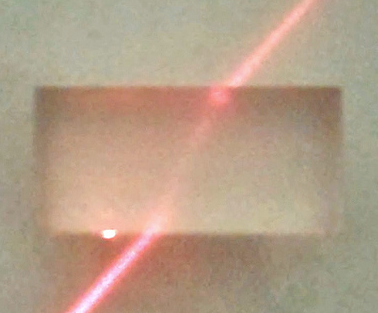
Mirrors and lenses use reflection and refraction to divert light from an object and create an image.
Magnification
4
Multiple Choice
5
Light travels in straight lines.
Mirrors are optical devices that divert light using reflection.
flat mirror (also called a plane mirror)
convex mirror (bulges out at the middle) diverge light rays
concave mirror (bows inward at the middle) converge light rays
Magnification Mirrors
6
Multiple Choice
7
Multiple Choice
8
These 3 mirrors each have a different magnification.
Object height is the same for each mirror, but image heights are different
Magnification Mirrors
9
Multiple Choice
A makeup mirror that has a magnification of 2X produces an reflected image of a pimple with a height of 1 cm what is the actual size of the pimple?
1/2
1/4
2
4
10
Ray Diagrams and the Law of Reflection
11
Normal: an imaginary line drawn perpendicular to the reflecting surface where the light ray strikes it.
Angle of incidence: the angle between the incident ray and the normal, θi.
Angle of reflection: the angle between the reflected ray and the normal θr.
Law of Reflection
12
Multiple Choice
According to the law of reflection the angle of incidence is ____________ the angle of reflection.
less than
greater than
equal to
13
Multiple Choice
In the diagram, which letter represents the angle of incidence?
A
B
C
D
14
Multiple Choice
Which is the angle of Incidence?
A
B
C
D
15
A ray diagram shows the paths that light rays follow.
Ray diagrams help explain shadow formation, and show how mirrors and lenses create images.
Incident ray: the incoming light ray that strikes this mirror
Reflected ray: the light ray that reflects off the surface of the mirror
Ray Diagrams
16
Multiple Choice
A beam of light drawn as straight lines with arrows
Incidence Ray
Reflected Ray
X-ray
Ray
17
The law of reflection can be used to locate images in a flat mirror.
Draw incident rays from the object to the mirror.
Draw the reflected rays using the law of reflection.
Extend the reflected rays until they intersect behind the mirror at the location of the image.
Ray Diagrams
18
Apparent Image Reversal
the image appears to flip right and left sides
In reality the image is inverted front to back
19
Types of Lenses
Concave
Convex
20
Multiple Choice
this is an example of
refraction
diffraction
infraction
reflection
21
Multiple Choice
Why does the arrow appear to change direction as water is poured into the glass? You can try this experiment at home.
Light waves are bouncing as they pass through air, glass and water.
Light waves are not passing through the air, glass, and water.
Light waves are traveling in a straight line as they pass through air, glass, and water.
Light waves are bending as they pass through the air, glass, and water.
22
Concave Lens
"caves in" on either side of lens
thinner in the middle than at the edges
The parallel light rays enter and then exit angled away from one another never meeting at a focal point
Like a Convex Mirror it produces only virtual images
23
Multiple Choice
24
Convex Lens
Thicker in the center than the edges
As parallel light rays enter the lens they exit at an angle so they meet at a focal point
If the object is between the focal point and the lens then a virtual image is produced
If the object is beyond the focal point then a real image is produced.
25
Multiple Choice
Which figure represents the path light takes through a converging lens?
26
Multiple Choice
27
28
Multiple Choice
A curved piece of glass that bends light toward a central focal point is called a(n)______.
mirror
concave lens
convex lens
filter
29
Multiple Choice
which type of lens
opaque
convex
concave
plano
Optical Devices part 2
By Stacy King
Show answer
Auto Play
Slide 1 / 29
SLIDE

Similar Resources on Wayground
19 questions
Horizontal Projectiles Review
Presentation
•
9th - 12th Grade
26 questions
Circuits and Symbols
Presentation
•
9th - 12th Grade
22 questions
3-1: Parallel Lines and Transversals
Presentation
•
9th - 12th Grade
22 questions
Ecological Succession EOC Review
Presentation
•
9th - 12th Grade
22 questions
E2 T2 Verbos Reflexivos
Presentation
•
9th - 12th Grade
22 questions
Ideal Gas Law
Presentation
•
9th - 12th Grade
22 questions
Protein Synthesis
Presentation
•
9th - 12th Grade
22 questions
avancemos 3 4.2 Preterite Irreg Verbs
Presentation
•
9th - 12th Grade
Popular Resources on Wayground
16 questions
Grade 3 Simulation Assessment 2
Quiz
•
3rd Grade
19 questions
HCS Grade 5 Simulation Assessment_1 2526sy
Quiz
•
5th Grade
10 questions
Cinco de Mayo Trivia Questions
Interactive video
•
3rd - 5th Grade
17 questions
HCS Grade 4 Simulation Assessment_2 2526sy
Quiz
•
4th Grade
24 questions
HCS Grade 5 Simulation Assessment_2 2526sy
Quiz
•
5th Grade
13 questions
Cinco de mayo
Interactive video
•
6th - 8th Grade
20 questions
Math Review
Quiz
•
3rd Grade
30 questions
GVMS House Trivia 2026
Quiz
•
6th - 8th Grade
Discover more resources for Physics
11 questions
Electricity Explained
Interactive video
•
9th - 12th Grade
18 questions
Series and Parallel Circuits
Quiz
•
9th Grade
15 questions
waves and wave properties
Quiz
•
9th - 12th Grade
35 questions
Electricity and Magnetism SPS10
Quiz
•
8th - 10th Grade
10 questions
Exit Check 7.1 Intro to Waves
Quiz
•
9th Grade
10 questions
Exit Check 7.2: Electromagnetic Waves
Quiz
•
9th Grade
10 questions
Exit Check 7.3 - Analog and Digital
Quiz
•
9th Grade
18 questions
Unit 1 and 2 Concepts Review
Quiz
•
9th - 12th Grade